Which Localization Tasks Belong to AI—and Which Need People?

What this means for your business
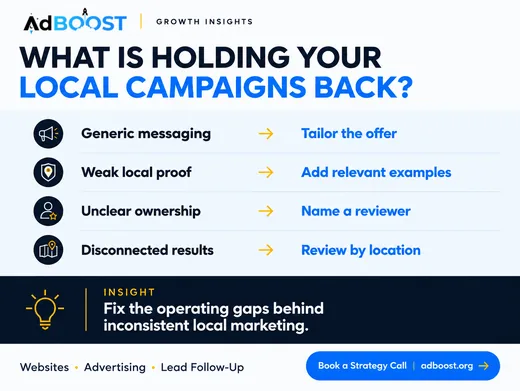
Name who approves local pages, who checks service areas and licensing, and who answers the phone for each location. A franchise or multi-crew business needs this written down.
For multiple offices, decide who reviews local content, who confirms provider details and who owns reviews at each location.
For multiple offices, decide who reviews each location's content, who verifies attorney and bar information and who is responsible for approvals.
 AD BOOST INTELLIGENCE
The AI-to-Human Handoff Protocol
Automate preparation. Assign judgment. Verify before publication.
AI-Assisted Preparation
Human and Local Review
Publication Operations
AI can prepare the material, but accountable people approve customer promises.
An original Ad Boost responsibility model that separates AI-assisted preparation from language, operational, professional, and final publication approval. It uses an explicit approval checkpoint so every consequential localized claim can be traced to an authorized reviewer.
The localization handoff fails when everyone assumes someone else checked it
A multi-office law firm prepares advertising for a new service territory. Its marketing team uses AI to produce localized landing-page variations and sends the files to the office manager. The office manager checks the address and phone number. The copywriter checks spelling. The website developer confirms that the pages display correctly. Everyone considers the work approved.
After publication, the team notices that one page describes a practice area the receiving office does not handle and another implies a consultation arrangement that has not been authorized. Every participant completed a review, but nobody was explicitly responsible for verifying the complete legal-service promise.
An AI-to-human localization handoff is the controlled transfer of work between automated drafting systems and people who can validate language, local context, business operations, and applicable requirements. The important concept is accountability: each material claim and publication decision must have an identified owner.
AI-generated localization can support speed by proposing translations, reorganizing approved information, checking terminology consistency, and preparing alternate wording. Those capabilities are useful when the inputs are reliable and the system is appropriately configured. They do not establish that the output is legally suitable, culturally appropriate, or commercially accurate.
Human review is also not one interchangeable activity. A language reviewer evaluates clarity and meaning. A local operations manager verifies office details, actual offerings, scheduling, and service boundaries. A qualified professional evaluates technical or regulated claims. A marketing manager checks brand consistency and campaign intent. The final approver confirms that required checks are complete before publication.
One employee may legitimately fulfill several roles in a small business, provided they have the necessary knowledge and authority. Conversely, a large organization may require separate reviewers. The goal is not maximizing approval signatures. It is ensuring that each relevant risk has an accountable reviewer.
Review intensity should depend on consequence. A minor internal formatting variation may need little oversight. A statement about medical treatment, legal representation, professional qualifications, pricing eligibility, or language assistance may require substantive expert approval. The workflow should identify those differences before work begins.
A good handoff also includes the ability to reject a draft. If AI produces an ambiguous claim, the reviewer should be able to return it for revision, replace it with verified wording, or remove it entirely. The process should not force approval merely because a launch date is approaching.
Ad Boost's approach treats AI as a preparation tool and the business as the accountable publisher. The resulting workflow should be faster where automation genuinely helps and more deliberate where mistakes could mislead customers.
Does every localization decision have an accountable owner?
Take one recently localized advertisement or service page and reconstruct its approval history. Identify the source information, the tool or person who drafted it, every material change, and who verified the final customer-facing promise. If the process relies on phrases such as the team checked it or someone at the location approved it, the handoff is insufficiently defined.
- Does the localization brief identify which source material is approved and who maintains its accuracy?
- Can reviewers distinguish AI-generated wording from verified business facts and authorized claims?
- Is a qualified language or market reviewer responsible for clarity and unintended meaning?
- Does a local operations representative verify service availability, contact information, geography, and booking promises?
- Are medical, legal, financial, or other regulated claims reviewed by appropriately qualified personnel when required?
- Can a reviewer reject a draft, document a correction, and prevent an unapproved version from being published?
- Does the business retain a record of which version was approved, who approved it, and how later corrections are handled?
Who should own each localization decision?
| Situation | Recommended action | Why | Exception |
|---|---|---|---|
| The business needs several language variations of approved service copy. | Use AI for initial drafts and qualified language review for final wording. | Drafting can be accelerated without treating generated language as independently verified. | High-risk or highly specialized language may require professional translation from the beginning. |
| A local promotion has different eligibility rules. | Require local operations and marketing approval before publication. | Only accountable business representatives can verify actual commercial terms. | A centrally controlled offer may use one approval when eligibility is genuinely identical everywhere. |
| A localized page makes legal or medical service claims. | Obtain appropriate professional and compliance review. | Language accuracy alone does not establish professional or regulatory suitability. | General administrative information may require less intensive review when it contains no consequential professional claims. |
| AI flags potentially inconsistent terminology. | Send the issue to the language or service expert with the original context. | Automated checks can identify candidates for review but may misinterpret legitimate variation. | Clearly mechanical formatting errors may be corrected through an approved routine workflow. |
| The website developer receives content marked ready. | Require a documented final approved version and publication checklist. | Technical readiness does not prove editorial or operational approval. | Minor non-substantive formatting adjustments may follow a preapproved change policy. |
| A published page contains an inaccurate local promise. | Pause or correct the affected material, notify responsible stakeholders, and investigate the approval failure. | The response must address both the visible error and the process that allowed it. | The urgency and required notifications depend on the consequence and applicable obligations. |
Worked example
Imagine a fictional family law and estate planning practice called Meridian Legal Group. It operates two legitimate offices and is preparing educational landing pages for a new geographic market. The practice wants clear information for customers who prefer Spanish-language materials, while ensuring that professional advertising statements remain accurate.
The marketing coordinator supplies an AI tool with approved general service descriptions and requests draft variations. The resulting pages are professionally written but contain several statements requiring review. One describes the availability of an attorney who does not practice at the target office. Another uses terminology that a qualified reviewer considers potentially misleading in the local service context.
The firm applies the AI-to-Human Handoff Protocol. AI prepares the initial language and a terminology comparison. A qualified language reviewer checks clarity and meaning. The office manager confirms contact details, intake availability, and actual service coverage. An authorized attorney reviews legal-service descriptions and professional advertising requirements. The marketing manager then verifies that the final approved version is used by the publishing team.
For a hypothetical teaching exercise, suppose a batch contains 24 individual localized content units. Six require substantive correction during review: two concern language clarity, two concern operational accuracy, and two concern professional claims. The material correction rate is six divided by 24, or 25%. That result measures only the fictional review batch and is not a benchmark for AI translation accuracy.
The six units are corrected and returned to the appropriate reviewers. The firm tracks whether each correction was resolved before publication. A technical test then confirms that the approved language appears on the intended page and that contact requests reach the correct office.
Suppose one later revision changes an attorney's office availability. The workflow requires the operations owner to update the approved source information and notify the content owner. The marketing team does not ask AI to guess which pages need changes; it uses the documented inventory and approval history to identify affected assets.
The valuable outcome is accountability. The firm knows which parts AI prepared, which statements required professional verification, and who authorized publication. The example also shows why a small number of carefully designed approvals can be more effective than a long email chain with no defined responsibilities.
Material correction rate = localized content units requiring substantive correction / localized content units reviewed x 100. Approval completion coverage = applicable required approvals documented / applicable required approvals x 100.
The law practice, offices, content units, corrections, percentages, and workflow outcomes are hypothetical teaching inputs, not actual Ad Boost client results or outside research findings.
How to build a reliable AI-to-human localization workflow
Define approval roles before drafting
Identify who owns source facts, language quality, local operations, professional claims, brand consistency, and final publication. Combine roles only when an individual is qualified and authorized to perform them. Record backup approvers and escalation procedures. Avoid vague shared responsibility that leaves important decisions unowned.
Create a controlled localization brief
Provide verified service descriptions, actual locations, contact details, relevant customer questions, approved offers, prohibited claims, and known limitations. Distinguish mandatory wording from flexible marketing language. Include data-handling restrictions and identify information unsuitable for unapproved AI tools.
Use AI for bounded preparation tasks
Request draft variations, terminology comparisons, organization of approved content, and potential inconsistency flags. Instruct the workflow not to invent credentials, service availability, promotional terms, professional outcomes, or customer evidence. Treat generated output as unapproved until the required checks are complete.
Run language and local-context review
Have qualified reviewers examine meaning, customer terminology, clarity, potentially misleading interpretations, and market relevance. Review the complete sentence and surrounding context rather than isolated words. Document material corrections and distinguish factual issues from stylistic preferences.
Verify operational and professional accuracy
Confirm real service offerings, geographic coverage, appointment processes, eligibility, pricing conditions, and customer promises. Obtain qualified professional review for regulated claims. Do not publish unresolved statements simply because language review is complete. Record the approver and approved version.
Test the approved customer journey
Check that final approved copy appears on the correct pages and advertisements. Test forms, calls, confirmations, routing, and relevant tracking. Ensure the language and service expectations established before contact remain accurate afterward. Use clearly labeled test inquiries and avoid exposing unnecessary personal information.
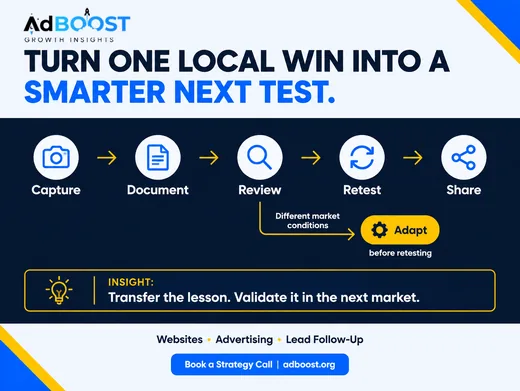
Maintain a correction and change-control process
Store approved assets, revision history, responsible owners, and material source changes. Define how inaccurate claims are reported, corrected, and reapproved. Periodically review active localized material when services, staffing, offices, offers, or applicable requirements change.
How to measure localization handoff quality
The number of drafts produced is not an adequate measure of workflow quality. Evaluate whether the material is accurate, required decisions are owned, corrections are resolved, and approved content is published correctly. Faster completion is useful only when it does not conceal serious review failures.
- Required approval completion
- Documented applicable approvals divided by applicable required approvals, multiplied by 100. Use version-controlled review records and verify reviewer authority.
- Material correction rate
- Reviewed content units requiring substantive changes divided by reviewed content units, multiplied by 100. Separate language, factual, operational, and professional corrections.
- Unresolved publication blockers
- Count outstanding material issues that prevent accurate or compliant publication. Track severity, responsible reviewer, and resolution status.
- Review cycle time
- Measure elapsed time from draft submission to final authorized approval. Report waiting time and revision time separately where useful.
- Post-publication correction incidents
- Record material inaccuracies found after publication and classify their underlying cause. Evaluate consequences individually rather than relying only on a total count.
- Approved-version consistency
- Review whether active pages, advertisements, and related customer communications match their authorized content versions. Document unauthorized or outdated variations.
Common mistakes and when this advice is wrong
- Assuming fluent language means verified meaning. A grammatically natural draft may still describe the wrong service or imply an inappropriate promise. Language and operational reviews address different risks.
- Having many reviewers but no final owner. Multiple approvals do not create accountability when nobody is responsible for confirming that all necessary checks are complete. Assign explicit publication authority.
- Treating every edit as equally consequential. A formatting adjustment and an incorrect professional claim require different levels of review. Define materiality so the process remains proportionate.
- Publishing while critical review is unresolved. Deadlines do not justify unverified services, misleading credentials, or incorrect customer promises. Escalate or remove unresolved material.
- Building a bureaucracy around low-risk work. Not every wording adjustment needs several approval layers. Use preapproved templates and risk-based review where appropriate, while preserving accountability for consequential content.
Frequently asked questions
Which localization tasks can AI handle safely?
AI can assist with bounded preparation tasks such as drafting variations from approved material, comparing terminology, organizing content, and identifying potential inconsistencies. Safety depends on the information provided, system controls, review process, and consequences of errors. Customer-facing claims about services, qualifications, availability, and regulated matters should receive the appropriate verification before publication.
Who should approve localized marketing content?
Approval responsibilities should match the risks. A qualified language reviewer can assess meaning and clarity. Local operations should verify actual services and availability. Appropriate professionals should review regulated claims. A designated publication owner should confirm that all required approvals are complete. In a small business, one qualified person may hold multiple responsibilities, but ownership must remain explicit.
Can a native speaker replace a professional localization reviewer?
Language familiarity can be valuable, but fluency alone does not guarantee knowledge of marketing terminology, professional requirements, or service-specific meaning. Choose reviewers based on the actual task. Sensitive legal, medical, technical, or regulated content may require specialized expertise in addition to language proficiency.
How do I prevent AI from inventing local service claims?
Provide an approved source-of-truth brief, restrict drafting to verified information, explicitly prohibit unsupported additions, and require material claims to be checked against actual operations. Do not rely on prompting alone as a guarantee. Maintain review checkpoints, version control, and a process for rejecting or correcting inaccurate output.
What should happen when reviewers disagree about localized wording?
Determine whether the disagreement concerns factual accuracy, professional requirements, customer understanding, or style. Factual and regulated issues should be resolved through authoritative information and qualified review. When two accurate alternatives remain, the marketing team may select one based on customer relevance or test them under suitable conditions. Document consequential decisions rather than allowing unresolved disagreement to disappear.
Review Your Localization Workflow
Clarify which work AI can prepare, which claims need local expertise, and who approves your marketing before launch.
Review Your Localization Workflow