What's Really Blocking Your Marketing From Working in Every Market?
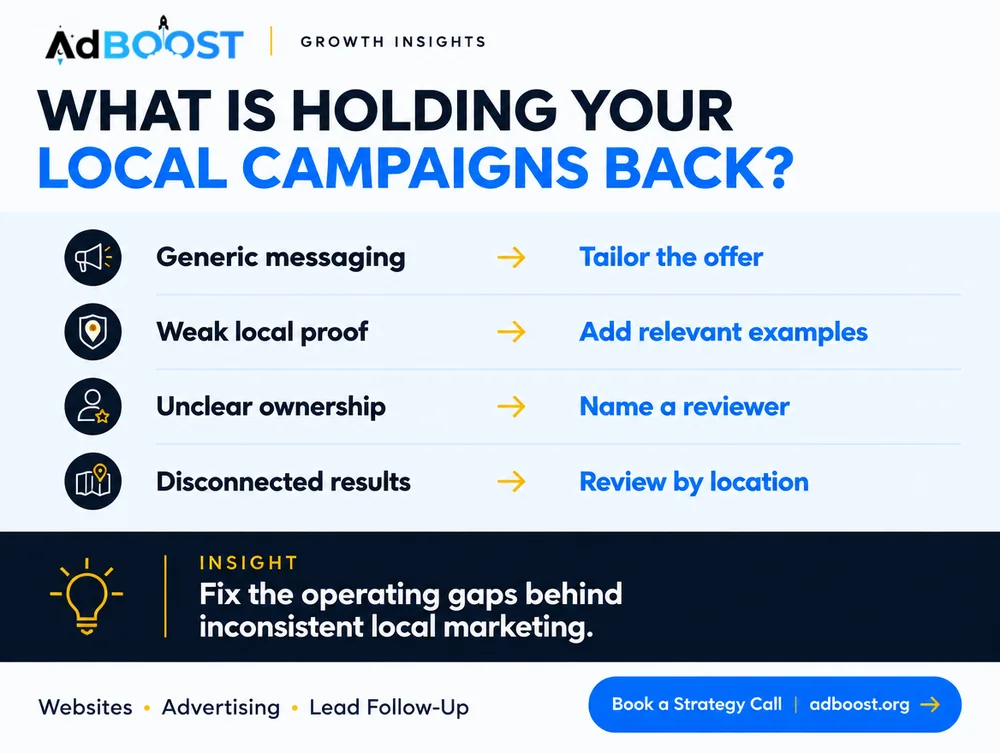
What this means for your business
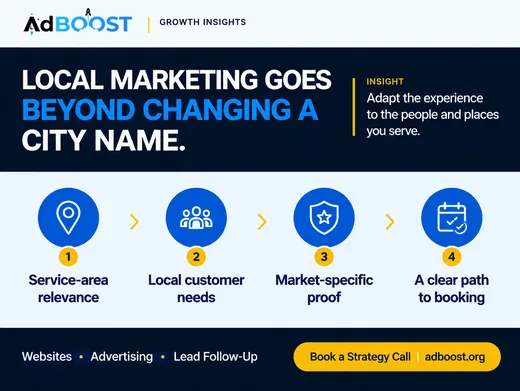
Common blockers for contractors: one generic page for every town, nobody owning local reviews, and job results that never get tied back to the ad that earned them.
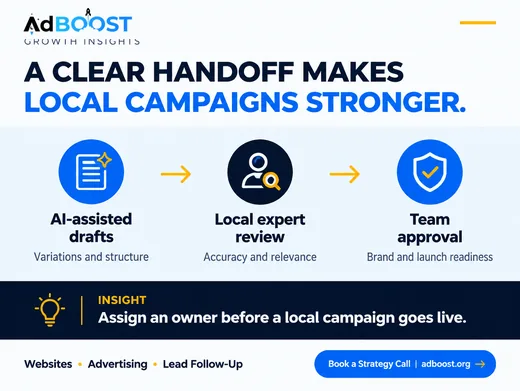
Typical blockers: the same page for every location, no one owning local listings, and appointments not tied back to marketing sources.
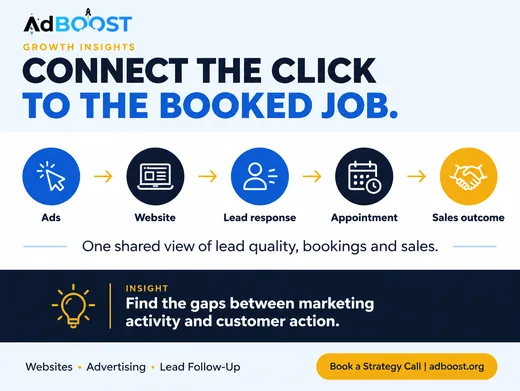
Typical blockers: one generic page for every city, unclear ownership of approvals and signed cases that are never matched to the marketing source.
 AD BOOST INTELLIGENCE
The Localization Bottleneck Map
Find the constraint before changing the campaign.
Diagnose the limiting step before rewriting the entire marketing strategy.
An original Ad Boost root-cause framework that investigates five categories of market-fit failure: wrong assumptions, unclear ownership, slow approvals, offer mismatch, and tracking gaps. Each branch connects an observable problem to a corrective action so teams stop treating every localization failure as a copywriting issue.
When a local campaign fails, the advertisement may be the least important problem
A regional property management company launches advertising across several territories. One location receives suitable inquiries and schedules consultations. Another receives frequent questions about services it does not offer. A third collects inquiries that sit in a shared inbox without a clear response owner. Leadership asks the marketing team to improve the local advertisements.
Changing the advertisements may help one territory. It will not repair the unassigned inbox in another, and it may not solve the service mismatch in the first. The apparent marketing problem is actually a collection of different operational failures.
A localization bottleneck is a constraint that prevents marketing from accurately reflecting local customer needs or moving suitable prospects through an effective customer journey. The constraint can involve information, approvals, service delivery, communication, tracking, or decision ownership.
The distinction between symptoms and causes matters. Low inquiry volume is a symptom. It might reflect weak demand, an unsuitable offer, poor targeting, limited brand recognition, website friction, or a tracking problem. A high volume of irrelevant inquiries is another symptom. It may indicate an incorrect service area, misleading message, or broad targeting. Neither symptom identifies its own cause.
Multi-market organizations face an additional challenge: central and local teams often possess different information. Central marketing controls advertising platforms and design standards. Local staff understand appointment capacity, service availability, common customer objections, and practical geographic boundaries. Finance may evaluate customer acquisition costs, while sales uses its own qualification definitions.
Without a shared operating process, each team can optimize its own activity while weakening the overall outcome. Marketing may pursue lower cost per lead. A local office may prefer fewer inquiries it can serve properly. Leadership may want rapid expansion. Those goals are not necessarily incompatible, but they require explicit definitions and coordinated decisions.
Localization challenges are also not exclusively international. A roofing company expanding between nearby metropolitan areas may encounter different service logistics, customer needs, competitive conditions, and local requirements. A dental group may offer different treatments at different offices. A real estate team may serve buyers and sellers with substantially different expectations across neighborhoods or property categories.
A practical bottleneck audit follows the customer journey and examines the dependencies between teams. If the offer is wrong, fix the offer. If approvals are late, fix ownership and review sequencing. If valid leads reach the wrong location, fix routing. If performance cannot be interpreted, fix measurement definitions before making confident budget decisions.
Ad Boost's Localization Bottleneck Map identifies five recurring root-cause categories. They are diagnostic prompts rather than statistical rankings. The first cause to address should be the one supported by evidence and consequential for customers, not the one that is easiest for the marketing team to edit.
Which localization bottleneck is limiting your results?
Start with a documented failure rather than a broad complaint that the campaign does not work. Select a market, service, reporting period, and meaningful outcome. Trace the customer journey through advertising, service information, contact, qualification, and follow-up. At each point, distinguish a verified problem from a possible explanation. The goal is to find a corrective action that can be assigned and tested.
- Are local customer needs and terminology supported by actual inquiry evidence rather than central-team assumptions?
- Does every market-specific offer have an accountable owner who can verify service availability and eligibility?
- Are approval responsibilities clear, with a defined process for resolving disagreements and urgent corrections?
- Do campaign launch dates routinely slip because information reaches reviewers too late or feedback is contradictory?
- Are advertisements, landing pages, contact forms, and scheduling processes consistent with real local operations?
- Can the CRM distinguish valid inquiries, qualified leads, appointments, and outcomes by market using reliable definitions?
- When a campaign underperforms, does the team investigate the limiting step before changing creative, targeting, and budgets together?
Match the localization symptom to the right investigation
| Situation | Recommended action | Why | Exception |
|---|---|---|---|
| A location attracts inquiries for services it cannot provide. | Verify offers, service-area wording, landing pages, and local qualification rules. | The customer-facing promise may not match operational capabilities. | Some unsuitable inquiries occur even when marketing is accurate; review patterns before making changes. |
| Campaigns launch late because several reviewers disagree. | Define approval ownership, materiality rules, and escalation deadlines appropriate to the workflow. | Ambiguous authority creates rework and delays. | Professional or legally required reviews must not be bypassed merely to accelerate publication. |
| Central marketing and local teams report conflicting lead quality. | Agree on valid inquiry and qualification definitions and review underlying records. | Different metrics can make the same campaign appear successful to one team and unsuccessful to another. | Legitimate local service differences may require documented additional qualification criteria. |
| Localized copy sounds natural but generates confusion. | Review the full service promise and customer pathway with knowledgeable local staff. | Language quality cannot compensate for incorrect offers, expectations, or routing. | A highly specialized customer need may require professional clarification rather than general copy revision. |
| One territory produces inquiries but few completed appointments. | Review response ownership, scheduling capacity, customer fit, and appointment handling. | The constraint may occur after the lead is generated. | Longer sales cycles can delay appointments without indicating an operational failure. |
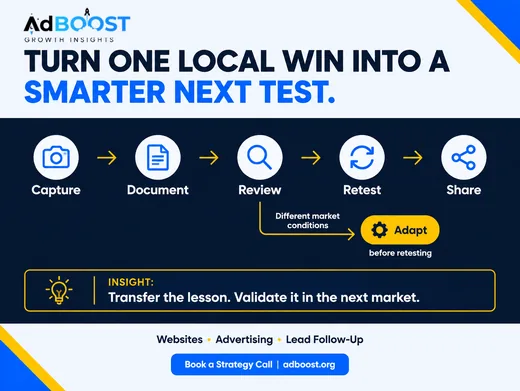
| Leadership wants to reuse a successful local campaign everywhere. | Document the original market conditions and test the transferable hypothesis elsewhere. | A result may depend on local demand, service mix, and capacity. | Consistent services and customer needs may justify substantial reuse after verification. |
Worked example
Imagine a fictional commercial landscaping company called Northfield Grounds Management. It serves office parks, property management firms, and multi-property facilities teams across three metropolitan territories. The company operates one central advertising account but uses separate local service managers.
During a hypothetical review period, Territory A records 20 valid inquiries and twelve qualified opportunities. Territory B records 20 valid inquiries and six qualified opportunities. Territory C records 20 valid inquiries and ten qualified opportunities. Leadership initially assumes Territory B needs better advertising creative.
The marketing manager uses the Localization Bottleneck Map rather than immediately rewriting advertisements. A review of Territory B's inquiries reveals that several prospects want a specialized commercial maintenance service not offered by that territory's current crews. Central marketing copied the service list from Territory A without obtaining local approval.
The same review also finds that the local manager receives inquiries in a shared mailbox but lacks consistent CRM assignment notifications. Some suitable prospects wait for a response because the local team assumes central sales is handling them. These are two separate problems: offer mismatch and unclear ownership.
The team corrects Territory B's service descriptions, limits advertising to its actual capabilities, changes the contact-routing rule, and assigns an accountable local response owner. It tests the workflow before resuming the affected campaign. The business does not invent additional customer demand or claim that the corrections will automatically increase revenue.
For an illustrative later period, suppose Territory B again receives 20 valid inquiries, with eleven meeting documented qualification criteria. The observed qualification rate changes from 30% to 55%. That difference does not establish causation because inquiry populations, advertising conditions, seasonality, and service capacity may have changed.
The company also examines whether qualified inquiries receive documented responses and whether appointments progress. If routing remains unreliable, the marketing problem is not fully repaired even if qualification improves. Likewise, if the corrected targeting reduces total lead volume but increases suitable opportunities, that may be a reasonable tradeoff depending on economics and capacity.
The lesson is that marketing localization should be diagnosed as a connected operating system. Rewriting a headline can correct a message problem. It cannot independently fix staffing, routing, service eligibility, or inconsistent reporting.
Territory qualification rate = qualified inquiries in the territory / valid inquiries in the territory x 100. Documented response coverage = qualified inquiries with an appropriate recorded response attempt / qualified inquiries requiring response x 100.
The landscaping company, territories, inquiry counts, qualification rates, and operational outcomes are hypothetical teaching inputs, not actual Ad Boost client results or localization research.
How to remove localization bottlenecks systematically
Define the business problem precisely
Choose the affected market, service, time period, and observable outcome. Distinguish low traffic, unsuitable inquiries, delayed approvals, unanswered leads, and weak appointment progression. Avoid describing all failures as poor campaign performance. Gather source records before assigning blame.
Map the affected customer journey
Trace the advertisement or discovery source through the landing page, offer, contact method, CRM record, assigned owner, and actual next action. Identify where the experience differs from the intended process. Include local operations and customer-facing employees in the review rather than relying solely on advertising dashboards.
Classify the bottleneck by root cause
Use the five framework branches: wrong assumptions, unclear ownership, slow approvals, offer mismatch, and tracking gaps. More than one category may apply. Document evidence for each suspected cause and avoid selecting a convenient explanation without verification.
Assign the corrective decision to the right owner
Language and customer-context issues belong with qualified reviewers. Service availability belongs with operations. Professional claims require appropriate specialist approval. CRM routing belongs with systems administration. Budget and campaign changes require authorized marketing decisions. Define escalation procedures for issues crossing several teams.
Correct one limiting process at a time where practical
Repair the highest-consequence verified problem first. If the campaign advertises an unavailable service, correct or suspend that message immediately. If records are missing, restore reliable capture before interpreting conversion rates. When several urgent issues must be fixed together, document them so later outcome changes are not falsely attributed to one action.
Retest the complete customer experience
Use representative test inquiries to verify content accuracy, location selection, CRM creation, routing, notifications, and appointment information. Review mobile and relevant language variations. Confirm that an approved creative change did not introduce a new operational mismatch.
Record the lesson and prevent recurrence
Document the failure, root cause, corrective action, owner, verification, and any other locations affected. Update shared templates and approval requirements where appropriate. Monitor customer outcomes after correction and account for changing market conditions. Use the finding to improve the broader multi-location playbook.
How to tell whether the bottleneck has actually been removed
A resolved ticket is not proof that the customer experience works. Verification should address the original failure and its downstream consequences. Measure the appropriate outcome for each cause, preserve territory-level context, and avoid interpreting every post-correction change as a causal effect.
- Verified unresolved bottlenecks
- Count open material problems by market, root-cause category, severity, and accountable owner. Track verification status rather than merely whether someone marked a task complete.
- Local offer accuracy
- Review active market-specific advertisements and pages against approved services, availability, geography, and commercial terms. Record material mismatches and corrective actions.
- Approval cycle time
- Measure elapsed time from a complete review submission to authorized approval. Separate incomplete briefs, waiting time, revision cycles, and mandatory professional reviews.
- Market-specific qualification rate
- Qualified inquiries divided by valid inquiries for the defined market, multiplied by 100. Preserve consistent core definitions and document legitimate market-specific eligibility.
- Lead routing accuracy
- Valid inquiries assigned to the correct authorized team divided by valid inquiries requiring routing, multiplied by 100. Verify through CRM records and representative test submissions.
- Outcome traceability
- Review whether qualified inquiries have documented ownership, response activity, and appropriate next-step outcomes. Record missing information separately from genuine customer rejection.
Common mistakes and when this advice is wrong
- Treating every performance problem as poor translation. Campaigns can fail because of targeting, unavailable services, broken routing, weak follow-up, or tracking errors. Diagnose the location of the failure before revising language.
- Fixing symptoms without changing ownership. A corrected advertisement may fail again when no one maintains the underlying service facts. Assign responsibility for ongoing accuracy and updates.
- Speeding approvals by removing necessary expertise. Eliminating professional or operational verification may increase the risk of misleading claims. Simplify duplicated reviews without bypassing consequential checks.
- Comparing markets using incompatible definitions. A lead may mean a phone call in one location and a qualified appointment in another. Reconcile reporting definitions before declaring a market stronger or weaker.
- Assuming every market needs a different solution. Some failures originate in shared infrastructure or central policy. Fix the common root cause when supported by evidence instead of multiplying local exceptions.
Frequently asked questions
What are the biggest barriers to effective marketing localization?
Common barriers include inaccurate assumptions about local customers, unclear ownership, slow approvals, mismatched offers or services, and disconnected measurement. Their relative importance varies by business and market. The most useful approach is to trace an actual customer journey, identify verified failures, and correct the limiting process rather than assuming every problem requires different advertising copy.
Why does a campaign work in one location but fail in another?
Markets can differ in customer needs, competition, service availability, brand familiarity, pricing conditions, and operational capacity. Tracking and lead handling may also differ. A campaign that succeeds in one location provides a useful hypothesis, not a guarantee. Compare accurate local information and qualified outcomes before deciding which element needs adaptation.
How can we reduce localization approval delays?
Assign clear responsibility for source facts, language, operations, professional claims, and final publication. Supply complete briefs before review and distinguish material corrections from stylistic preferences. Establish appropriate escalation procedures and approved reusable templates. Do not accelerate launches by skipping reviews necessary for accuracy, privacy, customer safety, or legal compliance.
How do I know whether the problem is marketing or sales follow-up?
Trace valid inquiries from their source through capture, assignment, response, qualification, and appointment. If suitable prospects never reach the CRM or the correct team, the problem may involve technology or operations. If customers receive accurate information and prompt responses but remain unsuitable, the issue may involve targeting or offer fit. Multiple causes can exist simultaneously.
Should we create different marketing campaigns for every branch?
Not automatically. Shared campaigns or templates may be appropriate when services, offers, customer needs, and operations are sufficiently consistent. Separate campaigns can help where meaningful differences require distinct targeting, messaging, budgets, or reporting. Balance local relevance against management complexity and verify that each additional variation serves a real operational purpose.
Diagnose Your Local Marketing Gaps
Identify whether your market-performance problems come from messaging, offers, approvals, tracking, or lead handling before making another campaign change.
Diagnose Your Local Marketing Gaps