Can AI Help You Expand Into New Markets Without Losing Local Relevance?
What this means for your business
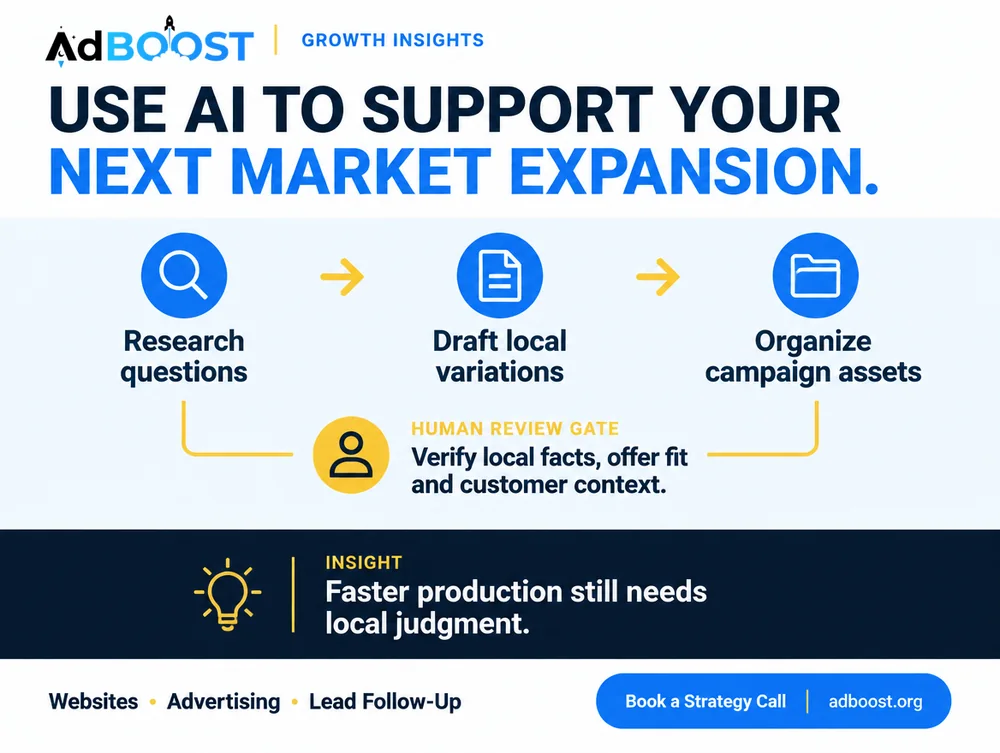
Opening a second service area or a new trade line? Use AI to research questions and draft local pages, then verify service areas, licensing and pricing locally before launch.
Adding a new location or specialty? Use AI to draft local content, then confirm credentials, accepted insurance and provider availability before publishing.
Expanding into another city or practice area? Use AI to draft outlines, then confirm state-specific rules, licensing and advertising requirements with an attorney.
 AD BOOST INTELLIGENCE
The Replicate–Adapt–Verify Model
Scale the system. Localize the promise. Verify the reality.
- What can remain identical?
- What must change locally?
- Who verifies each market claim?
- Can the location handle demand?
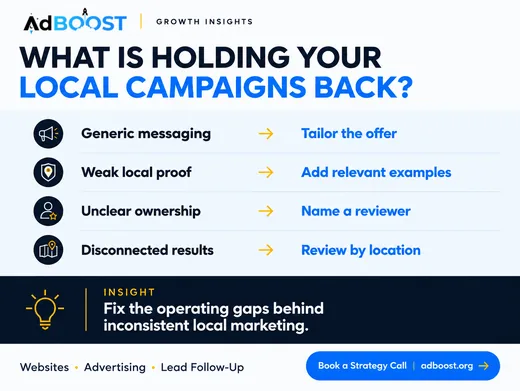
Centralize what should stay consistent; verify what customers experience locally.
An original Ad Boost expansion framework that separates reusable marketing infrastructure from market-specific customer experiences and local validation. It helps multi-location businesses use AI for efficient preparation while keeping service accuracy, operational accountability, and market-fit decisions under human control.
Copying a campaign is easy. Entering a new market is not.
A regional roofing contractor has a functioning advertising campaign in one service territory. The owner decides to expand into a neighboring metropolitan area and asks an AI tool to rewrite the advertisements using the new city name. The tool produces polished headlines, localized copy, and new landing-page text. Within minutes, the marketing materials look ready.
But the new territory has different service logistics, travel distances, customer questions, competitive alternatives, and appointment capacity. The contractor may not offer identical response coverage there. Some advertised inspection commitments may be impractical. Replacing a place name did not solve any of those problems.
Multi-location marketing is the coordination of customer acquisition across multiple physical locations, service territories, branches, or markets. It involves consistent brand standards alongside market-specific decisions about services, geography, staffing, customer needs, offers, and measurement.
AI-assisted market expansion uses AI tools to support activities such as organizing market information, drafting campaign variations, adapting approved content, documenting workflows, and preparing research questions. Those capabilities may reduce production effort. They do not establish that the market has sufficient demand, that the business can fulfill its promises, or that the adapted message is appropriate.
The distinction between replication and localization is critical. Replication reuses an existing process or asset. Localization adapts information and experience to a particular market. Verification confirms that the adaptation matches real business operations, customer circumstances, and relevant requirements.
Some components are good candidates for replication. CRM status definitions, lead assignment principles, conversion-event naming standards, accessibility requirements, and approved brand elements may remain consistent across territories. Other components need local decisions: service coverage, appointment windows, market-specific offers, relevant search language, location information, and professional or regulatory considerations.
A multi-location dental group, for example, may share patient inquiry procedures and brand standards across offices while maintaining accurate location-specific services, practitioner information, hours, and appointment availability. A property services company may share reporting methods while adjusting advertising to local service capacity and customer priorities.
AI can assist in documenting differences and preparing variants, but those outputs still require review by people who know the actual market and operation. A system cannot responsibly infer a branch's appointment availability from a neighboring office's calendar or assume that a service promise transfers to a new geography.
Ad Boost recommends expanding through a staged operating model rather than duplicating campaigns wholesale. The question is not how quickly AI can produce a new advertisement. It is how efficiently the business can establish a truthful, measurable, and commercially sensible customer acquisition process in another market.
Is your business ready to launch marketing in another territory?
Before producing advertisements, separate the work required to create marketing assets from the work required to serve customers. A launch can be technically complete while operationally unready. Ask the local team to verify every customer-facing promise and the central marketing team to demonstrate that inquiries will be captured, routed, and evaluated correctly. The first question is not whether the campaign can run. It is whether the location can deliver what the campaign advertises.
- Does the business genuinely serve the proposed territory, and are service boundaries documented accurately?
- Are location-specific services, appointment availability, pricing conditions, and operational limitations verified?
- Can existing CRM and reporting workflows distinguish inquiries and outcomes by market without duplication or confusion?
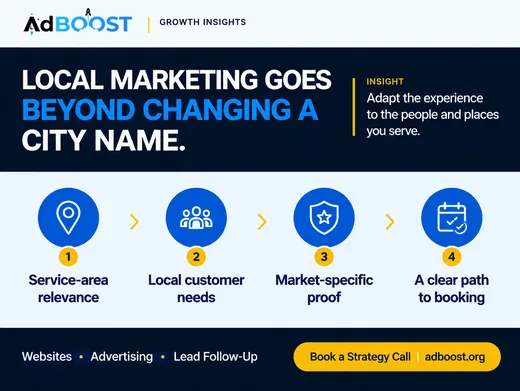
- Do campaign messages reflect real customer needs and relevant terminology rather than generic city-name substitutions?
- Has an accountable local representative reviewed advertising claims, landing pages, contact details, and fulfillment capacity?
- Are legal, professional, platform, and industry-specific advertising requirements understood for the new market?
- Does the business have a launch measurement plan that distinguishes marketing performance from staffing or service-delivery constraints?
What to replicate, adapt, or verify before expansion
| Situation | Recommended action | Why | Exception |
|---|---|---|---|
| An existing campaign performs well in another location. | Reuse its documented structure as a starting hypothesis, then verify local intent, offer fit, and capability. | Past success provides useful operating knowledge but not proof of identical demand. | A highly standardized offering may require little adaptation, but local validation remains necessary. |
| The new location has different appointment capacity. | Adapt scheduling promises, intake routing, and campaign budgets to actual capacity. | Advertising can create demand the location is not equipped to handle. | Centralized scheduling may support shared capacity when the operational model genuinely allows it. |
| AI generates market-specific copy using only a location name. | Review local terminology, customer questions, geography, and service realities before publishing. | Place-name substitution is not meaningful localization. | Simple location substitutions may be adequate for strictly factual content after verification. |
| The central team wants one reporting dashboard. | Standardize core metric definitions while preserving market-level detail and appropriate context. | Consistent definitions support comparison without concealing local differences. | Certain local services may require additional metrics or different qualification rules. |
| A new market receives inquiries that do not match its service capacity. | Review targeting, eligibility messaging, lead routing, and the location's actual offering. | Low lead quality may reflect an offer or operations mismatch rather than insufficient traffic. | An emerging market may require a longer observation period before conclusions are reliable. |
| Leadership wants to launch all territories simultaneously. | Consider staged launches with documented verification and readiness checkpoints. | Staging can make failures easier to identify and reduce the scale of avoidable errors. | A coordinated launch may be necessary when the business has sufficient verified capacity and operational safeguards. |
Worked example
Imagine a fictional regional fencing contractor called Stonebrook Fence Company. It serves residential homeowners and selected commercial properties. The company has an established operating process in one territory and is preparing to market its services in two additional service areas.
Its marketing team already has approved creative templates, landing-page components, CRM qualification fields, and reporting definitions. An AI tool can help draft variations and organize market research questions. The business initially plans to duplicate its existing advertisements with new city names.
The Replicate–Adapt–Verify Model exposes several issues. Under Replicate, the company can reuse its design standards, lead forms, appointment status definitions, and campaign reporting structure. Under Adapt, it must confirm service geography, installation scheduling, material availability, local customer needs, and appropriate offer wording. Under Verify, the branch manager must confirm that the advertised services can actually be delivered.
In one fictional territory, the company can handle residential privacy fencing but is not yet prepared to accept certain commercial installation projects. Its original campaign advertises both. The local review catches the mismatch before launch, preventing the team from publishing an inaccurate service promise.
For a hypothetical teaching exercise, assume preparing materials manually for each new territory requires ten staff hours, while an AI-assisted draft-and-review process requires six hours. Across two territories, the illustrative production effort changes from twenty hours to twelve hours. The gross difference is eight hours, but the business must also account for any additional verification or correction work not already included in the six-hour estimate.
Suppose the first territory's test period produces 20 valid inquiries, of which twelve meet the company's documented service and geography requirements. The second produces 20 valid inquiries, of which eight meet those requirements. The corresponding illustrative qualification rates are 60% and 40%. These observations are not evidence that one market is inherently better. Differences may reflect targeting, service scope, local awareness, customer needs, or incomplete qualification.
The team investigates the underlying reasons before changing budgets. It discovers that the second territory needs clearer service-area wording and more explicit commercial-project eligibility information. Those corrections are made and reviewed locally rather than asking AI to generate a persuasive explanation of services the company cannot provide.
The case demonstrates the central principle: AI may reduce content-production effort, but expansion quality depends on truthful local adaptation, accountable verification, and the ability to serve the resulting customers.
Net production time saved = manual preparation time - AI-assisted preparation, review, and correction time. Market-specific qualified inquiry rate = qualified inquiries in the market / valid inquiries in the market x 100. Report markets separately before combining outcomes.
The contractor, territories, hours, inquiry counts, percentages, and operational observations are hypothetical teaching inputs, not actual Ad Boost client results or market expansion benchmarks.
How to expand marketing into new locations without copying the wrong things
Document the proven operating components
Inventory existing campaign structures, approved brand assets, tracking definitions, CRM workflows, customer qualification rules, and reporting processes. Identify which components are genuinely reusable and which were designed around one market's circumstances. Do not classify a campaign as universally proven because it worked in one territory.
Build a verified market information sheet
For every territory, document actual service areas, operating locations where applicable, offerings, scheduling capacity, contact details, local restrictions, and accountable representatives. Include relevant customer questions and known operational constraints. Avoid inventing local offices, credentials, or coverage to increase geographic visibility.
Use AI to prepare, not approve, adaptations
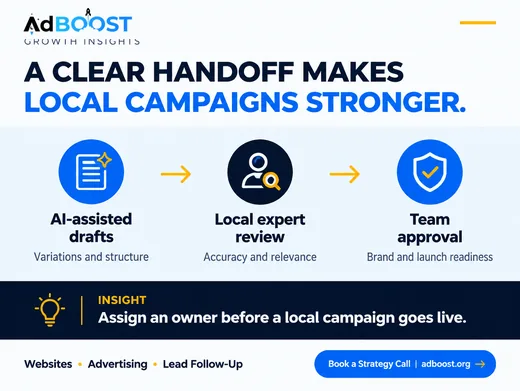
Supply approved source information and ask AI to organize research questions, propose copy variations, identify potential gaps, and prepare draft landing-page structures. Require reviewers to validate every local claim. Treat generated suggestions about language, customer behavior, or market norms as hypotheses until independently verified.
Adapt the customer journey to actual market needs
Review whether customers in the territory need different service explanations, qualification steps, contact options, or scheduling information. Maintain a recognizable brand while allowing genuine local differences. Do not multiply nearly identical city pages that provide no useful distinct information.
Verify tracking and lead ownership
Test calls, forms, campaign identifiers, location assignment, CRM creation, notifications, and appointment routing. Confirm that shared systems preserve the correct market information and that central reports do not combine incompatible metrics. Use clearly labeled test records and remove or classify them afterward.
Launch with explicit operational safeguards
Define budget controls, service capacity, approved claims, escalation contacts, and conditions requiring a pause. Monitor early inquiry relevance, incorrect service expectations, technical problems, and local fulfillment issues. Avoid declaring a market successful based only on inexpensive clicks or forms.
Transfer lessons without assuming identical markets
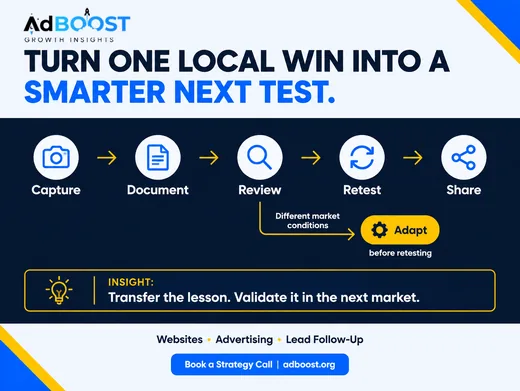
Record what was tested, what customers asked, how inquiries qualified, and which operational constraints shaped results. Compare markets using consistent definitions while preserving context. Adapt the successful principle rather than blindly copying a particular advertisement. Update the shared playbook when evidence supports a change.
How to measure expansion efficiency and local market fit
Expansion reporting should distinguish production efficiency from marketing performance and operational readiness. AI may reduce the time required to prepare materials while the new market still struggles with poor lead qualification or limited capacity. Track each dimension separately and compare locations using consistent definitions without erasing meaningful local differences.
- Net market preparation time
- Record staff time required for content preparation, adaptation, verification, corrections, and launch administration. Compare with a documented manual baseline using similar deliverables.
- Market launch verification coverage
- Verified applicable launch requirements divided by all applicable requirements, multiplied by 100. Include business facts, content approvals, tracking checks, routing tests, and operational readiness. Treat this as internal task completion, not an industry readiness score.
- Valid inquiries by territory
- Count genuine inquiries associated with each market using documented source, geography, and CRM rules. Exclude confirmed duplicates and unrelated requests.
- Market-specific qualification rate
- Qualified inquiries for a territory divided by valid inquiries in that territory, multiplied by 100. Apply consistent core definitions and document legitimate local qualification differences.
- Lead routing and response completeness
- Review whether inquiries reach the appropriate location team and receive a documented response attempt. Use CRM records, test submissions, and relevant call logs.
- Local expectation mismatch incidents
- Record verified complaints or corrections involving service availability, location claims, offers, appointment expectations, or service scope. Identify whether the issue originated in marketing content or operations.
Common mistakes and when this advice is wrong
- Treating city-name replacement as localization. Changing geographic wording does not verify customer needs, availability, offers, or local operations. Create distinct local content only when the underlying information is truthful and useful.
- Assuming AI eliminates the need for local knowledge. AI can organize and draft information but may misunderstand service boundaries, customer expectations, or local restrictions. Accountable local review remains essential for consequential claims.
- Expanding demand before verifying capacity. A campaign may generate relevant inquiries that the location cannot serve. Confirm staffing, travel coverage, scheduling, and fulfillment before increasing customer expectations.
- Comparing territories without context. Different markets may have different service mixes, demand patterns, competition, and operational conditions. Raw CPL or lead volume does not establish which territory is more profitable.
- Over-localizing standardized services. Not every location requires completely separate creative, workflows, or websites. Excessive customization can increase inconsistency and maintenance. Preserve shared standards wherever meaningful customer needs do not require differences.
Frequently asked questions
Can AI help a local business expand into new service areas?
Yes. AI can assist with organizing market information, drafting approved content variations, preparing checklists, and documenting reusable workflows. However, the business must verify service coverage, capacity, customer needs, claims, and relevant requirements locally. The strongest use of AI is reducing avoidable preparation work while preserving accountable human decisions about the market and customer experience.
Should I copy my best-performing campaign into a new city?
Use it as a starting hypothesis, not a guaranteed formula. Reuse compatible tracking, branding, and process components, then check local services, competitive conditions, customer intent, and fulfillment capacity. Test the adapted campaign and measure qualified opportunities. A campaign's success in one market does not prove that identical wording, targeting, or offers will succeed elsewhere.
Do I need a separate landing page for every service area?
Not necessarily. Distinct pages are appropriate when they provide accurate, meaningful information about different locations, service availability, customer needs, or processes. Creating many near-identical pages with substituted city names can add little value. Choose a structure that helps customers verify coverage and find relevant information without implying physical offices or capabilities that do not exist.
What should stay consistent across multiple locations?
Core brand identity, approved claims standards, essential lead definitions, reporting principles, privacy safeguards, and documented workflow expectations can often remain consistent. Actual services, appointment availability, geographic coverage, offers, contact details, and certain customer communications may require local variation. Use the Replicate–Adapt–Verify Model to decide which differences are necessary.
How do I know whether a new market is worth additional advertising spend?
Review valid demand, inquiry qualification, service capacity, appointment progression, acquisition costs, and commercial outcomes using an appropriate observation period. Investigate whether problems arise from targeting, offer fit, tracking, or operations before reallocating budgets. Early results may be uncertain, especially in low-volume or seasonal markets. Avoid expanding solely because the initial cost per lead appears inexpensive.
Review Your Multi-Location Marketing Plan
Identify what your business can replicate, what needs local adaptation, and what must be verified before launching another market.
Review Your Multi-Location Marketing Plan