Why Isn't Translating Your Marketing Enough?
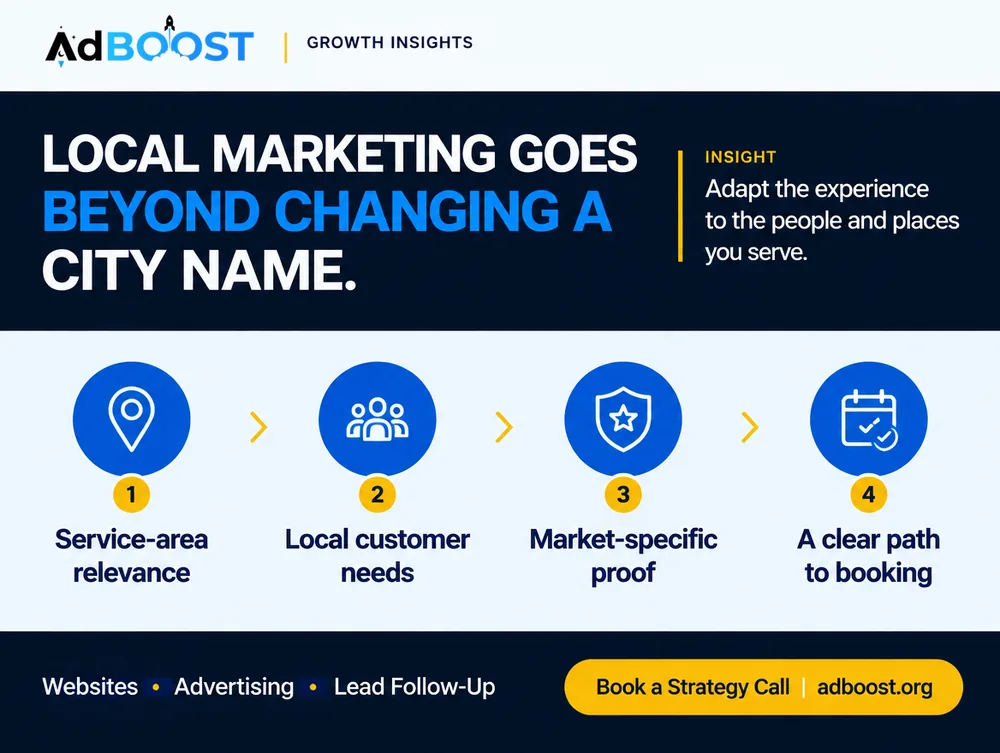
What this means for your business
A heating contractor in Phoenix and one in Minneapolis should not say the same thing. Weather, building age, permits and seasonal demand change what customers need.
Patients in different communities worry about different things: access, language, insurance, hours. Adapt the message to the people you actually serve.
Local courts, state rules and community needs shape what clients ask. Adapt practice pages to the jurisdictions and communities you actually serve.
 AD BOOST INTELLIGENCE
The Localization Depth Model
Move beyond translated words toward verified local relevance.
- Language and Terminology
- Local Search Behavior
- Service Expectations
- Offer Relevance
- Operational Reality
Translation changes words. Localization adapts the experience customers actually encounter.
An original Ad Boost framework that evaluates localization through five nested layers: language, search behavior, service expectations, offer relevance, and operational reality. The layers reveal whether an adaptation changes only the wording or genuinely supports an accurate customer experience in the intended market.
A translated advertisement can be perfectly written and still make the wrong promise
A dental group decides to advertise its services to Spanish-speaking residents in a new service area. An AI translation tool produces polished Spanish versions of the existing advertisements. The grammar reads naturally, the logo is correct, and the landing page looks professional. But the translated page promotes appointment availability at a location that does not offer the advertised service, and the appointment process provides no clear explanation of available language assistance.
The translation may be linguistically acceptable. The marketing experience is not.
Marketing localization is the process of adapting marketing information and customer interactions to the verified needs, language, expectations, and operating conditions of a particular audience or market. Translation is one part of that work. Localization may also involve terminology, service descriptions, search intent, offers, imagery, appointment processes, trust signals, and contact options.
The distinction matters because customers do not make decisions using language alone. A homeowner evaluating a roofing contractor needs to understand whether the company serves the property, performs the relevant work, offers an appropriate inspection process, and can explain what happens next. Translating an unrelated advertisement does not answer those questions.
Localization does not mean assuming everyone who speaks a language shares the same preferences. Spanish-speaking customers, for example, are not one uniform audience. Language proficiency, geographic context, service needs, individual circumstances, and communication preferences can vary substantially. Useful adaptation should be based on actual customer questions and verified service requirements rather than cultural stereotypes.
Nor does localization always require a separate campaign. A business operating in neighboring towns may need little variation beyond accurate service coverage and location information. A multi-location medical practice may require more substantial differences because specific providers, treatments, scheduling arrangements, and professional requirements vary by office.
For smaller businesses, unnecessary customization creates real costs. Each additional landing page, message variation, and automation requires review and maintenance. The objective is therefore selective localization: preserve what is genuinely consistent, change what customers need to be different, and verify the result before publication.
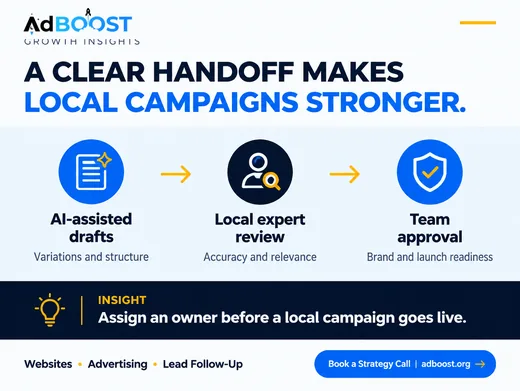
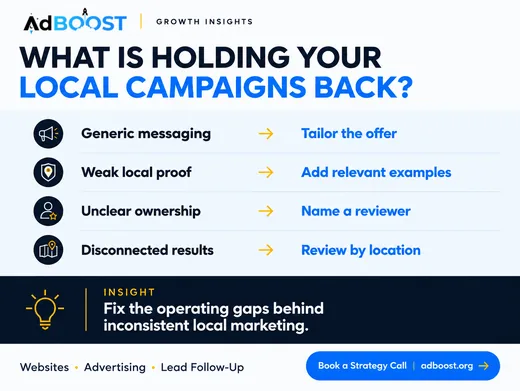
Localization becomes particularly important when advertising and operations are managed by different teams. A central marketer may know the brand but not the current appointment calendar. A local employee may understand customer questions but lack access to campaign settings. Without clear ownership, both groups can produce individually reasonable work that fails as a complete customer journey.
Ad Boost's operating principle is to localize from the customer inward. Begin with the words customers use, examine how they search and evaluate providers, understand what they expect from the service, confirm that the offer is relevant, and finally verify that the business can fulfill the promise. If the operational foundation is wrong, polishing the translation will not repair it.
How to tell whether your marketing is translated or truly localized
Review one customer journey in the intended market, beginning with the advertisement and ending with the first meaningful business response. Do not evaluate translation quality in isolation. Check what the customer is promised, which questions the page answers, whether the service is actually available, and what happens after contact. The strongest audit combines language review with operational verification.
- Does the marketing use terminology that intended customers genuinely understand, rather than a literal translation of internal business language?
- Are search terms and customer questions based on relevant local evidence rather than assumptions about language or culture?
- Does the page explain the services, process, and limitations that apply to the specific location or audience?
- Are advertised offers, pricing conditions, promotions, and appointment expectations actually valid in the target market?
- Can customers complete the contact or booking process using the communication options the business genuinely provides?
- Have knowledgeable local and service-qualified reviewers checked the message for accuracy, clarity, and unintended implications?
- Can the business measure valid inquiries, qualification, and customer outcomes separately for the adapted experience?
What should change when you localize a campaign?
| Situation | Recommended action | Why | Exception |
|---|---|---|---|
| Customers use different terminology for the same service. | Review actual customer language and adapt headings, descriptions, and relevant search terms. | An accurate translation may not match the words customers use when researching the service. | Do not replace technically accurate or legally required terminology with misleading informal language. |
| The same service is available across multiple locations. | Preserve common brand and service information while verifying each location's contact details and availability. | Consistency reduces unnecessary maintenance without sacrificing local accuracy. | Different staff qualifications, equipment, or operational processes may require additional local detail. |
| A translated advertisement receives inquiries for unavailable services. | Correct the offer, location targeting, service eligibility, and landing-page expectations. | The issue is an operational promise mismatch, not necessarily poor translation. | Some inquiries may simply misunderstand the service; review actual records before diagnosing the cause. |
| A campaign targets customers who prefer another language. | Verify the business can support the advertised communication and service process. | Language accessibility should continue beyond the advertisement when the business promises it. | A business may provide translated educational information while clearly disclosing the language options actually available. |
| Central marketing wants separate pages for every town. | Create distinct content only where meaningful service or customer differences justify it. | Near-identical location pages can increase maintenance without improving customer usefulness. | Accurate individual location pages may be important for genuinely separate offices or service operations. |
| Local reviewers disagree about the best message. | Compare the underlying customer need, factual constraints, and available evidence before choosing a version. | Localization decisions should reflect customer fit rather than personal stylistic preference. | Some creative alternatives may warrant a controlled test when both are accurate and appropriate. |
Worked example
Imagine a fictional multi-location dental organization called Harborview Dental Group. It operates several offices and wants to make information about selected dental services more accessible to customers who prefer Spanish-language materials. The organization plans to adapt an existing consultation campaign rather than build an entirely new marketing system.
The original English-language campaign accurately describes a consultation service available at one office. An AI tool produces Spanish advertising and landing-page drafts. During review, the team discovers that the translated material directs every inquiry to a central scheduling workflow, even though the advertised treatment is not available at every office. It also describes language assistance more broadly than the organization can currently verify.
The team applies the Localization Depth Model. At the Language layer, a qualified reviewer checks terminology and reading clarity. At Search Behavior, the team examines relevant customer questions without assuming that every Spanish-speaking customer searches alike. At Service Expectations, the page explains what the consultation can and cannot determine. At Offer Relevance, it confirms which office provides the actual service. At Operational Reality, scheduling staff verify provider availability and available communication support.
For an illustrative exercise, suppose the campaign receives 30 valid consultation inquiries during an initial period. Eighteen meet the documented location and service eligibility requirements. The observed qualification rate is 60%. Several unsuitable inquiries concern appointments at an office that does not provide the advertised service.
After correcting the location-specific service information and contact process, imagine a later period produces 30 valid inquiries, of which 24 meet those requirements. The observed qualification rate is 80%. That difference is not proof the changes caused the improvement. The audience, advertising conditions, appointment availability, and ordinary variation may differ between periods.
The organization investigates whether customers arrive with more accurate expectations, whether booking staff can communicate appropriately, and whether qualified consultations are completed. These outcomes matter more than whether the translated copy sounds elegant.
If the organization cannot provide a promised language service, it must revise the claim rather than allowing marketing to create an expectation staff cannot fulfill. The purpose of localization is to improve access to truthful information and appropriate services, not to manufacture a broader capability than the business possesses.
Market-specific qualification rate = qualified inquiries meeting verified service and location requirements / valid inquiries in the market x 100. Localization correction coverage = verified resolved applicable localization issues / all applicable documented localization issues x 100.
The dental organization, service arrangements, inquiries, percentages, and resulting observations are hypothetical teaching inputs, not actual Ad Boost client results or published localization benchmarks.
How to localize marketing beyond the words on the page
Define the intended customer and market
Specify the actual service territory, relevant customer need, language requirements where applicable, and service capabilities. Avoid inventing demographic preferences or assuming a uniform culture based on language. Use customer questions, actual inquiry records, service-team observations, and appropriate research to identify what needs adaptation.
Separate reusable content from local variables
Identify which brand promises, service explanations, accessibility standards, and process descriptions can remain consistent. Mark the fields requiring market-specific approval, including locations, hours, offers, appointment availability, contact details, and relevant professional limitations. Store approved facts in a controlled source document.
Review language and search intent
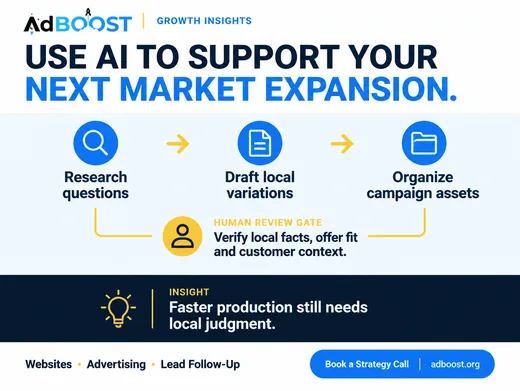
Use qualified language reviewers and relevant customer evidence to evaluate terminology, clarity, and search behavior. AI may prepare variations, but generated suggestions should be treated as drafts. Check whether the translated wording remains accurate in the actual service context. Avoid keyword variations that distort professional terminology or promise services the business does not offer.
Adapt the complete customer pathway
Review advertisements, landing pages, calls to action, form fields, confirmations, scheduling, and follow-up. Confirm customers can understand what happens after contact. Where language assistance or localized support is advertised, verify how the business actually provides it. Do not assume that translating a landing page automatically localizes the CRM workflow.
Validate offers and operational realities
Ask the responsible location or service manager to approve appointment availability, service eligibility, pricing conditions, geography, promotional terms, and material limitations. For regulated services, obtain appropriate professional and compliance review. Document unresolved claims and block publication until consequential inaccuracies are corrected.
Test and launch with safeguards
Perform technical tests for page rendering, forms, phone routing, CRM fields, attribution, and notification ownership. Review the complete customer experience on mobile. Establish a process to correct misleading language quickly and to suspend a campaign when material service or safety information is wrong.
Measure local outcomes and refine
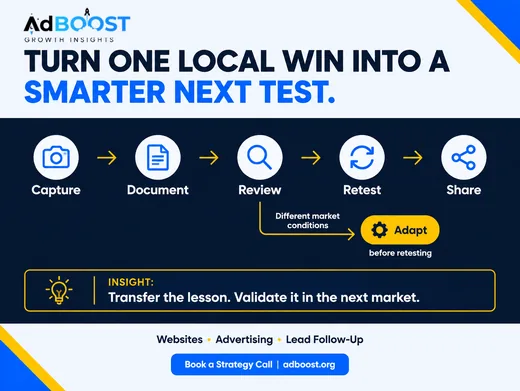
Compare valid inquiries, service fit, qualified appointments, and customer questions within each market. Record language and operational misunderstandings separately. Evaluate changes using comparable periods and acknowledge uncertainty. Update shared standards when a lesson is reusable, while preserving legitimate differences between locations.
What to measure when localization is working
Localization quality is not established by the number of translated assets or a general-purpose AI translation score. Measure whether customers receive accurate information, reach the appropriate service team, and advance through the intended journey. Keep language quality, service accuracy, and commercial outcomes separate so problems can be identified.
- Verified local claim accuracy
- Review material location-specific claims against approved service information. Record accurate, inaccurate, incomplete, and unverified statements, their severity, and correction status.
- Market-specific qualified inquiry rate
- Qualified inquiries meeting local service criteria divided by valid inquiries in that market, multiplied by 100. Use documented eligibility rules and CRM records.
- Localization issue resolution
- Resolved applicable issues divided by applicable documented issues, multiplied by 100. Separate language, customer-expectation, technical, and operational issues.
- Localized pathway completion
- Review whether eligible visitors can complete intended contact or booking actions using available website and CRM events. Investigate failures without assuming all abandonment reflects a localization problem.
- Customer expectation mismatches
- Record verified inquiries involving incorrect service areas, unavailable offerings, misunderstood appointments, or misleading language-support claims. Classify causes and corrective actions.
- Qualified appointment outcomes
- Track qualified appointments booked and completed for comparable market cohorts. Review appointment capacity and service availability before attributing changes to localization.
Common mistakes and when this advice is wrong
- Treating translation accuracy as the complete objective. A grammatically accurate advertisement can still promote the wrong service, use unfamiliar terminology, or create an unsupported scheduling promise. Review the full journey.
- Making cultural assumptions from language alone. Customers sharing a language do not necessarily share identical purchasing behavior or preferences. Use relevant evidence and qualified review rather than stereotypes.
- Localizing content the business cannot operationally support. Translated materials should not imply unavailable services, offices, appointments, professional capabilities, or language assistance. Accurate limitations are part of a trustworthy experience.
- Creating unnecessary local variations. If the customer need and operational reality are substantially the same, excessive duplication can create maintenance problems. Preserve shared content unless a genuine difference justifies adaptation.
- Overriding professional or legal accuracy for conversational language. Medical, legal, financial, and other regulated messages may require precise terminology and specialist review. Localization should improve comprehension without changing the underlying meaning.
Frequently asked questions
What is the difference between translation and marketing localization?
Translation communicates material in another language. Marketing localization considers how the message, offer, terminology, service expectations, and customer journey fit a particular market. A translated advertisement may still be unsuitable if it promotes an unavailable service or sends customers into an inappropriate process. Effective localization preserves factual accuracy while adapting meaningful customer-facing details.
Can AI handle marketing localization without human reviewers?
AI can help draft translations, organize terminology, prepare variations, and identify possible inconsistencies. It cannot independently verify every local service condition, professional requirement, or customer expectation. Use qualified reviewers for consequential language, cultural context, regulated claims, and operational accuracy. The amount of review should reflect the risks of the particular task.
Does every local market need different advertising?
No. Shared brand standards, service explanations, and operational processes may work across several markets. Adapt advertising when customer needs, service availability, terminology, offers, or other verified conditions differ meaningfully. Unnecessary customization can increase cost and inconsistency. The objective is useful local relevance, not variation for its own sake.
How do I localize marketing for Spanish-speaking customers?
Start by verifying the intended audience, actual language-support capabilities, services, and contact process. Use qualified language review and relevant customer questions rather than assuming one translation fits every Spanish-speaking community. Ensure the complete journey accurately represents what customers can expect, including scheduling and communication options. Obtain professional review when medical, legal, or other regulated information is involved.
How can I tell whether a localized campaign is successful?
Measure valid inquiries, service fit, appointment progression, customer misunderstandings, and actual outcomes for the intended market. Review technical functionality and factual accuracy separately. Compare similar periods and acknowledge differences in traffic, capacity, and demand. Translation volume and superficial engagement do not establish that the localized experience is commercially or operationally effective.
Review Your Localization Strategy
Identify where your marketing needs more than translated copy and where local verification can improve customer trust and lead quality.
Review Your Localization Strategy