How Do You Turn One Location's Marketing Win Into a Repeatable System?
What this means for your business
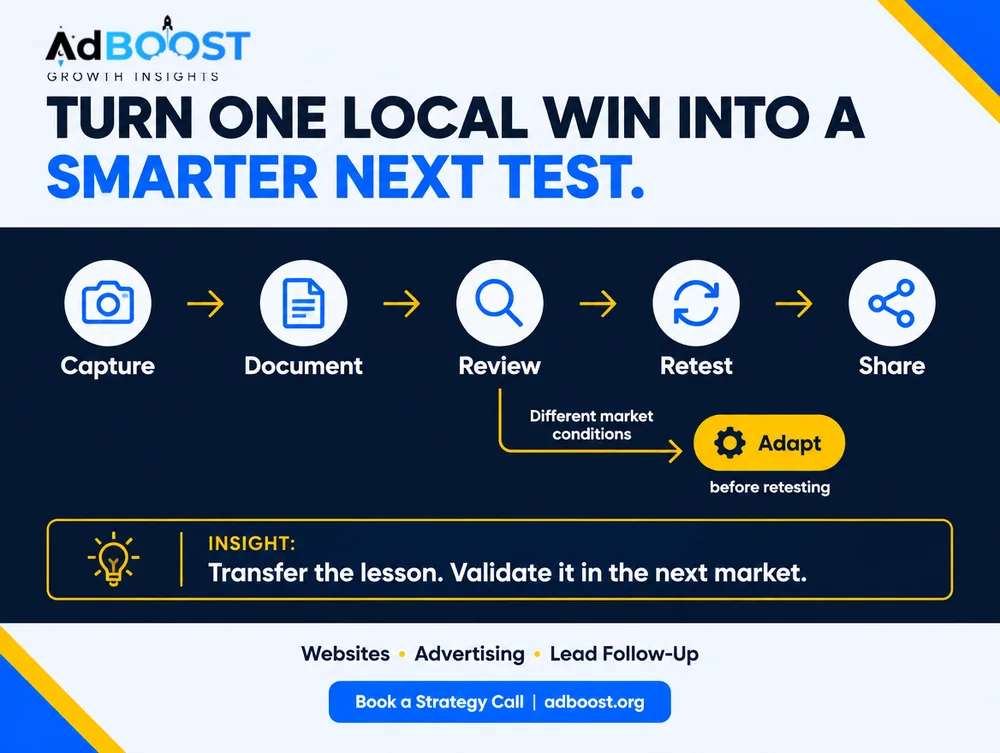
When a roofing offer works in one suburb, write down what ran, where and why, then test it in the next area before assuming it will repeat.
When a new-patient offer works at one office, document it and test it at another before rolling it out everywhere.
When one practice-area page brings in good matters, document what changed and test it elsewhere before treating it as a rule.
 AD BOOST INTELLIGENCE
The Local Win Transfer Protocol
Transfer the lesson. Verify the conditions. Adapt the execution.
- What actually worked?
- Which conditions mattered?
- What must change locally?
- What did the next market teach us?
A successful local result is a hypothesis for another market, not a universal performance guarantee.
An original Ad Boost six-stage framework that moves from a documented local result through contextual analysis, hypothesis extraction, adapted testing, outcome comparison, and shared playbook updates. A market-conditions checkpoint prevents teams from copying tactics when the assumptions supporting the original result do not apply.
Your best location may know something the rest of your business doesn't
A regional pest control company operates across several territories. One branch consistently receives inquiries from homeowners interested in recurring service plans. The local manager explains that customers respond particularly well when the sales team clarifies what an initial inspection includes and how ongoing service is scheduled.
The central marketing team sees the branch's encouraging results and copies its advertisements into every other territory. But another branch serves a different mix of residential and commercial customers. A third has limited availability for recurring appointments. The copied message attracts attention without consistently producing suitable customers.
The original success was real within its context. The mistake was assuming the visible advertisement contained the entire explanation for that success.
A local marketing win is an observed favorable outcome associated with a campaign, offer, customer journey, or operating process in a defined market. A transferable lesson is a documented explanation or hypothesis that another team can evaluate under its own conditions.
Those are not the same thing. A branch may report a lower cost per lead because of cheaper traffic, stronger local recognition, different service demand, or a more effective landing page. It may also benefit from better phone coverage, available appointments, or a local promotion. Without separating these factors, leadership risks copying the wrong element.
Multi-location marketing knowledge management is the process of capturing decisions, experiments, customer questions, operating conditions, and outcomes so they can inform other locations. It should preserve the circumstances that shaped each result rather than reducing every successful campaign to a screenshot and an instruction to repeat it.
This is especially important for businesses operating across locations with different service capabilities. A dental group might use shared advertising infrastructure while maintaining office-specific treatment availability. A roofing contractor may serve territories with different property types and inspection logistics. A real estate organization may have substantially different buyer journeys across communities.
The challenge is balancing standardization with local judgment. Standardizing useful processes can improve consistency. Forcing identical creative, offers, or qualification rules across materially different markets can make the system less responsive to actual customers.
A useful shared playbook therefore records both what should be repeated and what must be reconsidered. It explains the original customer problem, campaign hypothesis, execution details, observed outcomes, possible alternative explanations, and conditions required for a reasonable transfer.
Ad Boost's position is that marketing knowledge should travel farther than marketing assets. A reusable insight about customer uncertainty, service clarity, or lead handling can remain valuable even when the exact advertisement does not. The goal is to make each local experiment contribute to organizational learning without pretending that one market establishes a universal rule.
Is your business learning across locations or simply copying campaigns?
Select a recent successful local campaign and ask another location manager to explain why it worked using only the available documentation. If the manager can see the creative and results but cannot identify the original audience, offer, service conditions, qualification rules, or operational constraints, the organization has preserved an asset rather than a transferable lesson.
- Can the original location explain which customer problem the successful campaign addressed?
- Are the campaign's dates, offer, targeting, service area, budget conditions, and landing-page experience documented?
- Do reported results include qualified inquiries, appointments, or customers rather than only clicks and inexpensive leads?
- Can another location identify which original market conditions may differ from its own?
- Does the organization distinguish evidence from hypotheses about why a campaign performed well?
- Are local managers allowed to adapt an approved tactic when their actual services or customer needs differ?
- After transferring an idea, does the team document what happened and update the shared playbook?
When should a local marketing win be replicated, adapted, or rejected?
| Situation | Recommended action | Why | Exception |
|---|---|---|---|
| A campaign produces qualified appointments in one location and another offers the same service. | Transfer the campaign hypothesis, verify operating conditions, and test an adapted implementation. | Comparable services create a reasonable starting point but do not establish identical demand. | Different capacity, customer expectations, or competitive conditions may require substantial changes. |
| The successful campaign promotes a service unavailable in the receiving territory. | Do not copy the offer; determine whether the broader customer insight applies to an available service. | Advertising an unavailable service creates misleading expectations and unsuitable inquiries. | The location may become eligible later after verified operational expansion. |
| One branch reports unusually low cost per lead but cannot explain qualification outcomes. | Reconcile lead definitions and downstream outcomes before treating the campaign as a transferable success. | Inexpensive inquiries do not automatically represent profitable customer acquisition. | Early-stage campaigns may require a longer observation period to evaluate actual outcomes. |
| A local manager discovers a recurring customer objection. | Document the objection, evidence, response approach, and circumstances in which it applies. | Customer insights can transfer even when the original creative or promotion cannot. | Other territories should verify whether their customers share the concern. |
| The second market produces different results from the original. | Investigate service mix, audience, capacity, tracking, execution, and external conditions before rejecting the hypothesis. | A different outcome does not reveal its cause without further analysis. | An inaccurate or unsafe claim should be corrected immediately rather than retested. |
| Several locations independently report a similar operational problem. | Evaluate whether a shared process, template, or system correction can resolve the underlying issue. | Recurring patterns may indicate a central operating weakness. | Local regulations, staffing, and service requirements may justify documented exceptions. |
Worked example
Imagine a fictional regional pest control company called Oakline Pest Services. It operates three branches serving different combinations of residential neighborhoods and commercial properties. The central marketing team notices that Branch A is generating suitable inquiries for recurring residential pest management plans.
Branch A's team explains that customers frequently ask whether the first visit includes a property assessment and what recurring service actually covers. The marketing manager creates an educational landing-page section addressing those questions. During a hypothetical reporting period, Branch A receives 40 valid inquiries, of which 28 meet the company's documented residential service qualifications.
The observed qualification rate is 70%. This figure describes only the fictional example and does not establish that the landing-page explanation caused the result. The team records the audience, offer, page version, appointment capacity, and customer questions before considering whether the insight can travel.
Branch B serves residential customers but operates with different scheduling availability. Branch C focuses more heavily on commercial facilities and does not offer the same residential plan. Copying Branch A's exact advertisement into Branch C would be inappropriate because the service promise does not fit the local operation.
Using the Local Win Transfer Protocol, the marketing team identifies the potentially transferable hypothesis: customers may be more comfortable requesting service when the scope and next steps are clearly explained. The transferable idea is clarity about the service process, not the particular residential plan.
Branch B adapts the explanation to its actual appointment process. Branch C creates a separate explanation of commercial inspection and service planning, with accurate qualification information. Both versions receive local operations approval before publication.
For a second hypothetical period, suppose Branch B receives 30 valid inquiries and 21 qualify, while Branch C receives 20 valid inquiries and twelve qualify. Those observed qualification rates are 70% and 60%. They should not be compared as proof that one branch is better because the service categories, customers, availability, and markets differ.
Each branch records the questions customers ask, the suitability of inquiries, and the progression toward scheduled service. If the adapted explanations reduce verified misunderstandings, that provides useful operational feedback. It does not prove a universal advertising-performance effect.
The central team updates its shared playbook with three separate elements: the general lesson that service-process clarity may help customer evaluation, the approved examples for each branch, and the conditions that require local review.
The result is a more useful knowledge system. Future branches can understand why the idea was tested, how it was adapted, and what evidence remains uncertain rather than copying a creative file with no context.
Market-specific qualification rate = qualified inquiries in the market / valid inquiries in the market x 100. Documented transfer completion = transferred hypotheses with recorded context, local validation, outcome review, and decision / transferred hypotheses reviewed x 100.
The pest control company, branches, service arrangements, inquiry counts, percentages, and outcomes are entirely hypothetical teaching inputs, not actual Ad Boost client results or published marketing benchmarks.
How to turn successful local marketing into a shared operating advantage
Document the original result before celebrating it
Capture campaign dates, location, service, audience, offer, creative, landing page, spend definitions, conversion events, qualification criteria, and available customer outcomes. Preserve relevant conditions such as weather, seasonality, staffing, and appointment capacity. State what was actually observed without claiming the campaign element caused the result unless the evidence supports that conclusion.
Interview the local team about customer behavior
Ask employees which customer questions, service concerns, scheduling constraints, and operational realities may have influenced performance. Compare their explanations against inquiry records and customer feedback. Record hypotheses separately from verified observations. Do not treat a manager's confidence as proof of causation.
Extract one transferable hypothesis
Describe the mechanism the team wants to investigate. For example, clearer appointment expectations may help suitable customers decide whether to inquire. Identify which parts of the original campaign are essential to that hypothesis and which are local execution details. Avoid transferring an entire campaign when only one underlying idea appears relevant.
Check the receiving market before adapting
Verify actual services, local customer needs, contact options, appointment capacity, pricing conditions, professional requirements, and market-specific limitations. Compare them with the original conditions. If the underlying service or customer situation does not apply, adapt the hypothesis substantially or reject the transfer.
Run an appropriate local test
Implement the adapted approach using accurate assets and reliable tracking. Define the comparison, desired customer outcome, and stop conditions. Change one principal variable where practical, but document unavoidable operational changes. For low-volume locations, use cautious interpretation and avoid declaring winners from small samples.
Compare outcomes without erasing context
Review inquiry quality, booked opportunities, customer outcomes, and relevant operating constraints within each market. Compare consistent definitions while preserving legitimate differences. Record whether the original hypothesis was supported, contradicted, or left unresolved. Do not rank locations solely by raw cost per lead.
Update the shared playbook and assign maintenance
Store the original lesson, tested variations, approvals, outcomes, limitations, and recommended conditions for reuse. Link approved assets to their source briefs. Name the person responsible for keeping the information accurate as services and markets change. Make the playbook searchable by service, audience, problem, and market condition.
How to measure whether local knowledge is becoming a company advantage
The number of campaigns copied between locations is not a meaningful success measure by itself. Evaluate whether the organization preserves context, makes better decisions, avoids repeated errors, and supports qualified customer outcomes. Each transfer should remain traceable from its original observation to its receiving-market decision.
- Documented local learning coverage
- Eligible completed local tests with a documented hypothesis, context, outcomes, and decision divided by eligible completed tests x 100. Use the shared experiment register.
- Transfer verification coverage
- Transferred hypotheses with recorded receiving-market validation divided by transferred hypotheses requiring validation x 100. Review local service, offer, customer, and operating conditions.
- Time from insight to local decision
- Elapsed time between recording a transferable hypothesis and documenting a receiving-market decision. Report delays caused by missing information, approval, or test volume.
- Market-specific qualified inquiry rate
- Qualified inquiries in a defined territory divided by valid inquiries in that territory x 100. Preserve market-level qualification context.
- Repeat-error recurrence
- Count previously documented problems that recur after a corrective lesson has been incorporated into the shared playbook. Review whether the recurrence reflects poor adoption or changed conditions.
- Playbook adoption with verification
- Count locations that implemented an applicable lesson and completed the required local validation and outcome review. Do not count asset duplication alone as successful adoption.
Common mistakes and when this advice is wrong
- Copying the winning advertisement without its context. The creative may be associated with a favorable result because of local demand, service capacity, offer fit, or other conditions. Transfer the hypothesis and verify the circumstances before copying execution.
- Treating one favorable reporting period as proven causation. Performance can change because of seasonality, competition, customer mix, or operational differences. Document uncertainty and use appropriate comparisons rather than presenting correlation as proof.
- Forcing standardization when markets genuinely differ. Shared systems should support local accuracy. Do not impose unavailable offers, inappropriate customer journeys, or misleading service claims simply to maintain consistency.
- Allowing every location to reinvent the same process. Excessive independence can lead to repeated mistakes, incompatible reporting, and duplicated work. Standardize transferable definitions and operational safeguards while preserving necessary local variation.
- Building a playbook nobody maintains. Old creative files and unverified lessons can become liabilities as services and markets change. Assign an owner, review triggers, and version control so documentation remains usable.
Frequently asked questions
How do you scale a successful marketing campaign across multiple locations?
Document the original result, customer situation, offer, operational conditions, and measurement definitions. Identify the hypothesis most likely to transfer, then verify how the receiving market differs. Adapt the campaign, measure qualified outcomes, and record what the second location teaches you. Scaling means developing a repeatable decision process, not simply duplicating advertisements.
Should every location use the same marketing creative?
Not necessarily. Shared creative can be efficient when the service, offer, customer need, and operating conditions are genuinely consistent. Different markets may require accurate local details, distinct customer explanations, or different contact pathways. Use common brand standards and approved templates while allowing verified adaptations. Avoid customization that provides no meaningful customer value.
What should go into a multi-location marketing playbook?
Include approved brand standards, lead definitions, CRM workflows, tested campaign hypotheses, customer questions, service eligibility, location-specific limitations, reporting methods, approval ownership, and documented outcomes. Every transferable lesson should explain where it was observed, what was tested, what remains uncertain, and when another location should adapt or reject it.
How do I know whether a successful campaign will work in another city?
You cannot know from the original result alone. Compare customer need, service availability, competitive conditions, brand familiarity, offer relevance, and fulfillment capacity. Treat the previous campaign as a hypothesis and test it under the receiving market's actual conditions. Report differences without claiming that one favorable market establishes a universal rule.
What if a local manager refuses to use a centrally approved campaign?
Ask which specific customer, service, operational, or regulatory condition makes the campaign unsuitable. Verify the concern against actual evidence. If the objection identifies a genuine mismatch, adapt the campaign and record the exception. If the issue is a preference without meaningful customer implications, use agreed brand standards and a documented decision process rather than allowing indefinite disagreement.
Review Your Multi-Location Marketing Plan
Turn isolated campaign successes into documented lessons your other locations can test, adapt, and use responsibly.
Review Your Multi-Location Marketing Plan