What Should AI Handle in Your Marketing—and What Should You Keep?
What this means for your business
Let AI draft service-page copy and summarize call notes for your HVAC, plumbing or roofing crew; keep pricing, scheduling promises and who gets the emergency call with a person.
Let AI prepare reminder drafts and FAQ outlines, but keep clinical claims, patient-facing promises and compliance review with a licensed, accountable person.
Let AI organize intake notes and outline blog drafts; an attorney should approve every statement about results, eligibility or legal advice before it goes live.
 AD BOOST INTELLIGENCE
The AI Task Ownership Matrix
Match automation authority to task predictability and risk.
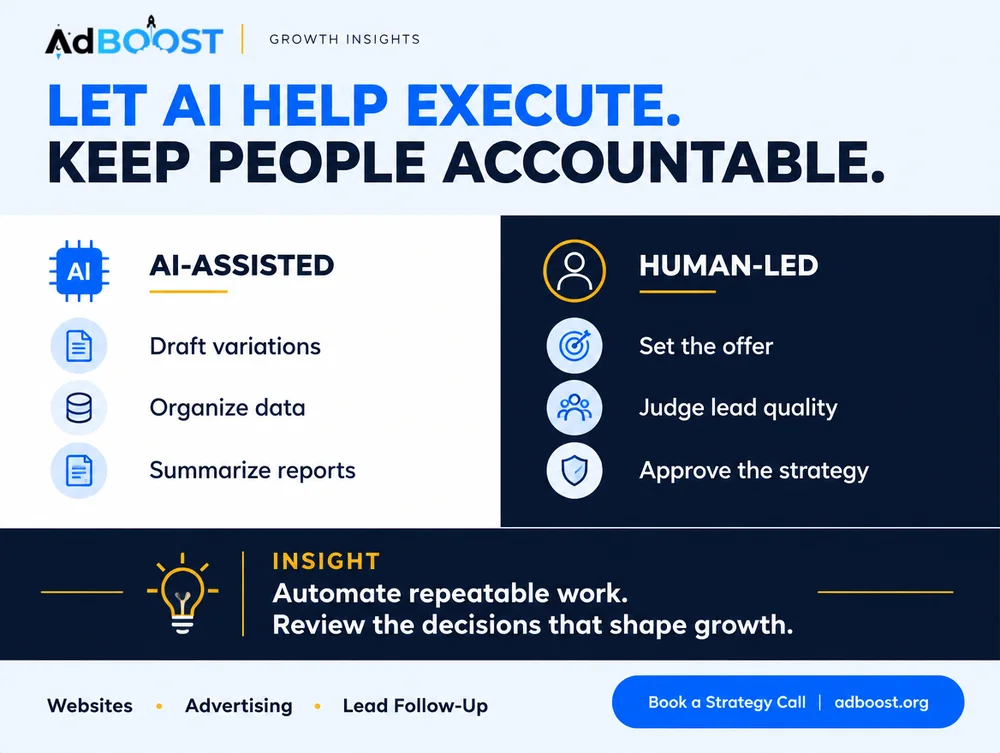
Automate predictable work. Keep consequential judgment accountable.
An original Ad Boost decision framework that evaluates marketing tasks using two dimensions: how repeatable the task is and how consequential an error would be. The matrix assigns an appropriate operating approach without assuming every task belongs entirely to AI or entirely to humans.
The real question is not what AI can do. It is who owns the outcome.
An AI system can draft twenty roofing advertisements before your sales manager finishes reviewing the first one. That sounds like an efficiency gain until the drafts promise same-day inspections your crews cannot provide, suggest insurance outcomes you cannot guarantee, or advertise discounts your business has not approved. Production speed means little when the output creates operational problems.
AI marketing automation means using artificial intelligence to assist with or perform marketing activities such as drafting copy, classifying information, summarizing performance, generating content variations, or supporting administrative workflows. It does not automatically mean that the system should control campaign strategy, spending, customer promises, or final publication.
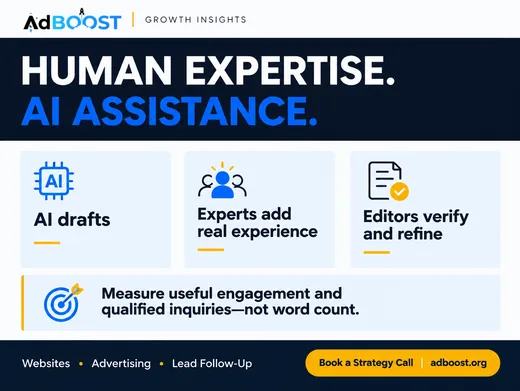
The distinction between performing a task and owning a decision is essential. A drafting assistant may suggest advertisements. A qualified employee approves their accuracy. A reporting assistant may organize campaign results. A marketing manager decides whether those results justify changing the budget. A scheduling assistant may collect appointment preferences. An authorized employee or appropriately controlled scheduling system confirms availability.
For local service businesses, the consequences of errors vary considerably. A typo in an internal campaign summary may be easy to correct. Publishing an inaccurate medical treatment claim, mishandling confidential legal information, targeting an inappropriate audience, or automatically promising unavailable emergency service can create much more serious problems.
AI also introduces a verification burden. Generated text can sound persuasive while containing unsupported facts. A spreadsheet summary can conceal misunderstood columns. A suggested optimization can overlook staffing limitations or the difference between inexpensive leads and profitable customers. The more consequential the output, the stronger the evidence and approval process should be.
The best operating model separates three responsibilities: production, judgment, and accountability. AI may assist with production. People establish business priorities and review consequential recommendations. A named business owner or authorized manager remains responsible for the resulting customer experience. The amount of automation should depend on task characteristics, not enthusiasm for a particular software product.
Which marketing tasks are actually ready for AI?
Do not begin by shopping for automation software. Begin with a task inventory. Ask employees what they repeat, what requires expertise, what information they use, and what happens when a mistake reaches a customer. A task that appears routine to management may depend on dozens of judgment calls made by an experienced employee. Document those decisions before attempting to automate them.
- Can you write clear instructions explaining what a correct completed task looks like, including exceptions?
- Does the task use information that is current, reliable, accessible, and appropriate to provide to an AI system?
- Could an incorrect output create a misleading customer promise, advertising violation, privacy problem, financial loss, or reputational damage?
- Can someone verify the output against an authoritative source before it reaches customers or changes a campaign?
- Is the task genuinely repetitive, or does it require understanding individual customer circumstances and professional judgment?
- Will automating the task remove meaningful work, or simply transfer that work into reviewing and correcting AI output?
- Who has authority to stop the workflow, correct errors, and take responsibility when the system behaves unexpectedly?
Practical AI ownership decisions for local service marketing
| Situation | Recommended action | Why | Exception |
|---|---|---|---|
| A marketing assistant spends time formatting weekly performance reports. | Use AI to organize validated data and draft summaries, then review calculations and conclusions. | The structure is repetitive, and humans can compare the output against source records. | Do not let the assistant invent missing metrics or recommend major budget changes without analysis. |
| A roofing company needs advertising headlines and copy variations. | Allow AI to produce drafts from approved offers, service areas, and claim restrictions. | Variation generation is repeatable, but claims about pricing, insurance, timing, and availability need verification. | Sensitive or regulated claims may require specialized approval before publication. |
| A dental practice wants AI to respond to treatment questions. | Use approved administrative responses for suitable general questions and route clinical matters to qualified personnel. | Clinical advice and individual treatment decisions carry consequences beyond ordinary copywriting. | Applicable privacy rules, professional requirements, and communication policies govern what information may be processed. |
| An advertising platform recommends moving budget between campaigns. | Treat the recommendation as an input to a decision, not automatic authorization. | The system may not understand margins, staffing capacity, lead quality, or operational commitments. | Low-risk adjustments may be automated within tested guardrails and documented spending limits. |
| A real estate team wants automatic follow-up after inquiries. | Automate appropriate acknowledgments, routing, and permitted reminders while preserving human ownership of substantive conversations. | Administrative consistency can improve without surrendering the relationship. | Consent, communication preferences, fair housing requirements, and brokerage rules still apply. |
| An agency wants AI to design an entire customer acquisition strategy. | Use AI to research options, organize hypotheses, and challenge assumptions; retain final strategic authority. | Positioning, financial priorities, acceptable risk, and customer promises require accountable judgment. | AI-assisted analysis can be substantial, but recommendations still need verified inputs and competent review. |
Worked example
Imagine a fictional roofing business called Ridgepoint Roofing. Its marketing coordinator prepares Google Ads copy, reviews campaign reports, updates landing pages, and sends appointment reminders. Management wants AI to reduce repetitive work but does not want inaccurate claims about insurance coverage, repair timelines, or inspection availability appearing in advertisements.
For a hypothetical teaching exercise, the coordinator identifies five weekly activities. Drafting advertising variations requires three hours, formatting reports requires two hours, reviewing customer feedback requires one hour, approving promotional offers requires one hour, and planning campaign strategy requires two hours. These invented quantities establish a baseline for the example; they are not typical agency productivity figures.
Using the AI Task Ownership Matrix, the team places report formatting in AI-Assisted Routine Work. Advertising drafts belong in AI Draft + Review because offer accuracy matters. Customer feedback summaries are AI-assisted, but original reviews remain available for verification. Promotional approval and campaign strategy remain human-led because those decisions depend on margins, availability, positioning, and customer commitments.
After testing a controlled workflow, suppose the coordinator spends one hour preparing advertising drafts and one hour formatting reports. Total time for those two activities changes from five hours to two hours. However, the team also spends one additional hour checking AI-generated material. Net time saved is therefore two hours, not three. The example demonstrates why gross production speed and net operational efficiency are different.
The team also records corrections by category. A minor formatting adjustment is treated differently from a fabricated discount or unsupported insurance statement. If serious errors repeatedly escape review, the workflow is restricted or suspended even if it saves time. Efficiency is valuable only when the business maintains acceptable quality and control.
Net time saved = baseline task time - new production time - additional review and correction time. Review correction rate = outputs requiring material correction / outputs reviewed x 100.
The company, activities, hours, savings, and workflow outcomes are hypothetical teaching inputs, not actual Ad Boost client results or published AI productivity benchmarks.
How to introduce AI into marketing without losing control
Inventory actual marketing work
List recurring activities across advertising, content, CRM administration, reporting, customer communication, and campaign planning. Record the current process, tools, inputs, output, responsible employee, and common exceptions. Separate complete workflows into individual tasks. For example, creating an advertisement includes researching the offer, drafting copy, checking claims, approving creative, publishing, and monitoring results. These steps do not necessarily belong to the same owner.
Classify each task using the matrix
Evaluate repeatability and the consequence of mistakes. Consider customer harm, legal exposure, financial decisions, privacy, brand trust, and operational disruption. Do not assign artificial numerical precision to these judgments. Record why a task belongs in its chosen category and identify uncertain cases requiring further review.
Create approved inputs and boundaries
Provide current service descriptions, actual operating areas, approved offers, tone guidelines, prohibited claims, and examples of acceptable work. Establish which data the AI tool may receive and which must remain outside it. Never paste confidential client, medical, legal, or sensitive personal information into an unapproved system. Review vendor data-handling settings and contractual requirements before connecting business systems.
Define the approval rules
Identify which outputs may remain internal, which require human verification, and which must never be published or executed automatically. For advertisements, check offer accuracy, landing-page consistency, service availability, and platform rules. For analytics, verify calculations and underlying source data. For customer communications, confirm consent and escalation requirements.
Run a limited, reversible pilot
Choose a repeatable task with manageable consequences. Record the baseline time and quality of the existing process. Test AI assistance using representative inputs, including unusual cases. Keep a record of time spent drafting, reviewing, correcting, and handling exceptions. Avoid changing several unrelated workflows simultaneously because it becomes harder to identify what improved.
Build monitoring and rollback
Create a clear way to disable automated actions, recover earlier content, correct customer-facing errors, and escalate unexpected outputs. Monitor examples of actual work rather than assuming that successful setup means reliable ongoing operation. Reevaluate the process whenever inputs, offers, platform rules, or business operations change.
Expand only when net value is demonstrated
Compare actual time savings, review effort, output accuracy, customer outcomes, and relevant software costs. Expand to additional tasks only when the first workflow provides reliable value. Retain human control over strategic priorities and consequential decisions. Automation should make a functioning marketing process more dependable, not disguise a process that was never clearly defined.
How to measure whether AI is helping your marketing
Production speed is only one dimension of performance. A useful AI workflow should reduce avoidable effort without increasing serious errors, customer confusion, compliance exposure, or operational complexity. Measure the complete task, including review and correction. Keep the same task definitions and comparable input complexity between baseline and pilot periods.
- Net task time saved
- Subtract AI-assisted production, review, correction, and exception-handling time from comparable baseline task time. Use employee time records or a consistent task log. Report material changes in task complexity.
- Material correction rate
- Outputs requiring substantive factual, strategic, compliance, or customer-promise corrections divided by outputs reviewed, multiplied by 100. Maintain a correction log and distinguish minor style edits.
- Unsupported claim incidence
- Record outputs containing unverified offers, invented facts, misleading guarantees, or unsupported credentials. Review against approved source information. Treat serious issues individually rather than hiding them inside an average.
- Approval compliance
- Customer-facing or consequential outputs receiving all required approvals divided by outputs requiring those approvals, multiplied by 100. Verify through workflow records rather than employee recollection.
- Workflow cost
- Combine relevant software expense, staff time, review effort, correction effort, and maintenance costs for the period. Compare with the previous process using consistent accounting assumptions.
- Business outcome quality
- For work affecting live campaigns, separately monitor qualified leads, bookings, conversion quality, customer complaints, and campaign outcomes. Do not assume improved results were caused solely by AI.
Common mistakes and when this advice is wrong
- Automating a process nobody understands. If employees cannot explain how a task should work, automation may repeat inconsistencies more quickly. Document the process and its exceptions before selecting software.
- Mistaking polished language for accurate information. AI-generated copy can sound confident while inventing offers, misrepresenting services, or misunderstanding regulations. Approval must include factual verification, not merely grammar and tone.
- Counting production savings but ignoring review time. A workflow that saves drafting time but requires extensive correction may have little net benefit. Evaluate complete task costs and the consequences of mistakes.
- Using AI where confidentiality or professional judgment requires stronger safeguards. Healthcare, legal, financial, and sensitive customer matters may require professional oversight, approved systems, and specific privacy controls. Some tasks should not be automated at all.
- Refusing automation simply because a task is important. High-consequence work can still benefit from AI-assisted preparation, classification, and quality checking. The appropriate response is controlled assistance with accountable review, not necessarily a complete prohibition.
Frequently asked questions
Which marketing tasks should a small business automate first?
Start with repeatable work that has clear rules and manageable consequences, such as formatting reports, organizing approved information, preparing internal summaries, or drafting content variations for review. Choose a task whose output can be verified. Document the existing process and measure the complete time required after AI assistance, including corrections. Avoid beginning with autonomous budget decisions, sensitive customer communications, or unsupported advertising claims.
Can AI manage my Google Ads or Meta Ads without a human?
AI-powered advertising systems can assist with bidding, targeting, creative delivery, and other functions depending on platform capabilities and campaign settings. That does not remove the need for business oversight. Someone must verify tracking, lead quality, spending limits, offers, compliance, and whether campaigns support the company's economics and capacity. Automation can execute within an approved strategy, but it should not be mistaken for independent understanding of the business.
How much time should AI save before it is worth using?
There is no universal savings threshold. A practical rule of thumb is to evaluate net value after accounting for subscription costs, setup, review, corrections, and ongoing maintenance. A workflow that saves modest time while improving consistency may be worthwhile. Another that saves substantial drafting time but produces dangerous mistakes may not be. Use comparable baseline and pilot records rather than vendor productivity claims.
Should AI write all of my company's advertising copy?
AI can create useful drafts and variations, especially when provided with accurate service details, approved offers, and clear brand guidance. Human review remains important for promises, pricing, claims, customer sensitivity, and strategic fit. Strong advertising also depends on a genuine offer and customer understanding. Producing more variations does not automatically make the message more persuasive or improve lead quality.
How do I know when an AI task needs human approval?
Consider the consequence of an incorrect output, the reliability of its inputs, and whether the task requires professional judgment or customer-specific decisions. If an error could mislead a customer, violate a rule, expose private data, change spending materially, or damage trust, establish an appropriate approval checkpoint. The AI Task Ownership Matrix provides a repeatable way to document that choice.
Review Your AI Marketing Workflow
Identify which marketing tasks deserve automation, which need stronger safeguards, and where human judgment creates the most value.
Review Your AI Marketing Workflow