How Do You Make AI-Assisted Content Worth Reading?
What this means for your business
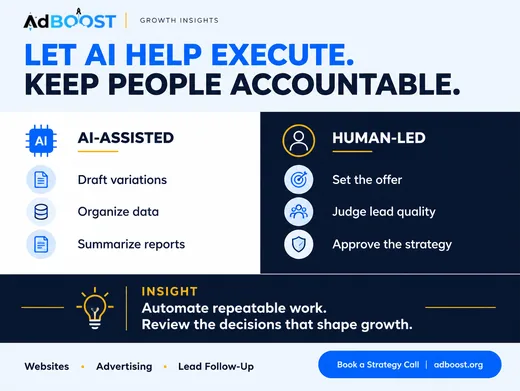
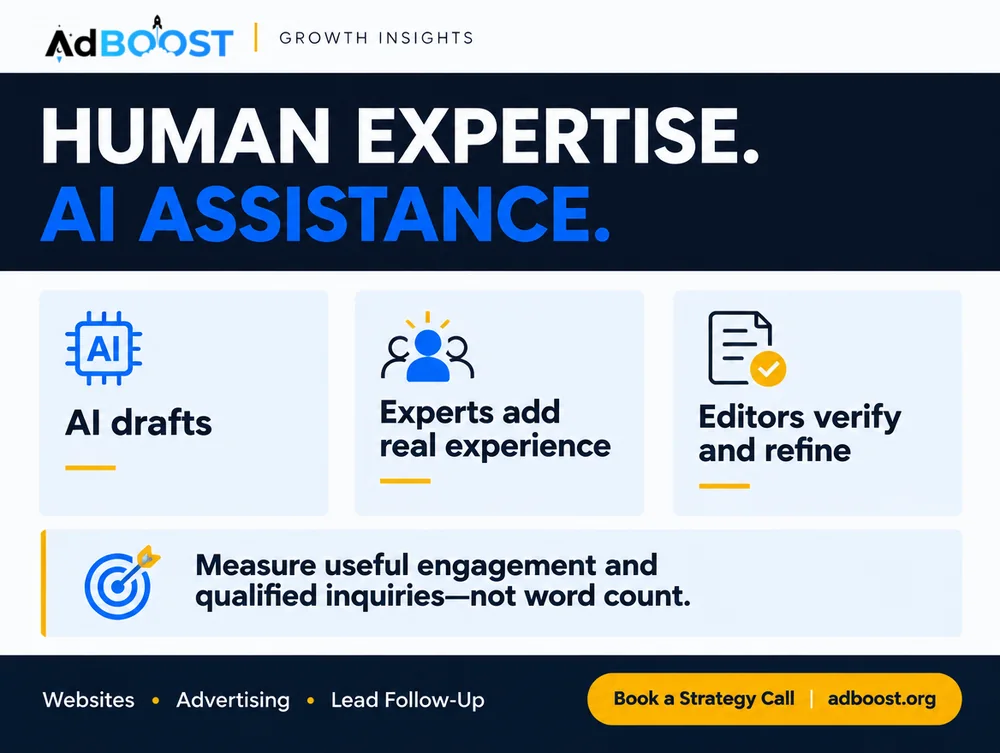
Use AI to draft how-to and cost-factor pages, then add real job photos, local details and a licensed person's review so readers trust it.
Use AI to draft educational content, then have a qualified clinician review it and add practice-specific details before it is published.
Use AI to outline educational articles, then have an attorney review, add jurisdiction-specific detail and keep disclaimers accurate.
 AD BOOST INTELLIGENCE
The Content Value Check
Five editorial gates between a draft and a useful page.
- Does this page answer the query?
- What can readers learn here?
- Can we substantiate every claim?
- Is the next action appropriate?
Publishing faster is not valuable if the content fails to help someone decide.
An original Ad Boost editorial quality-control framework that evaluates AI-assisted content through five gates: answering the question, adding specific value, verifying claims, making action clear, and earning the next click. A page must address material failures before publication rather than compensating with more keywords or decorative writing.
The problem with AI content isn't that a machine helped write it
Imagine someone searching for what to do when a water heater starts leaking. They find a plumbing company's article titled What You Need to Know About Water Heater Problems. The introduction explains that water heaters are important household appliances. The next section describes the benefits of regular maintenance. Several paragraphs later, the article finally mentions leaks. The visitor leaves without receiving a useful answer.
The page may be grammatically correct, neatly formatted, and optimized around relevant keywords. It still fails because the reader's immediate problem was never treated as the priority.
AI-assisted content is material developed with the help of generative systems for tasks such as outlining, drafting, editing, summarizing, or organizing information. The use of AI does not determine whether the content is accurate or helpful. Quality depends on what the finished page contributes, whether its claims can be verified, and whether it serves the intended reader.
For a local service business, useful content answers questions that arise before a customer calls, requests a quote, schedules a consultation, or chooses a provider. An emergency plumbing article may need to explain immediate safety precautions and when professional assistance is necessary. A roofing guide might explain what information a homeowner should collect before requesting an inspection. A dental service page should clearly describe its actual offerings while leaving individualized clinical decisions to qualified professionals.
Time on page is sometimes used as an engagement indicator, but it is not a universal measure of content quality. A reader who finds the correct phone number and calls immediately may have had an excellent experience despite a short visit. Someone who spends several minutes struggling through a confusing article may generate a longer session without receiving value.
Likewise, bounce rate and engagement metrics depend on the analytics system's definitions. They should not be interpreted as direct measurements of reader satisfaction, professional credibility, or search ranking.
The stronger editorial question is whether the page removes uncertainty. Does it answer the searcher's question early? Does it explain what matters and what does not? Does it contain information the business can genuinely stand behind? Does it help the reader make a safer or better-informed decision?
Google's published guidance emphasizes helpful, reliable, people-first content and warns against using generative AI to produce large amounts of low-value material primarily to manipulate rankings. AI assistance is not itself the problem. Thin content, unsupported claims, and limited original value are the risks. Source: Google Search Central, Creating Helpful, Reliable, People-First Content, https://developers.google.com/search/docs/fundamentals/creating-helpful-content.
Ad Boost's editorial position is simple: a page should earn its length. If a paragraph does not answer a question, clarify a choice, establish relevant credibility, or move the reader toward an appropriate next step, it probably does not deserve the space.
Why your AI-written pages may be losing readers
Start with the exact customer question the page is supposed to answer. Read the first screen without looking at the page title, then ask whether a visitor could identify the answer and the business's relevant expertise. Continue through the article looking for repeated ideas, unsupported generalizations, inaccurate service claims, irrelevant examples, and abrupt sales pitches. The purpose is to evaluate usefulness, not merely produce an automated content score.
- Does the first meaningful paragraph directly answer the visitor's likely question?
- Would a customer learn something specific about the service, decision, process, or limitation that generic content leaves unclear?
- Are factual and professional claims reviewed against reliable information and actual business capabilities?
- Does the page distinguish general education from circumstances requiring individual professional evaluation?
- Can readers scan the headings and find the information they need without navigating repeated introductions?
- Is the next action relevant to the reader's stage of decision-making rather than an unrelated consultation pitch?
- Do available engagement and lead records suggest a specific problem, or are you assuming a short visit means poor content?
What to change when content isn't delivering value
| Situation | Recommended action | Why | Exception |
|---|---|---|---|
| An article delays the answer behind several introductory paragraphs. | Move the direct answer near the beginning and use later sections for nuance. | Readers should not have to work through generic context to find the requested information. | Safety-critical subjects may require an immediate warning or qualification before the main answer. |
| Several service pages repeat nearly identical descriptions. | Differentiate the real customer intent, service scope, process, and eligibility of each page. | Changing keywords without adding distinct value does not create a useful resource. | Closely related services may be better explained on one comprehensive page. |
| A page receives visits but few contact inquiries. | Review the query intent, service suitability, CTA relevance, contact usability, and actual lead records. | Informational traffic is not necessarily ready to buy. | A useful educational page may succeed without immediate conversions. |
| AI drafts include confident claims without supporting evidence. | Remove, qualify, or verify each material claim before publication. | Plausible language is not evidence of factual accuracy. | Clearly identified opinions and illustrative models do not need to be presented as research findings. |
| Readers appear to leave quickly. | Inspect page usability, traffic intent, answer placement, and observed downstream actions. | A short visit can indicate either satisfaction or frustration. | Do not rewrite a page solely because one engagement metric seems low. |
| A page contains useful facts but is difficult to scan. | Add descriptive headings, concise definitions, decision tables, and appropriately placed examples. | Information structure helps readers locate what matters. | Avoid fragmenting a straightforward answer into unnecessary sections. |
Worked example
Imagine a fictional residential plumbing company called Brookstone Plumbing. Its marketing team uses AI to draft an article about whether homeowners should repair or replace a leaking water heater. The original draft contains general maintenance advice, broad claims about energy savings, and repeated instructions to contact a professional. It does not distinguish a leaking connection from a potentially failed tank.
The editor applies the Content Value Check. The first gate reveals that the article never directly answers the repair-versus-replacement question. The second reveals that it lacks a practical explanation of the information a technician would need. The third identifies unsupported claims about savings and equipment lifespan. The fourth finds no clear guidance about immediate safety concerns. The fifth reveals that the only CTA is a generic promotional button unrelated to the reader's situation.
The revised article opens with a qualified answer: the appropriate decision depends on the source of the leak, equipment condition, safety considerations, and professional evaluation. It advises readers to avoid unsafe contact with water or electrical equipment and to seek appropriate assistance when necessary. It explains what observations may be useful to report without encouraging an unqualified homeowner to perform hazardous repairs.
The article then compares common decision factors, identifies circumstances requiring urgent professional attention, and explains how the company's actual inspection process works. The editor removes invented savings claims and any service promises the company cannot substantiate.
For a hypothetical measurement exercise, suppose the original page receives 300 eligible visits during a defined period and produces nine valid service inquiries. Its observed visitor-to-inquiry rate is 3%. A revised version receives 300 eligible visits and twelve valid inquiries during another period, an observed rate of 4%. These observations do not establish causation because the audience, traffic mix, seasonality, and customer needs may differ.
The team also examines whether readers reach the decision section, whether contact clicks work, and whether inquiries concern the service described. Suppose the revised article generates fewer questions about what an inspection includes. That would provide useful qualitative feedback, although it would not prove that the rewrite caused every change.
The editorial improvement is clear even without claiming a statistical performance lift: the revised page gives a direct, safer answer, eliminates unsupported statements, explains a decision, and offers an appropriate next action.
Observed inquiry rate = valid inquiries / eligible article visits x 100. Qualified inquiry rate = qualified inquiries / valid inquiries x 100. Content review completion = verified applicable editorial checks completed / applicable editorial checks x 100.
The company, article versions, visit totals, inquiries, percentages, and observations are hypothetical teaching inputs, not actual Ad Boost client results or measured AI-versus-human content performance.
How to turn an AI draft into an article worth publishing
Define the reader's real decision
Start with the customer problem rather than a broad keyword. Ask what the visitor wants to know, which facts they need, and what decision follows. For a dental practice, a treatment page may need to explain the consultation process and appropriate limitations rather than promise clinical outcomes. For a roofing contractor, an inspection guide may need to explain how an appointment works.
Build an approved source-of-truth brief
Gather verified service details, operating areas, availability, professional restrictions, approved offers, and relevant primary references. Mark information that is uncertain or requires expert review. Provide AI tools only with information approved for the intended environment. Do not introduce private customer records or sensitive business information into unapproved systems.
Draft the direct answer before the introduction
Write a concise answer explaining what the visitor should understand immediately. State meaningful limitations when the outcome depends on individual circumstances. Then design supporting sections that expand the answer through examples, comparisons, procedures, and relevant questions. Avoid creating several paragraphs of industry background before addressing the query.
Add real business-specific knowledge
Include process explanations, legitimate customer questions, service boundaries, decision criteria, and authentic examples where authorized. Replace generic advice with details the actual business can confirm. Label hypothetical examples clearly. Do not manufacture testimonials, awards, years of experience, statistics, or customer outcomes.
Perform factual, safety, and editorial review
Check material claims, quotations, source references, offers, and professional limitations. Remove unsupported certainty and misleading comparisons. For medical, legal, or other regulated content, obtain appropriate qualified review. Confirm any AI-generated examples are clearly fictional and do not resemble fabricated client proof.
Make the next action useful and accessible
Match the CTA to the reader's likely need. An emergency service explanation may warrant a clear calling option; an early research guide may benefit from a comparison worksheet or relevant service page. Test mobile navigation, forms, buttons, headings, and page readability. Do not hide the answer behind a lead form.
Review actual outcomes and maintain the page
Monitor relevant search queries, page usability, engagement events, valid inquiries, and customer questions. Use those observations to form specific improvement hypotheses rather than rewriting for arbitrary engagement targets. Revisit content when services, regulations, business processes, or material source information change.
Measure content usefulness without worshipping time on page
A good content report distinguishes information consumption, customer action, and commercial outcomes. Time-based metrics can provide context, but they do not establish satisfaction or quality by themselves. Review page purpose before choosing success measures, use consistent analytics definitions, and connect content to qualified inquiries where the evidence supports it.
- Engaged sessions or engagement time
- Use the analytics platform's documented engagement definitions. Segment by page purpose and traffic source. Interpret alongside actions and usability rather than assuming longer always means better.
- Relevant content interactions
- Track meaningful actions such as expanding a decision guide, viewing a service explanation, clicking a relevant internal link, or initiating appropriate contact. Confirm event tracking works and avoid treating every scroll as success.
- Valid inquiry rate
- Valid inquiries associated with eligible page visits divided by eligible visits, multiplied by 100. Use consistent attribution and lead definitions while acknowledging visitors may interact with several pages.
- Qualified inquiry quality
- Review inquiries against documented service-fit criteria. Record whether the customer understood the offering and whether the requested service was appropriate.
- Material editorial corrections
- Count verified factual errors, misleading claims, outdated service details, and significant content omissions discovered during review. Classify severity and document resolution.
- Customer-question recurrence
- Categorize questions received through calls, forms, and consultations. Identify recurring misunderstandings that the page should address without assuming every repeated question indicates a content failure.
Common mistakes and when this advice is wrong
- Assuming longer articles automatically rank better. Length is not a substitute for usefulness. A direct answer may require little text, while a complex buying decision deserves more explanation. Write to solve the problem, not satisfy a word-count formula.
- Treating time on page as proof of quality. Long engagement can reflect interest or confusion. A visitor who quickly finds an accurate answer and contacts the business may have had a better experience than someone who reads extensively without finding what they need.
- Publishing unsupported claims because AI sounds confident. Generated content may invent credentials, guarantees, performance statistics, or service limitations. Verify substantive statements before publication and use qualified review where necessary.
- Producing near-identical pages for every keyword. Pages should answer meaningfully distinct questions. Consolidate overlapping material when separate pages provide no useful difference, and avoid changing only location or service terminology.
- Forcing a sales CTA into every informational moment. Some visitors need safety information, a definition, or decision criteria before they are ready to contact anyone. Provide the answer first and offer an appropriate next step without creating unnecessary pressure.
Frequently asked questions
Does Google penalize content simply because AI helped write it?
Google's published guidance focuses on whether content is helpful, reliable, original, and created for people rather than primarily to manipulate rankings. AI assistance alone is not the deciding factor. However, generating large quantities of low-value material can create search-policy problems. The business should verify claims, contribute original expertise, and ensure the page genuinely satisfies its intended audience.
Is AI-written content worse than human-written content?
Neither production method guarantees quality. Human writers can produce vague or inaccurate material, and AI-assisted workflows can help organize useful information. The decisive factors are factual accuracy, original contribution, editorial judgment, and relevance to the reader. Avoid universal performance claims unless supported by properly designed research comparing clearly defined content and outcomes.
What is a good average time on page for a service business?
There is no universally correct duration. An emergency plumber's contact page serves a different purpose from a detailed renovation planning guide. Analytics platforms may also define engagement time differently. Establish the page's purpose, review relevant customer actions, and compare similar pages or periods under consistent conditions. A short visit with a completed appropriate action can be successful.
How much should I edit content generated by AI?
Edit as much as necessary to ensure the page is correct, original, specific, and genuinely useful. Review the underlying facts, not just the wording. Replace generic statements with verified service knowledge, remove unsupported claims, and ensure the answer addresses the customer's real question. Sensitive medical, legal, and other regulated subjects may require additional professional review.
Should every blog post include a sales pitch?
No. Each page should provide an appropriate next step based on the reader's intent. A service comparison may naturally lead to a consultation. An educational article may benefit from a related guide or practical checklist. The CTA should be relevant and truthful, and the useful information should remain available without requiring a visitor to submit contact details.
Review Your AI Content Workflow
Turn generic drafts into useful service pages with clearer answers, verified claims, and customer-focused conversion paths.
Review Your AI Content Workflow