How Do You Get Your Business Found in AI Search?
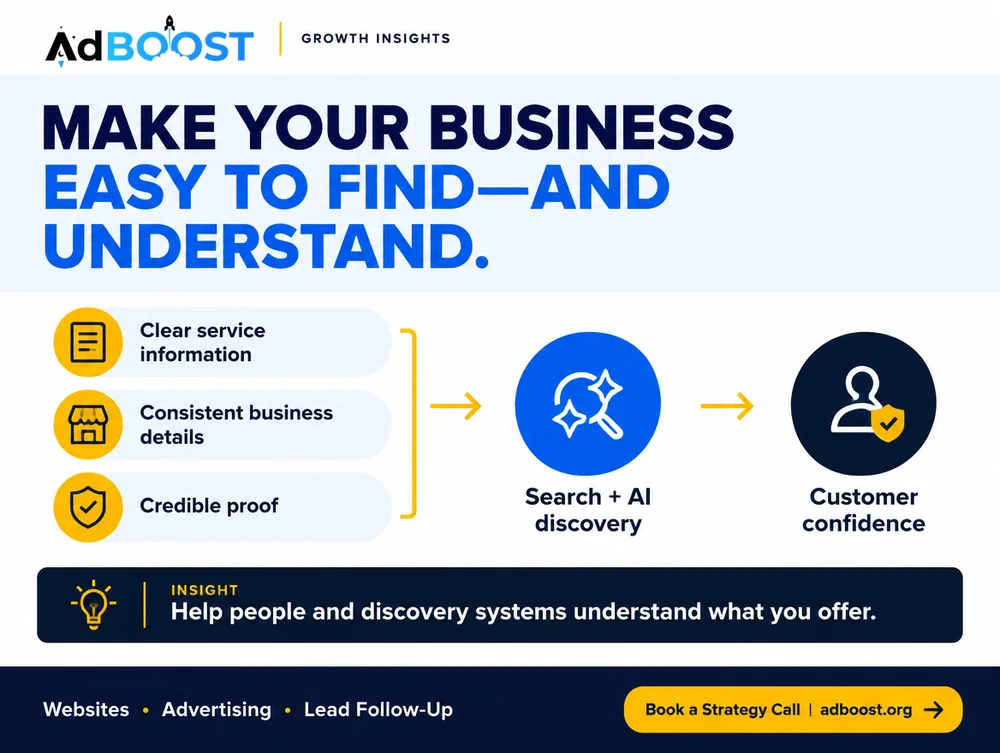
What this means for your business
When a homeowner asks an AI assistant for an emergency electrician or a roofer near them, your trade, service area and proof need to be easy to find and consistent everywhere.
Patients ask AI assistants who treats a specific condition nearby. Clear specialties, locations, insurance details and credentials make a practice easier to recommend accurately.
People ask AI tools which firm handles a specific kind of case in their city. Practice areas, jurisdictions and attorney credentials need to be stated plainly and match across profiles.
 AD BOOST INTELLIGENCE
The AI Discovery Trust Check
Give search systems clearer facts and customers better answers.
- Are business facts consistent?
- Do service pages answer real questions?
- Can customers verify your claims?
Improve what can be verified. Never promise inclusion in AI answers.
An original Ad Boost framework that examines the chain between accurate business facts, helpful service information, credible supporting signals, potential AI-assisted discovery, and customer verification. It identifies information gaps a business can fix without promising control over AI-generated answers.
What is AI search optimization for a local business?
AI search optimization is the practice of making your business's public information accurate, accessible, understandable, and useful in environments where AI systems help people research options. It overlaps with conventional search engine optimization, local SEO, website information architecture, and reputation management. It is not a replacement for those disciplines and does not require a mysterious separate set of ranking tricks.
Consider a homeowner researching an air conditioning replacement. Instead of searching only for a company name, the homeowner may ask an AI-powered search service what to compare before hiring an HVAC contractor in their area. The service might provide general advice, link to relevant pages, or identify businesses when that particular product, prompt, and available evidence support doing so. Another system may respond differently to the same question.
The business cannot control which companies an assistant decides to mention. It can control whether its own site clearly explains the services it performs, whether its service areas and contact details are accurate, whether important information is publicly accessible, and whether its claims are supported by verifiable information.
Three outcomes must be distinguished. Discovery means a customer encounters your business or content. Citation means an AI interface provides a link or reference to a page. Recommendation means the system presents a business as a possible choice. These outcomes are not interchangeable, and a citation does not necessarily generate a customer inquiry.
AI answer engines do not all use identical retrieval, browsing, business-information, or ranking systems. Some experiences rely more heavily on web search, while others may also use different sources or product-specific processes. Visibility therefore needs to be evaluated by platform, question, geography, and time. One favorable answer is not proof of broad coverage.
Google's published guidance says that existing search fundamentals remain relevant to AI Overviews and AI Mode and that there is no special markup required solely for those features. Google also states that eligibility does not guarantee a page will be indexed, displayed, or cited. Source: Google Search Central, AI Features and Your Website, https://developers.google.com/search/docs/appearance/ai-features.
Why an AI assistant may overlook or misdescribe your business
Start by checking whether your business provides enough reliable information to answer the question being asked. Do not assume that the solution is adding more mentions of AI to your website. An assistant cannot be expected to describe your emergency plumbing service accurately if the website barely explains emergency availability, geographic coverage, or how customers should request help. Just as importantly, even excellent information does not guarantee inclusion in an answer.
- Does your website clearly state your real business name, services, contact information, and actual service locations?
- Can a customer reach an informative page for each major service without navigating through vague marketing language?
- Do your service pages answer practical questions about suitability, process, service area, scheduling, and next steps?
- Are important factual claims about credentials, professional services, locations, and availability current and verifiable?
- Are your Google Business Profile and other relevant public business profiles accurate, where those services apply?
- Can major search crawlers access the important pages without login walls, accidental noindex rules, or blocking configuration?
- When you test relevant questions across AI systems, do you record the full prompt, location context, date, sources, and answer rather than relying on memory?
What to improve based on the discovery problem
| Situation | Recommended action | Why | Exception |
|---|---|---|---|
| AI answers contain incorrect information about your services or location. | Correct the underlying website and relevant business-profile information; document where the conflict appears. | Clear, consistent source information makes errors easier to investigate and may support more accurate descriptions. | Corrections may not propagate quickly or appear consistently across all systems. |
| Your website has one generic page covering many distinct services. | Create useful service-specific sections or pages with original answers and clear qualification details. | Specific content helps customers understand whether your business fits their needs. | Avoid creating near-duplicate pages for every minor keyword or neighborhood variation. |
| Your business appears in conventional search but not in a particular AI answer. | Check question relevance, query wording, geography, accessibility, and publicly available supporting information. | AI answer selection may differ from conventional rankings and may vary between sessions. | Omission from one answer is not sufficient evidence that the site needs rebuilding. |
| AI responses repeat an unsupported business claim. | Correct or qualify the claim on owned properties and investigate the public source where possible. | Accuracy and customer trust matter more than securing a favorable but false description. | You may not be able to remove a claim immediately from third-party systems. |
| You have many generic blog posts but few inquiries. | Prioritize useful service content, clear conversion pathways, and actual customer questions. | Visibility that does not help customers evaluate or contact you has limited commercial value. | Informational content can still be useful when it supports a longer research journey. |
| An agency promises guaranteed AI recommendations. | Ask for a documented methodology, controllable deliverables, measurement definitions, and limitations. | No outside marketer controls all answer-generation and recommendation decisions. | The agency may legitimately guarantee work products such as site improvements, not independent platform outcomes. |
Worked example
Imagine a fictional plumbing company called Clearbrook Plumbing serving a defined group of nearby towns. Its website has a home page, a contact page, and a broad services page. The home page claims the company handles every plumbing problem, but the site does not explain water heater replacement, emergency availability, or which towns receive service. A relevant business profile lists a different service area. None of these issues proves that an AI assistant will omit the company, but they create avoidable uncertainty.
The owner builds a verified service inventory and identifies the company's actual water heater services, service boundaries, intake process, and operating hours. The website is updated with a specific water heater service page explaining repair versus replacement considerations, what information customers should have ready, and how scheduling works. Public business information is reconciled to actual operations.
The owner then runs a controlled visibility review using ten hypothetical customer questions relevant to water heaters and plumbing services. Each question is recorded exactly, with the selected AI system, geographic context, date, and whether the company was mentioned, linked, or described accurately. Suppose two answers mention the company and one contains an inaccurate service-area statement. Those observations would be a snapshot of the selected tests, not an estimate of all consumer searches.
After correcting the service-area information, the owner repeats the same questions under comparable conditions. Any difference is documented without automatically attributing it to the edits, because answer systems can change independently. The most defensible business outcome is that the company's service information is clearer and its discovery issues are easier to monitor. Actual customer inquiries must be measured separately.
Observed mention coverage in a defined test = prompts mentioning the business / prompts tested x 100. Observed description accuracy = mentions with verified accurate business facts / mentions reviewed x 100.
The business, prompts, observations, and any quantities in this example are entirely hypothetical and do not represent client performance, search market share, or guaranteed AI visibility.
How to improve your business's AI search discoverability
Create a verified business-facts record
Document the exact business name, website, contact details, physical locations where applicable, actual service areas, business hours, service categories, and relevant professional information. Assign someone to approve changes. Do not invent physical offices or service coverage to target more cities. This record becomes the internal source of truth for website and profile updates.
Build pages around real customer decisions
Choose major services based on what the business actually provides and the questions customers ask before hiring. For a roofing company, a storm-damage inspection page should explain eligibility, process, timing considerations, and what customers can expect rather than merely repeating roofing keywords. For dental or legal services, have qualified professionals review specialized or regulated claims.
Improve crawlability and information structure
Confirm that public content is accessible through ordinary HTML navigation, that major pages have descriptive titles and headings, and that important information is not hidden behind required logins or inaccessible scripts. Review indexing controls, canonical URLs, internal links, and structured data that accurately describes the business. Structured data clarifies eligible information; it does not purchase or guarantee an AI citation.
Align relevant public business information
Review your Google Business Profile and other relevant business profiles, directories, and professional listings you legitimately maintain. Correct inconsistent contact details, outdated service categories, or obsolete locations. Prioritize platforms customers actually use; mass-producing low-quality directory listings is not a substitute for accurate information.
Publish verifiable evidence of expertise
Add useful explanations of the service process, genuine project or work examples when authorized, transparent qualifications, real photos where appropriate, and accurately represented customer feedback. Avoid fake testimonials, unsupported awards, unverified years of experience, and claims the business cannot prove. For regulated services, obtain the necessary professional review.
Establish a repeatable AI answer review
Create a small question set reflecting informational, comparison, and local hiring intent. Record the exact question, date, tool, location setting, output, link or citation where available, and factual accuracy. Track mention, citation, and recommendation as separate observations. Do not claim that repeated manual prompts measure all user exposure or true platform market share.
Connect discovery work to business outcomes
Track relevant organic visits, referral visits when identifiable, inquiries, qualified leads, and booked appointments using appropriate analytics and CRM records. Ask customers how they found you when useful, but treat self-reported discovery as one source of evidence rather than perfect attribution. Continue improving customer usefulness even when an AI interface provides limited referral data.
What to measure without pretending you control AI answers
AI visibility reporting is especially vulnerable to overclaiming. A prompt test measures what a specific system said under specific conditions. It does not establish your share of all AI searches. Use a transparent question set, stable definitions, and repeated observations, then evaluate whether the website earns genuine qualified interest.
- Verified business-fact consistency
- Count reviewed priority properties with correct information divided by all priority properties reviewed, multiplied by 100. Maintain a source-of-truth inventory and an audit date.
- Priority service-page completeness
- For each real major service, review whether the page explains who it serves, what it includes, relevant limitations, actual locations, and contact options. Report completed criteria rather than an invented industry quality score.
- Observed AI-answer mention coverage
- Number of defined test prompts in which the business is explicitly mentioned divided by prompts tested, multiplied by 100. Report platform, prompt set, geographic context, date, and sample size. Do not label this overall AI market share.
- AI-answer factual accuracy
- Review observed descriptions against the verified business-facts record. Classify each as accurate, inaccurate, incomplete, or unverifiable. Store the answer text and date for follow-up.
- Visible source and citation coverage
- Record when the selected interface provides a link to an owned page and which page appears. Keep mentions without citations separate from explicit links and distinguish citations from endorsements.
- Qualified inquiry outcomes
- Track valid inquiries, qualified opportunities, appointments, and customers in the CRM. Associate attributable sessions or referrals where reasonably observable. Avoid assuming that every organic conversion was caused by AI search.
Common mistakes and when this advice is wrong
- Treating AI visibility as a guaranteed ranking. AI systems can produce different answers to similar questions and may not recommend specific companies at all. Improve public information and evaluate observed results without promising placement.
- Manufacturing authority signals. Fake reviews, fabricated credentials, fictional locations, and invented case studies create customer-trust and compliance risks. Credibility should come from evidence the business can actually support.
- Writing hundreds of superficial local pages. Changing a city name in near-identical copy does not create useful local expertise. Publish pages only where there is a genuine, distinguishable customer need and accurate service information.
- Confusing an AI mention with a new customer. A favorable mention is an observation, not a booked appointment. Connect visibility efforts to useful visits, lead quality, and customer outcomes where measurement is possible.
- Ignoring ordinary search and operational quality. If the website is inaccessible, the business information is wrong, or calls go unanswered, AI-specific reporting is not the first priority. Repair foundational problems before investing heavily in advanced monitoring.
Frequently asked questions
Can I pay to guarantee that ChatGPT or Google AI recommends my business?
No agency can legitimately guarantee independent organic recommendations across AI answer systems. Some platforms may offer advertising products, but paid placements are different from organic mentions or citations and are governed by their own rules. A credible service provider should specify what work it controls, such as page improvements and information audits, and clearly distinguish those deliverables from decisions made by an outside platform.
Is AI search optimization different from local SEO?
They overlap substantially. Local SEO focuses on helping a business appear and be evaluated in relevant local search experiences. AI search optimization adds attention to how AI-assisted systems may retrieve, summarize, or reference business information. Both benefit from accurate business facts, accessible pages, useful content, and credible supporting information. Neither can guarantee that a particular customer will see or select your business.
Do I need special schema to appear in AI Overviews?
Google says no special schema or AI-only file is required for its AI search features. Appropriate structured data can help describe eligible content, but it must match what visitors can actually see. Start with crawlability, accurate business information, useful service pages, clear internal links, and standard search eligibility. Validate structured data for correctness rather than treating it as an AI placement shortcut.
How can I tell whether an AI assistant is giving customers incorrect information about my business?
Create a repeatable set of relevant questions and review the answers against an approved record of your services, locations, and contact details. Save the platform, wording, date, and output. If you find an error, identify whether the underlying problem appears on your website or public profiles, correct what you control, and use any available feedback mechanism. Recheck later without assuming the change will appear immediately.
Will publishing more blog posts automatically improve AI search visibility?
No. Additional pages help only when they contribute genuine, useful information and can be discovered by relevant systems. A detailed page answering an actual customer question may be more valuable than many repetitive articles. Prioritize content that clarifies services, decisions, limitations, and next steps. Evaluate engagement and qualified inquiries as well as any observed AI-answer mentions.
Review Your AI Search Visibility
Find out whether your business information, service pages, and public profiles give customers and AI-assisted search systems a clear, accurate picture.
Review Your AI Search Visibility