Is Your Business Ready to Be Discovered Through AI Search?
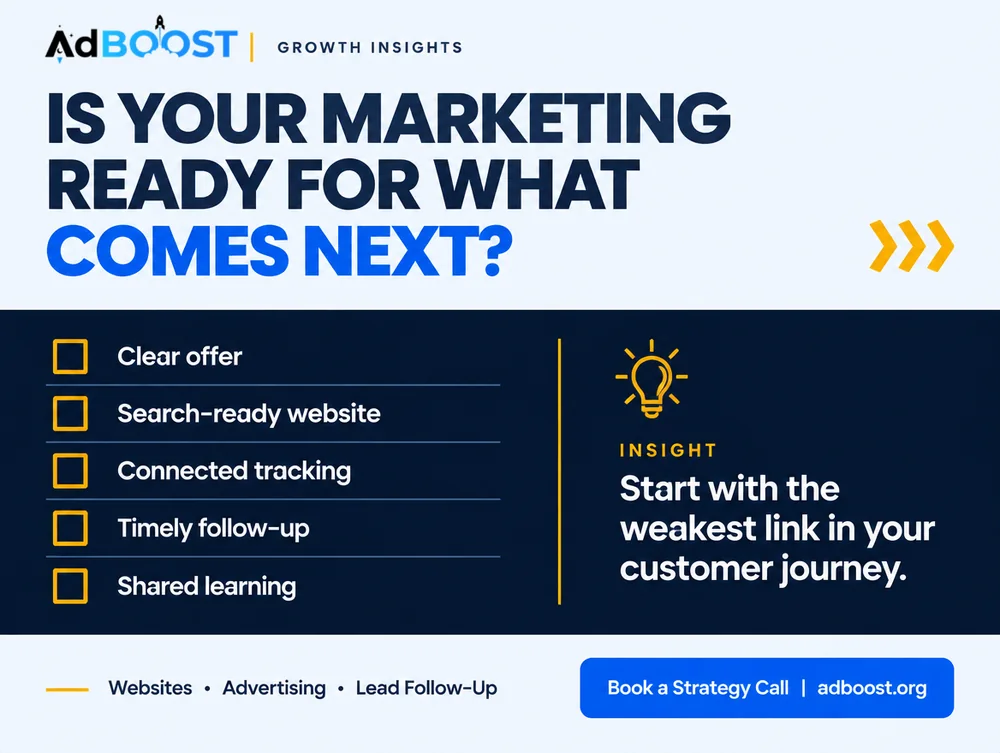
What this means for your business
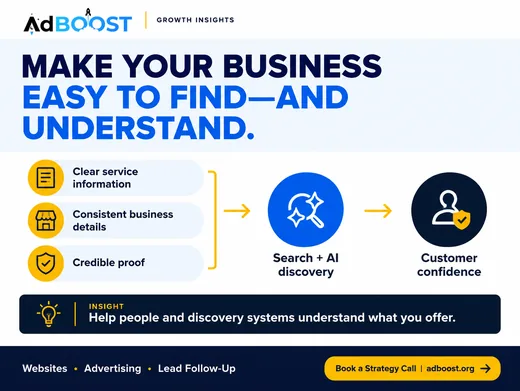
Make sure each trade you offer has its own page, your service areas are named, licensing and insurance are shown, and your business details match across every listing.
Give each specialty and location its own clear page with provider credentials, insurance information and consistent practice details.
Give each practice area its own page, name the jurisdictions you serve, show attorney credentials and keep firm details identical across directories.
 AD BOOST INTELLIGENCE
The AI Search Readiness Ladder
Build a reliable foundation before chasing AI mentions.
- Are the facts correct?
- Can customers find answers?
- Can important pages be accessed?
- Is discovery being measured honestly?
Readiness improves the information foundation. It does not guarantee AI citations.
An original Ad Boost capability checklist organized into five connected areas: accurate identity, useful service content, technical accessibility, consistent supporting information, and ongoing visibility review. The ladder describes what to audit and improve; it does not assign invented scores or predict inclusion in AI answers.
What does AI search readiness actually mean?
AI search readiness is an operational assessment of whether your business has the information, technical accessibility, and review processes needed to participate meaningfully in AI-assisted search experiences. It is not an official certification, a platform ranking, or a predictive score. A ready business has reduced avoidable information and website problems; it has not purchased a guarantee of being mentioned.
An owner might ask whether their business is ready for AI search after hearing that customers use ChatGPT, Google AI Overviews, or other assistants to research services. That is a reasonable question. But the immediate answer should not be to rewrite every page around phrases such as best contractor according to AI. The better starting point is to ask whether the website clearly explains the business and whether a potential customer can verify that explanation.
Consider a fictional med spa with a polished website. Its visual design looks expensive, but treatment pages provide little detail, location information is inconsistent, and some important content is embedded in inaccessible visual components. A potential customer researching a treatment needs more than attractive branding. The business needs medically appropriate and accurately reviewed information explaining its real offerings, consultation process, relevant limitations, and where services are available.
Readiness has both technical and editorial dimensions. Technical readiness includes accessible pages, correct indexing settings, useful navigation, appropriate structured data, and reliable website performance. Editorial readiness includes accurate services, clear explanations, authentic identity, transparent qualifications, and customer-focused answers. Operational readiness means someone owns corrections and periodically evaluates whether published details remain true.
A readiness audit should also respect the limits of the technology. Search engines and AI assistants may use different mechanisms and sources. One assistant may display links, another may answer without naming a company, and a third may misunderstand a geographic question. The audit can identify controllable weaknesses but cannot determine a universal probability of recommendation.
Google's official guidance for AI Overviews and AI Mode reinforces the importance of existing search fundamentals, including crawlability, helpful content, internal linking, accurate structured data, and current business information. It does not establish a separate required AI optimization standard. Reference: Google Search Central, AI Features and Your Website, https://developers.google.com/search/docs/appearance/ai-features.
Your AI search readiness audit: seven questions to answer first
Begin with a written inventory instead of buying a visibility report built from unexplained scores. Review a representative set of important service pages and public profiles. Record each issue as verified, unresolved, or not applicable, then assign a person to fix it. The purpose is to create a reliable work queue, not an impressive-looking numerical grade.
- Is the business's legal or customer-facing identity clearly represented without contradictory names, locations, or contact information?
- Does each major service have a useful explanation of scope, suitability, actual availability, and the next step for a potential customer?
- Are important pages accessible through crawlable internal links, with appropriate canonical and indexing settings?
- Can a customer distinguish authentic reviews, credentials, service claims, and professional information from generic marketing language?
- Are relevant public profiles current and consistent with the business's verified operating information?
- Does your website work well enough on mobile for a customer to read service details, call, or request an appointment without avoidable friction?
- Have you established a repeatable way to review relevant AI-generated answers while keeping mentions, citations, referrals, and bookings separate?
Where to focus your effort based on what the audit finds
| Situation | Recommended action | Why | Exception |
|---|---|---|---|
| Your website and business profiles disagree about service areas. | Confirm actual coverage and correct the inconsistent records. | Conflicting business facts make customer evaluation and information verification harder. | Some platforms represent service areas differently; document legitimate differences rather than forcing misleading uniformity. |
| Important services are mentioned only in a vague home-page paragraph. | Build informative service content with scope, process, suitability, and contact details. | Customers researching a specific need benefit from specific answers. | Separate pages are unnecessary where there is no meaningful difference in customer intent. |
| A priority page is blocked, noindexed unintentionally, or unreachable through normal navigation. | Correct the technical restriction and verify that the page can be accessed as intended. | Content that cannot be accessed or indexed may be ineligible for particular search experiences. | Some pages should remain private or excluded for legal, security, or business reasons. |
| The site makes broad trust claims without verification. | Replace unsupported language with accurate, demonstrable information and legitimate examples. | Credibility should survive independent scrutiny. | Do not expose private client details or confidential information merely to add proof. |
| The business has many directory profiles but little original service information. | Prioritize owned-site usefulness and maintain only relevant, legitimate public profiles. | More listings are not automatically better than accurate and useful information. | A specialist professional directory may have independent customer value and deserve continued maintenance. |
| A monitoring tool reports a low AI visibility score. | Request its methodology, prompt set, geographic settings, and underlying observations before acting. | An unexplained composite score can hide sampling limitations. | A well-documented internal benchmark can be useful for comparing the same test over time. |
Worked example
Imagine a fictional dental group operating three legitimate offices. Its marketing team wants to improve readiness for patients researching emergency dental care through AI-assisted search. The initial review discovers that one office has an outdated phone number on an important public profile, another office's emergency service page does not clearly explain its intake process, and a third location has a useful service page that is unintentionally marked noindex.
The team creates a readiness worksheet with five sections matching the Ad Boost ladder. Accurate Identity contains the contact-record correction. Useful Service Pages contains the emergency-care explanation. Accessible Information contains the indexing problem. Consistent Public Facts contains the profile reconciliation. Visibility Monitoring contains the testing procedure that will be used after the corrections.
For an illustrative teaching exercise, the team lists twelve audit tasks across those categories. Eight are verified complete, three remain open, and one is not applicable. A completion rate calculated as eight divided by eleven, or approximately 72.7%, can help manage the project. It is not an AI readiness score issued by a platform, and it does not mean the company has a 72.7% chance of appearing in an AI answer.
The practice first corrects the public contact information, updates and professionally reviews the emergency-service explanation, and removes the unintended indexing restriction. The team then checks page accessibility and tests an internally defined set of customer questions. It records observed business mentions and factual errors but does not promise that the changes caused any particular answer to appear.
The resulting value is operational: the practice has more accurate public information, more useful service explanations, and a repeatable process for identifying future errors. If qualified patient inquiries improve, that outcome must be evaluated separately with appropriate source and appointment records.
Audit completion rate = verified completed applicable tasks / total applicable tasks x 100. Exclude genuinely nonapplicable tasks from the denominator. This is an internal project-completion measure, not a predicted search ranking or AI citation probability.
The dental group, audit tasks, counts, percentage, and outcomes are entirely illustrative and are not actual customer research or Ad Boost performance data.
A practical AI search readiness implementation plan
Establish an accurate identity record
Gather approved business names, addresses where applicable, service areas, contact details, current hours, and actual service offerings. Identify the person authorized to verify and change each fact. For a multi-location business, maintain separate location-specific records rather than combining multiple offices into one fictional geographic presence.
Prioritize pages by real service demand
List the major services customers inquire about and the questions that arise before contact. Review whether each topic is answered clearly on an appropriate public page. Prioritize pages for important actual services, not speculative keyword combinations. Have qualified professionals review content involving medical, legal, financial, or other regulated claims.
Run the technical accessibility audit
Check robots directives, intended indexing, canonical URLs, internal linking, mobile usability, HTTP status codes, and significant rendering problems. Ensure the substantive content is available as readable page text rather than requiring a visitor or crawler to interpret a decorative image. Review structured data for accuracy and eligibility, not as a shortcut to AI inclusion.
Repair inconsistent public information
Review the important platforms where customers find or verify the business, including applicable business profiles and professional listings. Correct outdated services, invalid contacts, misleading category selections, and obsolete locations. Keep an audit trail so changes can be verified later. Do not create unstaffed or nonexistent locations for geographic visibility.
Strengthen proof and editorial trust
Replace vague promotional claims with useful facts: what the business does, who it serves, what customers can expect, relevant limitations, and how the service is performed. Where legitimate and authorized, include real team information, credentials, completed work, and authentic reviews. Avoid turning client confidentiality or sensitive patient matters into marketing material.
Create a documented monitoring baseline
Select a practical set of customer questions spanning informational, comparison, and local hiring intent. Record the system used, exact prompt, test date, geographic context, outputs, links where available, and factual accuracy. Separate mentions, citations, recommendations, and referral traffic. Do not extrapolate from a small prompt set to platform-wide visibility.
Assign maintenance and outcome ownership
Schedule periodic reviews after significant business changes such as new services, office moves, staffing changes, or website redesigns. Maintain an issue log and connect future organic activity or identifiable referrals to actual qualified inquiries. Use the readiness audit to maintain good information hygiene, not to declare the project permanently complete.
How to track readiness improvements honestly
Treat readiness measurement as an internal quality-control exercise. A completed checklist measures work performed, while crawlability checks measure technical access and prompt reviews measure selected observations. None of these measures alone predicts whether an AI system will recommend your business. Compare like with like and document the conditions of each review.
- Applicable readiness tasks completed
- Verified completed applicable audit tasks divided by all applicable audit tasks, multiplied by 100. Maintain evidence, completion dates, and assigned owners. Do not call this a standardized platform readiness score.
- Priority URL accessibility
- Review important URLs for expected HTTP status, intended indexing, correct canonical settings, readable content, and internal discoverability. Report the number of verified pages and unresolved technical issues.
- Business-profile consistency
- Compare reviewed priority profiles against the approved identity record. Classify discrepancies by severity and document corrected and unresolved items. Focus on accuracy rather than sheer listing quantity.
- Service information coverage
- For each major real service, check whether relevant pages explain scope, customer suitability, service area, process, important limitations, and contact method. Track missing information by page and assigned editor.
- Observed AI-answer factual accuracy
- Review a documented question set against approved business facts. Record accurate, inaccurate, incomplete, and unverifiable statements alongside the platform and test conditions. Avoid interpreting this as universal answer accuracy.
- Qualified lead outcomes
- Track valid inquiries, qualified opportunities, and booked consultations or appointments through the business's own records. Link to identifiable channels when supported, without assigning unobservable conversions to AI search.
Common mistakes and when this advice is wrong
- Confusing readiness with guaranteed inclusion. A technically sound, accurate website is better prepared to participate in relevant search experiences, but an independent system still decides whether and how to display it. Avoid promises of a fixed ranking, recommendation, or citation.
- Fixating on an unexplained readiness score. A proprietary score can be useful only when its criteria and limitations are transparent. Prefer a documented list of specific, verifiable problems to a dramatic percentage without a defensible definition.
- Publishing more pages instead of fixing existing ones. If customers cannot understand your major service pages or contact information is wrong, additional articles may increase maintenance obligations without fixing the underlying problem. Improve essential content first.
- Overlooking regulatory and customer safety issues. A dental practice, law firm, or med spa should not simplify technically sensitive claims merely to produce concise AI-friendly answers. Accuracy, professional review, confidentiality, and applicable advertising requirements take priority.
- Treating monitoring results as causal proof. A business appearing in more observed prompts after an edit does not automatically prove the edit caused the change. Systems, sources, prompts, and available information can change independently. Report observations and limitations plainly.
Frequently asked questions
How do I know if my website is ready for AI search?
Audit five areas: accurate business identity, useful service information, technical accessibility, consistent public business facts, and a repeatable review process. Record specific problems rather than relying on a mystery score. Readiness means the business has addressed important controllable issues. It does not mean Google, ChatGPT, or another system has certified the website or guaranteed future mentions.
Does my website need a special AI search optimization plugin?
Not necessarily. Some software can help with content audits, technical checks, or monitoring, but a plugin does not guarantee AI citations. Start by examining ordinary website fundamentals: accessible content, useful headings, correct indexing, accurate business information, and relevant service explanations. Add tools only when they solve a specific problem you can identify and verify.
Should I create a separate web page for every city I serve?
Only when a page provides meaningful, truthful value for that location. A business should never invent offices or imply local facilities it does not operate. If service areas differ in availability, local rules, customer needs, or operational processes, accurate location-specific information may be useful. Near-identical pages that merely swap city names are unlikely to provide a strong experience for customers.
How often should I repeat an AI search readiness audit?
Use business changes and material site updates as primary triggers. New locations, changed hours, new services, redesigned pages, or significant indexing problems justify another review. A routine periodic check can also help maintain accuracy, but the cadence should reflect the size and complexity of the business. Preserve earlier audit results so you can distinguish newly introduced issues from long-standing problems.
What is the difference between an AI search readiness audit and AI visibility monitoring?
A readiness audit checks the quality and accessibility of information you control. Visibility monitoring observes what selected AI systems say when given particular questions under documented conditions. A business can have strong readiness and limited observed mentions, or receive mentions despite unresolved site issues. Both activities are useful, but neither should be confused with actual qualified inquiries or revenue.
Review Your AI Search Readiness
Use an Ad Boost consultation to identify which website, business-information, and discoverability issues deserve attention first.
Review Your AI Search Readiness