Where Do Your Best Customers Actually Find You?
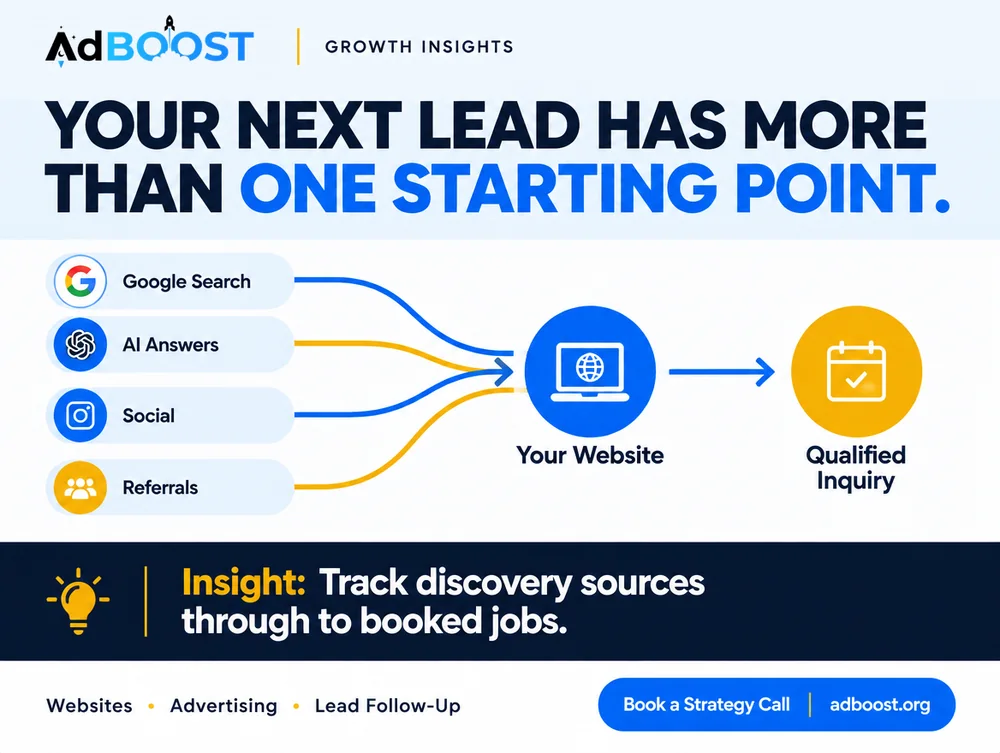
What this means for your business
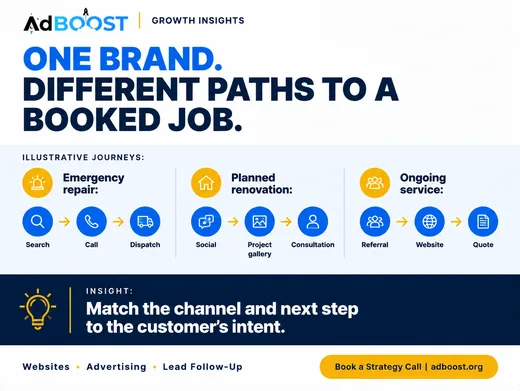
A pest control or garage door customer may first see a Maps listing, then a neighbor's recommendation, then call from an ad. Track the first touch, not just the last click.
A new patient may find you through a search, a referral from another provider, or a review site before booking. Ask at intake how they first heard of you.
Clients often hear a referral name first and search you second. Record how each inquiry first learned of the firm so you can tell referral work from advertising work.
 AD BOOST INTELLIGENCE
The Discovery-to-Lead Map
Different entry points. One accountable customer journey.
- Google Search
- Google Maps
- Customer Referral
- Paid Advertising
- AI-Assisted Research
- What introduced the business?
- What made the customer confident?
- Which action generated contact?
- Was the resulting opportunity qualified?
The last recorded click may not reveal the first meaningful discovery.
An original Ad Boost customer-acquisition framework that tracks distinct discovery sources into a shared evaluation, contact, and lead-record process. It separates how customers first encounter a business from how they ultimately contact it and whether those inquiries become qualified opportunities.
Your customer journey probably started before the lead arrived
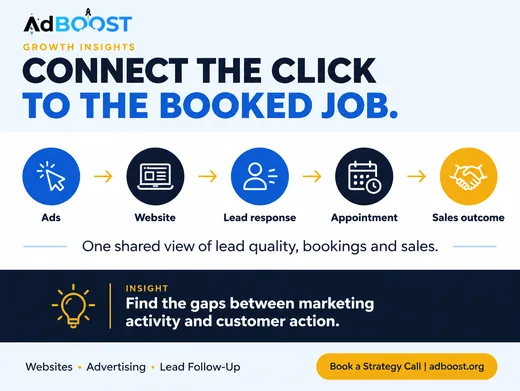
A homeowner calls your plumbing company and says they found you on Google. Your marketing report credits organic search. The homeowner later explains that a neighbor recommended your company last month, they saw one of your trucks in the neighborhood, and they searched your name only when a pipe started leaking. Which channel created the customer?
Google helped the customer locate your contact information. The recommendation introduced the business. Your visible presence reinforced recognition. The urgent plumbing problem triggered action. Assigning complete credit to any single touchpoint would oversimplify what happened.
Customer discovery is the process through which someone first becomes aware of a business or recognizes it as a possible solution. Customer acquisition includes the additional steps of evaluation, inquiry, qualification, and becoming a customer. Marketing attribution is the practice of assigning credit to observed interactions according to a defined measurement model. These concepts overlap, but they are not identical.
A first recorded website session is not necessarily a first discovery event. A direct visit may follow an offline conversation. A branded search may follow a social advertisement. Someone could review a business through an AI assistant and later visit the company's website directly. In some circumstances, there may be no reliable digital record of the original introduction.
For local businesses, the distinction has financial consequences. If a roofing contractor sees strong branded-search conversions, it might conclude that search alone drives demand. But some of those customers may have learned the company name through referrals, signs, previous advertising, or neighborhood visibility. Cutting those activities solely because the final inquiry came through branded search could remove contributions that are difficult to observe.
The right objective is not perfect attribution. That is rarely available across disconnected devices, offline conversations, private recommendations, and changing platform reporting systems. The objective is better decisions using multiple evidence sources: web analytics, advertising records, call tracking where appropriate, CRM outcomes, customer-reported discovery, and the actual economics of acquired customers.
Can you tell how customers discover you, or only how they contact you?
Start by reviewing the difference between what analytics records and what customers remember. A phone number on a website does not reveal why someone searched for the company. A referral entered in the CRM may not identify every advertisement the customer encountered beforehand. The investigation should identify observable evidence, missing information, and the decisions that those limitations permit.
- Can you distinguish branded searches from searches for services that do not include your business name?
- Do website forms and call records preserve available campaign or referral information without assuming it is the complete customer journey?
- Does your team ask a consistent, open-ended question about how customers first heard of the business?
- Can you connect inquiries to qualified appointments, estimates, purchases, or signed agreements?
- Do you review differences between new customers, returning customers, referrals, and existing customer service requests?
- Are Google Business Profile interactions, paid advertising contacts, direct visits, and organic search inquiries reported using clear definitions?
- When two attribution sources disagree, can your team explain what each actually measures instead of declaring one automatically correct?
How to interpret different customer discovery patterns
| Situation | Recommended action | Why | Exception |
|---|---|---|---|
| Customers search for your business name before calling. | Review branded-search activity alongside referrals, repeat customers, offline exposure, and advertising history. | A branded search may capture existing demand rather than explain what originally created awareness. | Some customers genuinely discover unfamiliar businesses through branded searches prompted by third-party content. |
| Google Ads generates clicks but few qualified inquiries. | Review search intent, landing-page fit, conversion tracking, and actual CRM outcomes. | Traffic alone does not establish that the right customers are arriving. | Longer purchase journeys may produce valuable research visits before later contact. |
| Referral customers frequently become valuable projects. | Document the referral journey and strengthen the customer experience that supports recommendations. | Customer introductions may contribute value that conventional click reports cannot capture. | Self-reported referrals can be incomplete or influenced by memory. |
| Google Maps interactions appear important. | Maintain accurate local business information and review available calls, directions, website visits, and appointment outcomes. | Maps can be a meaningful point of evaluation for location-sensitive services. | Not every Maps interaction represents a new customer or qualified lead. |
| AI-assisted research appears in customer conversations. | Document customer descriptions, test relevant questions, and improve accurate service information. | AI systems may influence consideration even when referral tracking is incomplete. | A customer's recollection does not establish which system caused the decision. |
| Several channels appear to influence the same customer. | Compare multiple attribution views and customer outcomes before reallocating budget. | Different measurement models emphasize different observed interactions. | Small samples and disconnected identifiers may prevent reliable channel-level conclusions. |
Worked example
Imagine a fictional residential plumbing company called Harborline Plumbing. It serves homeowners across a defined local territory and receives inquiries through Google Ads, organic search, Google Maps, and referrals. The owner wants to know which marketing channel deserves more investment.
During a hypothetical four-week review, the CRM contains 30 new, valid inquiries. Based on the final observable contact channel, twelve are attributed to paid search, eight to organic search, four to direct website visits, and six to referrals. The company also asks each customer how they first heard about the business, using a consistent open-ended question.
Among the twelve paid-search inquiries, suppose five customers say they already knew the company through an earlier recommendation or neighborhood exposure. Among the eight organic-search inquiries, three report hearing the company name before searching. These responses do not prove which earlier influence caused the inquiry, but they demonstrate that the final contact channel and reported discovery source can describe different parts of the journey.
Now suppose the company reviews booked appointments rather than stopping at inquiry counts. Seven of the twelve paid-search inquiries, six of the eight organic-search inquiries, three of the four direct inquiries, and five of the six referral inquiries resulted in appointments. The owner can calculate an observed booking rate for each group, but the groups are too small to treat slight differences as reliable evidence of future channel performance.
The company therefore avoids immediately cutting paid search or declaring referrals the only worthwhile channel. Instead, it reviews inquiry quality, available capacity, channel costs, branded versus nonbranded searches, and the timing of the customer journey. It also improves CRM fields so customer-reported discovery and recorded contact source remain separate.
The key lesson is not that one channel wins. It is that a business makes better investment decisions when it knows what each source record actually represents and follows customer outcomes beyond the initial click.
Observed appointment booking rate by contact channel = booked appointments from that channel's eligible inquiries / eligible inquiries assigned to that contact channel x 100. Record reported first-discovery source separately from final observed contact channel.
The plumbing company, inquiry counts, customer responses, appointment totals, and resulting comparisons are hypothetical teaching inputs rather than Ad Boost performance claims or industry findings.
How to build a customer discovery map that improves marketing decisions
List every meaningful discovery route
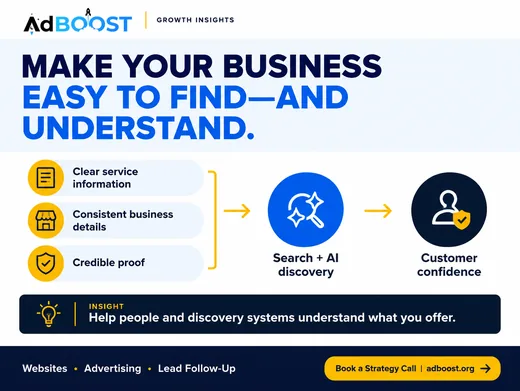
Inventory search engines, Google Maps, paid advertising, social platforms, referrals, previous customers, community exposure, signs, partnerships, and AI-assisted research where relevant. Separate channels that create awareness from contact methods such as calls and website forms. A single contact method may serve customers arriving through several discovery paths.
Standardize source definitions
Create separate fields for recorded contact channel, available campaign source, customer-reported first discovery, and customer-reported reason for choosing the business. Define how direct traffic, unknown sources, referrals, and repeat customers are classified. Do not overwrite uncertainty with a guessed source simply to complete a dashboard.
Connect website and advertising evidence
Use appropriate analytics, conversion events, campaign tagging, call tracking, and CRM integrations to preserve available source information. Test forms, landing pages, and phone routing. Where consent or privacy requirements limit tracking, respect those boundaries and document the resulting measurement gaps.
Ask customers how discovery happened
Train staff to use a neutral question such as: How did you first hear about us? Allow customers to describe multiple influences without forcing an answer into a single marketing channel. A second question, such as: What helped you decide to contact us today? can reveal evaluation factors. Store responses as customer-reported information rather than verified attribution.
Follow inquiries through actual outcomes
Connect valid inquiries to qualification, appointments, estimates, sales, and customer value where the records support it. For a real estate business, distinguish browsing interest from genuine listing or buying consultations. For a plumbing company, distinguish existing-customer service calls from new-customer opportunities. Compare channels using consistent eligible populations.
Build a decision-focused channel review
For each channel, examine available spend, inquiries, qualification, appointments, and customer outcomes alongside uncertainty about earlier influences. Do not treat a low-cost contact channel as automatically more profitable. Consider service type, seasonal demand, capacity, and the time between discovery and purchase.
Test changes without erasing important demand sources
When adjusting advertising, referral activity, or content investment, document the hypothesis and compare appropriate periods. Avoid sweeping conclusions from short tests in businesses with infrequent or high-value sales. Review whether changes affect qualified customer outcomes, not merely website visits. Preserve enough operational context to explain unusual periods.
Which customer discovery metrics are actually useful?
The goal is to connect discovery evidence with real business outcomes while making uncertainty visible. A channel report should distinguish what the tracking system observed, what the customer reported, and what the business ultimately earned. None of those sources is perfectly complete, and each serves a different purpose.
- Valid inquiries by recorded contact channel
- Count genuine new-business inquiries by the final observable contact source using website analytics, call records, form submissions, and CRM fields. Exclude duplicates and classify unknown sources honestly.
- Customer-reported first discovery
- Record open-ended customer responses describing where they initially heard of the business. Allow multiple influences and unknown answers. Report the share of customers who provided an answer alongside any distribution.
- Qualified inquiry rate
- Qualified inquiries from an eligible channel group divided by valid inquiries in that group, multiplied by 100. Use a documented qualification definition and CRM records.
- Appointment or consultation rate
- Eligible inquiries resulting in booked appointments or consultations divided by eligible inquiries, multiplied by 100. Record cancellations and reschedules consistently.
- Cost per qualified inquiry
- Attributable channel spend divided by qualified inquiries associated with that channel during a comparable period. Explain what expenses and attribution assumptions the calculation includes.
- Customer acquisition cost
- Defined acquisition costs divided by acquired customers from a comparable, sufficiently matured cohort. Include the costs specified in your reporting policy and do not pretend attribution uncertainty disappears at the sale.
Common mistakes and when this advice is wrong
- Assuming the last click created all the demand. Last-click attribution describes one observable interaction under a particular model. It may omit referrals, offline exposure, previous research, and other influences. Use it as evidence, not a complete history.
- Treating customer recollection as perfect attribution. Customers may forget advertisements, combine sources, or describe only their most memorable interaction. Self-reported discovery is useful but should remain distinct from tracked events.
- Comparing channels using raw lead volume. A source producing many irrelevant inquiries may be less useful than one generating fewer qualified opportunities. Follow inquiries to appointments and customers before drawing conclusions.
- Making budget decisions from tiny samples. Small differences between groups may reflect randomness, customer mix, seasonality, or incomplete records. Do not present a handful of inquiries as conclusive proof that one channel is superior.
- Trying to track everything regardless of privacy. Customer discovery analysis must respect consent, platform requirements, confidentiality, and applicable privacy rules. Imperfect but lawful measurement is preferable to intrusive collection or unsupported identity matching.
Frequently asked questions
What is the most common way customers find local businesses?
There is no single discovery channel that dominates every service, market, and customer situation. Someone needing emergency plumbing may begin with search or a recommendation, while a homeowner planning a major renovation may research options over a longer period. Review your actual inquiries, customer-reported discovery, and qualified outcomes. Do not substitute an unrelated industry average for evidence about your business.
Is Google Maps more important than my website?
Both can serve different functions in a local customer journey. Maps may help customers identify and evaluate nearby businesses, while your website can explain service scope, qualifications, process, and next steps in greater detail. The balance depends on the business and customer need. Maintain accurate local information and useful service pages rather than treating the two channels as competitors for attention.
How do I find out where a customer first heard about my business?
Use available tracking evidence and ask customers a consistent, neutral question. Keep first-discovery responses separate from final contact channels. For example, a customer may say a neighbor recommended your company but that they later used Google to find your number. Both details are useful. Preserve uncertainty when the customer does not remember or several interactions influenced the decision.
Why does my CRM show different lead sources than Google Analytics?
The tools may use different attribution rules, identifiers, event definitions, and reporting periods. A CRM may record a form submission or sales opportunity while analytics records a website session. Offline calls and privacy restrictions can further complicate matching. Review how each system defines its metrics, trace representative events, and document limitations before deciding whether a technical correction is needed.
Should I stop advertising if most customers say they come from referrals?
Not automatically. Advertising may create awareness that customers do not remember, and referrals may be particularly strong for established businesses. First examine customer outcomes, acquisition costs, available capacity, and the role advertising plays in generating new demand. If you test lower spending, document the change and monitor appropriate results rather than treating referral responses as conclusive attribution.
Review Your Customer Journey
Understand how customers discover your business, what builds their confidence, and where promising inquiries may be getting lost.
Review Your Customer Journey