Is Your Brand Helping You Win Leads—or Lose Them?
What this means for your business
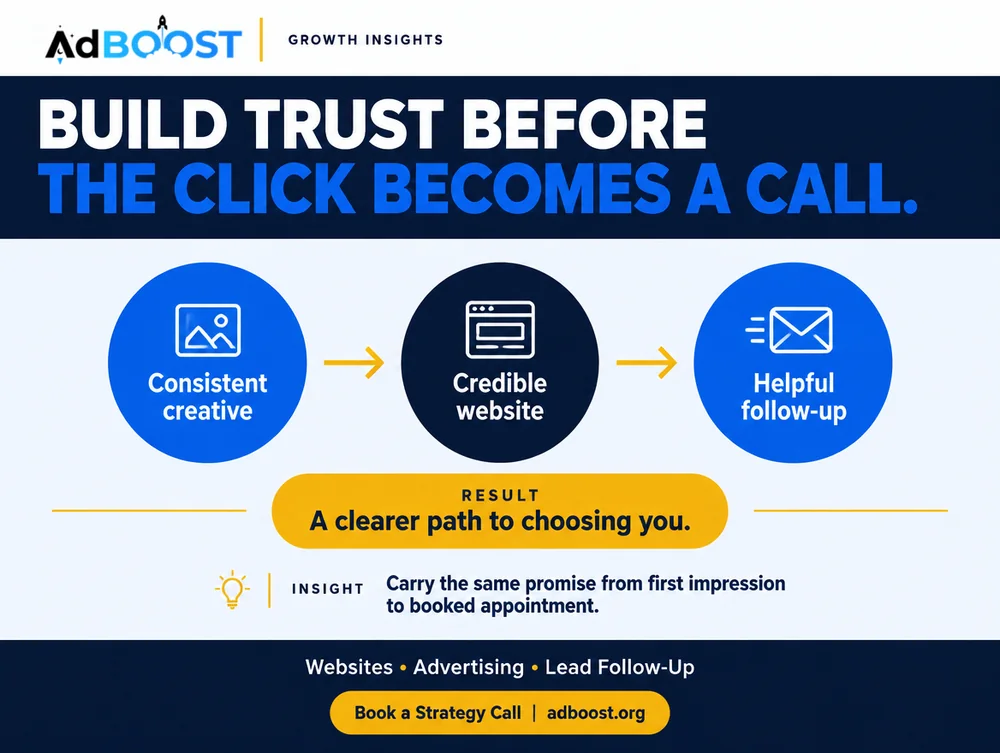
A recognizable truck, consistent estimates and a website that matches your ads make a homeowner more comfortable calling you instead of the next name on the list.
Consistent messaging, a clear description of care and transparent next steps help patients feel confident enough to book.
A consistent firm identity, clear explanation of what happens after the first call and credible attorney information help prospective clients decide to reach out.
 AD BOOST INTELLIGENCE
The Trust-to-Lead Bridge
Four trust supports between attention and action.
- Message Consistency
- Service Clarity
- Credible Proof
- Response Experience
Weak points
- Mismatched Promise
- Missing Service Details
- Unsupported Claim
- Booking Friction
Make every customer promise clear, credible, and consistent with delivery.
An original Ad Boost diagnostic model that identifies four supports connecting initial customer interest to confident contact: message consistency, service clarity, credible proof, and response experience. The framework also identifies weak points that can interrupt the journey, allowing businesses to improve trust without inventing brand-performance statistics.
A strong brand makes the next customer decision easier
Imagine two med spas advertising the same type of consultation in the same market. One advertisement leads to a polished page with clear treatment information, realistic expectations, identifiable professionals, an understandable consultation process, and contact details consistent with its public profiles. The other leads to a page filled with dramatic promises, generic imagery, vague qualifications, and a booking form that gives little indication of what happens afterward.
The second business might still attract inquiries. The first provides more information a cautious customer can use to evaluate whether it is a suitable choice. The difference is not simply graphic design. It is the amount of uncertainty each business removes during the decision.
Brand strength describes the associations, expectations, familiarity, and trust customers develop around a business. In a local service context, it can be influenced by customer experience, reputation, consistent communication, recognizable identity, and the degree to which public promises match actual delivery.
Lead quality describes how closely an inquiry matches the business's intended customers, service capabilities, and qualification criteria. Conversion describes progression from one defined stage to another, such as visitor to inquiry, inquiry to consultation, or consultation to customer. These outcomes are influenced by multiple factors, including demand, pricing, competition, availability, message relevance, and the sales process.
Brand credibility can contribute to conversion by making a decision feel better informed. A homeowner may be more willing to request an estimate when the contractor clearly explains the process and has credible evidence of relevant work. A prospective dental patient may need accurate professional information and reasonable expectations before scheduling a consultation. A business owner choosing a bookkeeping provider may value transparent scope and dependable communication.
This does not mean every professional-looking brand converts better or that expensive branding automatically improves advertising returns. A beautiful website with poor service availability may underperform a simpler site that answers customer questions clearly. Strong branding supports a credible offer; it does not manufacture one.
The useful question is therefore not whether the business looks established. It is whether the customer receives a consistent, believable explanation of why the company is relevant, what will happen next, and what evidence supports its claims. Those are the connections the Trust-to-Lead Bridge examines.
How to tell whether your marketing is creating confidence or hesitation
A brand audit should begin with the actual customer experience, not an internal debate about logo colors. Open one of your advertisements, follow it to the landing page, inspect the public information a customer might check, and attempt the next step. Look for broken promises, missing explanations, and moments when customers must guess what your company does. Then compare those observations with real inquiries and customer feedback.
- Does your advertising describe the same service, offer, geographic coverage, and next step that appear on the landing page?
- Can a first-time visitor quickly understand what your business does, who it serves, and what makes the service relevant?
- Are testimonials, professional credentials, project examples, and other trust claims genuine, current, and verifiable?
- Does your website explain what happens after someone calls, requests an estimate, or books a consultation?
- Do your website, business profiles, advertisements, and customer communications present consistent factual information?
- Are customers encountering unexpected fees, unclear availability, confusing forms, or unanswered questions before scheduling?
- Can your reporting distinguish an inquiry-volume problem from an inquiry-quality, appointment, or service-experience problem?
Which brand problem should you fix first?
| Situation | Recommended action | Why | Exception |
|---|---|---|---|
| Advertisements promise a specific offer, but the landing page barely mentions it. | Align the advertisement, landing-page headline, eligibility details, and next action. | Customers need confirmation that the page matches the reason they clicked. | A broader landing page may be appropriate when the advertisement accurately describes multiple services. |
| The website looks professional but does not explain service details. | Add clear scope, process, qualification criteria, limitations, and customer expectations. | Design cannot replace the information needed to make an informed decision. | Some technical details should be discussed during a professional consultation rather than oversimplified online. |
| Reviews are positive, but advertising relies on exaggerated guarantees. | Remove unsupported promises and use accurate descriptions supported by genuine evidence. | Misleading claims can undermine trust and create compliance exposure. | A legitimate guarantee may be described when its terms are accurate, clearly disclosed, and legally appropriate. |
| Customers inquire but repeatedly seem surprised by the service or price. | Review targeting, qualification language, offer clarity, and what the booking process communicates. | The issue may be expectation mismatch rather than insufficient lead volume. | Some services require individualized pricing that cannot responsibly be quoted before evaluation. |
| A business is not widely recognized in its market. | Build consistent identification, useful service messaging, authentic proof, and reliable customer experiences. | Recognition develops through repeated credible encounters, not solely visual redesign. | A highly specialized provider may succeed without broad public awareness if it reliably reaches the right buyers. |
| Advertising generates interest, but customers struggle to contact the company. | Repair form usability, call handling, scheduling clarity, and follow-up ownership. | A trustworthy message loses value when the actual process creates frustration. | Some prospects will choose not to proceed for reasons unrelated to the contact experience. |
Worked example
Imagine a fictional med spa called Willow Aesthetics. It offers professional consultations for selected aesthetic treatments. Its advertising emphasizes personalized consultations, but its landing page uses generic promotional imagery, broad claims about results, and a booking button that leads to an unexplained intake form. The clinic wants more consultation requests and assumes it needs more advertising traffic.
The owner applies the Trust-to-Lead Bridge. Message Consistency reveals that the advertisement promises a personalized discussion while the landing page emphasizes discounts. Service Clarity reveals that visitors cannot easily determine which treatments require professional assessment. Credible Proof reveals that staff qualifications are difficult to locate. Response Experience reveals that the booking confirmation does not explain when a team member will respond.
For a hypothetical comparison, suppose the original page receives 200 eligible visits and 12 consultation requests. Its observed visitor-to-inquiry rate is 6%. The business revises the page to clarify the consultation process, present verified professional information, explain appropriate limitations, and align the booking language with the advertisement.
In a later hypothetical period with 200 eligible visits, suppose the revised page receives 18 consultation requests. The observed rate is 9%. That is a difference of three percentage points, but it does not automatically prove the page changes caused the improvement. Audience composition, traffic source, seasonality, appointment availability, and ordinary variation may also affect outcomes.
The business therefore compares traffic quality, completed consultations, and customer questions as well as form submissions. If inquiries become more numerous but less suitable, the revision may not be an improvement. If customers understand the process better and more appropriate consultations are booked, those observations provide stronger practical evidence.
The example also illustrates an important boundary: a med spa should not publish unsupported treatment outcomes or use fabricated credentials to strengthen its brand. Accurate professional review and appropriate advertising safeguards are part of credibility, not obstacles to it.
Visitor-to-inquiry rate = valid inquiries / eligible landing-page visits x 100. Qualified consultation rate = qualified consultations booked / valid consultation inquiries x 100. Compare periods using consistent definitions and account for differences in traffic and availability.
The business, page conditions, visit totals, inquiry counts, percentages, and outcomes are entirely hypothetical and do not represent actual Ad Boost client performance or a claim that branding produces a particular conversion lift.
How to make your brand strengthen the customer journey
Define the promise your business can actually deliver
Write a short statement identifying the customer you serve, the problem you help solve, your real differentiating characteristics, and what customers should expect. Replace vague claims such as unmatched excellence with details that can be explained or demonstrated. For a commercial contractor, that might involve clearly describing project types and the estimating process. For a med spa, it might involve the consultation approach and verified professional qualifications.
Audit message consistency from advertisement to contact
Select active advertisements and trace each to its landing page and booking process. Compare service names, offers, qualifications, locations, availability, and calls to action. Correct differences that could mislead or confuse customers. Do not force identical wording everywhere; preserve the same factual promise while adapting language to the context.
Replace vague credibility claims with verified evidence
Review public statements about expertise, training, licensing, years of experience, completed work, customer feedback, and service outcomes. Remove or qualify anything that cannot be substantiated. Add genuine proof where appropriate and authorized, using real professional biographies, relevant work examples, or authentic feedback. Protect customer confidentiality and comply with applicable professional advertising requirements.
Explain the service before demanding the inquiry
Make sure important pages answer what the service includes, who it is appropriate for, what the process looks like, where it is available, and what happens after contact. Address common customer concerns without overwhelming readers. Where individual professional evaluation is necessary, explain that boundary clearly rather than offering misleading certainty.
Improve contact and booking confidence
Test calls, forms, appointment requests, confirmation messages, and response ownership. Explain what information customers need to provide and what will happen afterward. Reduce unnecessary form fields and ensure mobile visitors can complete the process. Avoid implying that an appointment is confirmed when the system has only received a request.
Review the quality of inquiries, not just the quantity
Compare valid inquiries with qualified consultations, appointments, completed estimates, and actual customers. Ask staff what expectations prospects bring into the conversation. Record common misunderstandings about pricing, suitability, timing, or service scope. Use those patterns to improve messaging before assuming that more advertising spend is the answer.
Test improvements while preserving the brand promise
Choose a specific hypothesis, such as clarifying consultation requirements or making professional qualifications easier to verify. Record the baseline and relevant customer outcomes, then evaluate a controlled change when practical. Consider traffic composition and operational differences before interpreting results. Keep improvements that demonstrably help customers understand and act; reconsider changes that increase confusion or unsuitable inquiries.
How to measure brand influence without inventing a brand score
Brand influence is not fully captured by a single marketing metric. Branded search, direct inquiries, customer feedback, conversion behavior, and qualification outcomes can provide useful signals, but each has limitations. Avoid creating an arbitrary brand strength percentage and presenting it as objective research. Measure observable behavior, record customer expectations, and evaluate whether changes improve the quality of the customer journey.
- Branded search activity
- Review available search queries containing the verified business name or recognized brand variations using appropriate search reporting. Track trends with context. Branded searches may reflect existing awareness, repeat customers, advertising, or other influences.
- Landing-page inquiry rate
- Valid inquiries divided by eligible landing-page visits, multiplied by 100. Use consistent analytics and lead definitions. Segment by campaign and service where the records support it.
- Qualified inquiry rate
- Qualified inquiries divided by valid inquiries, multiplied by 100. Use documented qualification criteria and CRM records. A higher raw inquiry rate is not automatically better.
- Consultation or appointment completion
- Completed eligible consultations or appointments divided by booked eligible consultations or appointments, multiplied by 100. Track cancellations and reschedules consistently. Review whether expectations influence attendance.
- Customer expectation mismatch
- Record recurring questions or complaints involving pricing, availability, service scope, offers, and advertised promises. Categorize verified incidents and investigate their sources rather than inventing a standardized trust index.
- Inquiry-to-customer conversion
- New customers acquired from a sufficiently matured valid-inquiry cohort divided by valid inquiries in that cohort, multiplied by 100. Interpret alongside service mix, sales process, pricing, and operational capacity.
Common mistakes and when this advice is wrong
- Confusing expensive design with a trustworthy brand. Beautiful typography and imagery can improve presentation, but they do not prove service quality, accurate claims, or dependable operations. Make the visual identity support useful information rather than substitute for it.
- Using fabricated proof to create confidence. Fake testimonials, invented client results, unsupported awards, exaggerated credentials, and misleading guarantees undermine the very trust the brand is supposed to establish. Use authentic, verifiable evidence.
- Assuming branding caused every conversion change. Conversion outcomes can shift because of traffic quality, pricing, competition, availability, seasonality, and operational performance. Evaluate context before attributing a change to revised messaging or design.
- Prioritizing broad awareness when the business needs qualified demand. A specialized service provider may benefit more from clear positioning and reaching the right customers than from becoming widely recognized. Brand investment should support the actual commercial objective.
- Ignoring customer experience after the form submission. An excellent advertisement and website cannot compensate indefinitely for unanswered calls, unexpected promises, or confusing follow-up. The brand experience continues through scheduling, service delivery, and customer support.
Frequently asked questions
Does having a strong brand improve advertising conversion rates?
A credible, recognizable, and consistent brand can help customers evaluate a business and feel more confident taking action. However, there is no universal conversion improvement that can be promised. Results depend on audience relevance, pricing, service availability, page experience, competition, and other factors. Measure qualified inquiries and customer outcomes rather than assuming that visual branding alone caused a change.
What matters more for a local business: branding or lead generation?
They serve different but connected purposes. Lead generation creates opportunities for contact. Branding helps communicate why the business is relevant and credible. A company with excellent branding but no practical customer acquisition process may struggle. A company buying leads while making inconsistent promises may waste opportunities. The strongest approach aligns positioning, advertising, landing pages, and follow-up around an accurate customer expectation.
How can I build trust if my business has very few reviews?
Start with accurate service information, transparent processes, real professional qualifications, consistent contact details, and dependable customer communication. Invite genuine feedback through appropriate methods without fabricating or manipulating reviews. A newer company should not pretend to have an extensive history. Customers can evaluate honesty, clarity, professionalism, and responsiveness even when the public review record is still developing.
Should I redesign my website if leads are not converting?
Not automatically. First determine whether the problem involves traffic quality, offer relevance, unclear information, contact friction, or follow-up. A redesign may help when the site is difficult to use or fails to communicate the business accurately. But replacing the visual appearance without correcting underlying conversion problems can consume resources without improving customer outcomes.
How do I measure brand trust without conducting an expensive survey?
Use observable signals such as customer questions, verified complaints, branded-search trends, appointment completion, inquiry quality, and feedback about why people chose the business. Keep the limitations of each measure visible. These observations can identify practical improvements, but they do not produce a scientifically validated brand-trust score. The goal is better customer decisions, not an impressive invented percentage.
Review Your Customer Acquisition Journey
Find the places where your advertising, website, credibility signals, and follow-up may be creating unnecessary doubt.
Review Your Customer Acquisition Journey