Where Are Leads Getting Lost Between Your Ads and Your Sales Team?
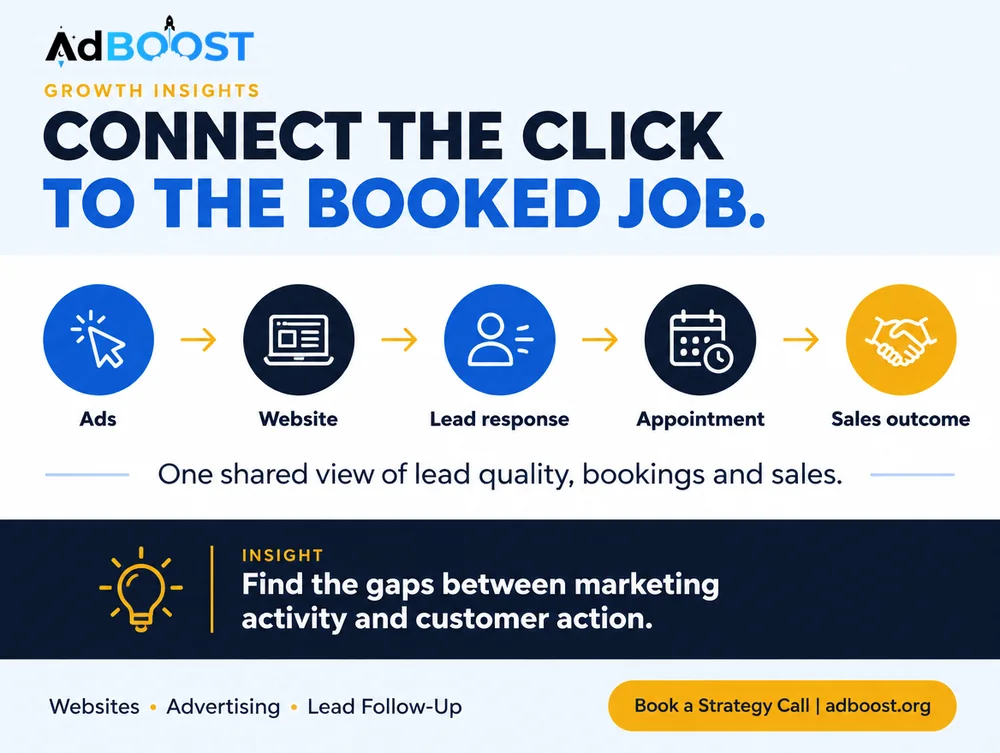
What this means for your business
A click on a plumbing ad is wasted if the form goes to an inbox nobody checks. Trace every lead from ad to call, estimate and booked job.
A new-patient inquiry can disappear between the ad, the web form and the front desk. Make sure each one is answered and recorded.
A consultation request that waits a day for a reply often goes to the next firm. Connect the ad, the form, the phone line and your intake process.
 AD BOOST INTELLIGENCE
The 3-Gap Lead Leak Check
Follow the inquiry. Find the broken handoff.
- Was the inquiry captured?
- Was a response attempted?
- Was the next action owned?
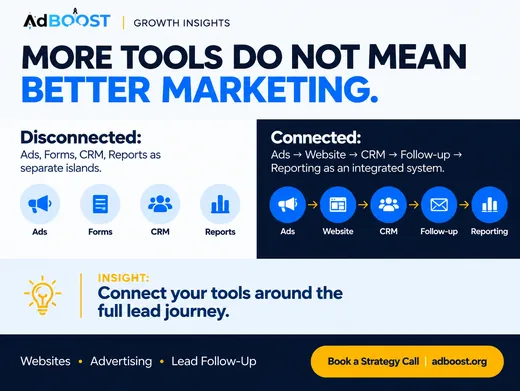
Fix broken handoffs before buying more traffic.
An original Ad Boost diagnostic framework that follows each customer inquiry from its entry point through capture, first response, and the next commercial action. It separates technical failures from operational failures so owners can fix the actual bottleneck instead of blaming advertising without evidence.
What is lead leakage, and why does it matter?
Lead leakage occurs when a potential customer's inquiry is lost, delayed, mishandled, or left without a documented next action. It can happen before an inquiry reaches your CRM, after it reaches your team, or during the transition from conversation to appointment. A lead leak is not necessarily a failed advertisement. It is often a failure in the system responsible for handling the opportunity.
Imagine an HVAC company running Google Ads for emergency air conditioning repairs. Someone clicks an advertisement, visits the landing page, and calls. The call goes unanswered. The caller does not leave a voicemail, and nobody reviews the missed-call record. The advertising platform may show that the click occurred, but the sales team never gets a usable opportunity. Increasing the budget would not correct the underlying problem.
Now consider a dental practice receiving implant consultation requests. Every form submission enters its CRM, but new inquiries are assigned to a general inbox without a named owner. Some patients receive a call, while others wait until someone notices the notification. Lead capture technically works; response ownership does not.
The distinction matters because marketing performance has multiple layers. Traffic measures whether people arrive. Lead capture measures whether inquiries become records. Response measures whether the business engages those inquiries. Conversion measures whether suitable inquiries advance toward appointments, estimates, or sales. Each layer needs its own evidence.
For this guide, a valid inquiry means a genuine contact attempt from a potentially relevant customer, excluding confirmed spam, duplicates, and unrelated contacts under a documented classification policy. An inquiry is not automatically a qualified lead, and a qualified lead is not automatically a sale. Keeping those definitions separate prevents misleading reporting.
How to identify where your leads are disappearing
Do not begin by comparing advertising dashboards. Start with the customer journey and reconstruct actual inquiries. Select a recent reporting period, gather source records, and trace each valid contact attempt to its latest documented status. For a manageable initial audit, review recent inquiries individually rather than assuming a dashboard total tells the whole story. Every missing record, unexplained delay, and unassigned next step is worth investigating.
- Can you identify every valid form submission, incoming call, chat inquiry, and relevant direct message during the period?
- Do website forms create CRM records reliably, and have you tested the process using a legitimate test submission?
- Can you distinguish answered calls, missed calls, abandoned calls, spam, duplicates, and calls outside your service area?
- Does every new inquiry have a named owner and a documented first-response attempt?
- When a prospect cannot be reached, is there an approved follow-up process rather than an indefinite open record?
- Can your team tell which inquiries became booked appointments, estimates, closed sales, or disqualified opportunities?
- Are advertising reports, call records, appointment calendars, and CRM outcomes using definitions you can reconcile?
What to fix first: a practical lead-leak decision table
| Situation | Recommended action | Why | Exception |
|---|---|---|---|
| Form submissions are visible on the website but missing from the CRM. | Test the form integration, field mapping, notifications, and duplicate rules before increasing traffic. | An inquiry cannot be managed reliably if it never enters the operating system. | Some test, spam, or intentionally excluded submissions may not belong in the CRM. |
| The CRM captures leads, but response times are inconsistent. | Assign a responsible owner, define coverage hours, and introduce escalation for unattended inquiries. | A recorded lead is not a handled lead. | Urgency and acceptable response windows differ for emergencies, scheduled consultations, and after-hours inquiries. |
| Calls are being missed during business hours. | Review call routing, staffing, voicemail, callbacks, and permitted missed-call notifications. | A phone-first campaign depends on someone owning unanswered calls. | Not every unanswered call represents a genuine prospect; classify the call before treating it as lost revenue. |
| Many conversations occur, but few appointments are documented. | Audit qualification questions, appointment scheduling, next-step language, and CRM status updates. | The breakdown may occur after contact rather than at lead generation. | Some inquiries are informational, unqualified, or legitimately unwilling to book. |
| Advertising platforms show more conversions than the CRM. | Compare conversion-event definitions, attribution windows, tracking tests, and duplicate events. | Platforms and CRMs may count different actions and assign credit differently. | A reporting difference is not automatically a technical failure or evidence of missing customers. |
| Lead handling appears consistent, but bookings remain weak. | Review audience fit, offer clarity, pricing expectations, landing-page promises, and service availability. | Not every conversion problem is a follow-up problem. | Avoid changing advertisements until you have enough evidence to isolate the likely cause. |
Worked example
Imagine a roofing contractor reviewing a hypothetical four-week period containing 40 valid customer inquiries. Twenty-two came through website forms and 18 came by phone. The team finds that 35 inquiries were entered into its lead system. Of those 35, only 28 have a documented first-response attempt, and 16 have a clearly recorded next action such as an inspection appointment or scheduled follow-up.
The first failure is capture: five valid inquiries lack a corresponding lead record. The second is response: seven recorded inquiries lack evidence of an attempted response. The third is progression: twelve inquiries with documented response attempts have no recorded next step. That does not prove all twelve were mishandled; some customers may have declined or been unqualified. It does establish that the business lacks enough information to explain their outcomes.
Documented capture coverage is 35 divided by 40, or 87.5%. Documented first-response coverage among captured inquiries is 28 divided by 35, or 80%. Documented next-step coverage among responded inquiries is 16 divided by 28, approximately 57.1%. These are three different measurements with different denominators. Treating them as a single conversion rate would conceal where the process needs attention.
The contractor's first action is not to increase the advertising budget. The office manager tests the lead forms, reviews missed-call records, assigns ownership for unattended inquiries, and defines mandatory CRM outcome categories. The team then measures the same process during another comparable period. A better result would be more complete capture and outcome documentation, followed by improvement in qualified appointments where appropriate.
Capture coverage = recorded valid inquiries / total valid inquiries x 100. Documented response coverage = captured valid inquiries with a recorded first-response attempt / total captured valid inquiries x 100. Documented next-step coverage = responded inquiries with a recorded disposition or next action / total responded inquiries x 100.
Every count, percentage, and business scenario in this example is hypothetical teaching material, not an Ad Boost client result or industry benchmark.
How to repair your lead pipeline step by step
Define what counts as a valid lead
Write a short definition that distinguishes contact attempts, valid inquiries, qualified leads, appointments, and customers. Decide how spam, duplicates, wrong numbers, recruiting calls, and outside-service-area inquiries will be classified. Apply the same definitions across marketing and sales reports. Without this step, one employee may call every phone ring a lead while another counts only booked appointments.
Map every inquiry entry point
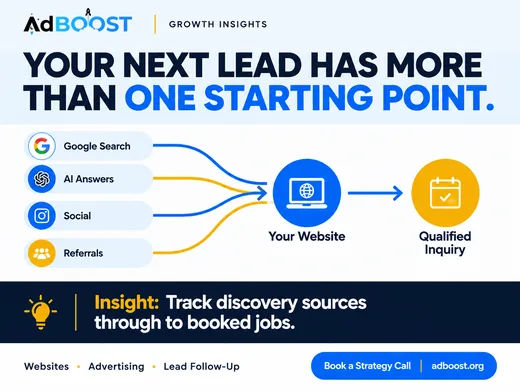
Inventory Google Ads calls, website forms, landing-page submissions, Google Business Profile interactions where observable, Meta lead forms, direct messages, chat, and referral inquiries. Identify where each inquiry is stored and who receives the notification. Note any channels that rely entirely on an employee remembering to check an inbox.
Test capture from the customer's perspective
Use clearly marked test inquiries to check forms, phone routing, CRM creation, notifications, and field mapping. Confirm timestamps, campaign identifiers where available, and contact details survive the transfer. Remove or label test records afterward. Do not assume a green integration status means the complete workflow functions.
Assign first-response ownership
Give each real inquiry a responsible person or queue with explicit coverage rules. Define what happens during lunch, after hours, vacations, and unusually busy periods. Prioritize response according to customer urgency and staff capability. Automated acknowledgments can confirm receipt, but they should not be reported as substantive human responses.
Create a documented next-step process
Use CRM statuses such as Awaiting Response, Contacted, Qualified, Appointment Booked, Follow-Up Scheduled, Unqualified, and Closed. Define each status and require a responsible person to record the next action. For a roofing estimate, that might mean confirming property location and inspection availability. For a dental consultation, it may mean scheduling the appropriate intake process.
Connect outcomes to marketing decisions
Where accurate and permitted, connect CRM appointment and sales outcomes back to campaigns using reliable identifiers and privacy-conscious processes. Compare inquiry volume with qualified opportunity volume rather than optimizing solely for inexpensive form submissions. Treat platform attribution as a measurement model, not an unquestionable record of causation.
Review failures and retest
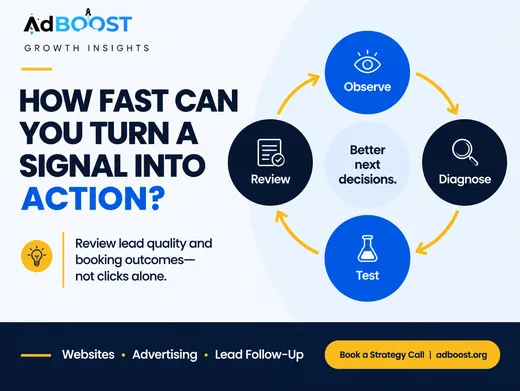
Establish a regular exception review for missing records, unanswered valid inquiries, overdue follow-ups, and status inconsistencies. Assign corrective actions, document whether the fix worked, and compare equivalent reporting periods. Increase advertising investment only after the business understands whether it can reliably handle additional inquiries.
The lead management metrics worth tracking
Set a baseline over a defined period, make one operational change where practical, and compare the same measures afterward. Segment by source and service when the records support it. Distinguish attempts from successful conversations and genuine customer outcomes. A clean process dashboard is more useful than a large collection of disconnected advertising numbers.
- Inquiry capture coverage
- Recorded valid inquiries divided by all identifiable valid contact attempts, multiplied by 100. Reconcile form logs, call records, messaging channels, and CRM entries. If the total contact-attempt population is incomplete, label the result as partial.
- Documented first-response coverage
- Captured valid inquiries with an appropriate documented response attempt divided by captured valid inquiries, multiplied by 100. Use CRM activity and phone or messaging records. Separate automatic receipt confirmations from substantive responses.
- Time to first response attempt
- Elapsed time between inquiry receipt and first appropriate response attempt. Record operating-hours context and compare similar inquiry types. Report the distribution or median alongside urgent outliers rather than relying only on an average.
- Qualified appointment rate
- Qualified inquiries that result in a booked appointment divided by all qualified inquiries eligible for booking, multiplied by 100. Use CRM qualifications and scheduling records. Define how cancellations and reschedules are handled.
- Follow-up ownership coverage
- Open inquiries with an assigned owner and documented next action divided by all open inquiries requiring action, multiplied by 100. Use CRM assignment and task records.
- Lead-to-customer conversion
- Valid inquiries becoming customers divided by valid inquiries from a comparable, sufficiently matured cohort, multiplied by 100. Reconcile with actual closed outcomes and account for the time between initial contact and sale.
Common mistakes and when this advice is wrong
- Assuming every missed call is lost revenue. Some calls are spam, existing-customer service requests, duplicates, or outside the service area. Review available evidence before labeling them lost sales. The purpose of the audit is accurate diagnosis, not exaggeration.
- Treating automated messages as completed follow-up. An acknowledgment can reassure a prospect that the inquiry arrived, but it does not necessarily answer a question, qualify the need, or arrange service. Track automated receipts separately from meaningful engagement.
- Optimizing for lead quantity alone. A campaign can deliver more forms while producing fewer viable opportunities. Analyze qualification and customer outcomes before concluding that cheaper leads are better.
- Assuming faster response solves every conversion problem. If the offer is unsuitable, the business lacks capacity, or leads are poorly targeted, immediate callbacks may not improve outcomes. Diagnose demand quality and service fit alongside response operations.
- Automating follow-up without permission or safeguards. SMS, email, and automated calling must follow applicable consent, privacy, opt-out, and industry requirements. Sensitive medical or legal inquiries need particular care. Process improvements never justify noncompliant communication.
Frequently asked questions
What is the biggest cause of lost marketing leads?
There is no universal biggest cause. The most useful starting point is to examine whether valid inquiries are captured, assigned, responded to, and advanced to a documented next step. A business with unreliable forms needs a different fix from a business receiving calls it cannot answer. The 3-Gap Lead Leak Check separates those situations so the owner can prioritize the most consequential verified failure.
How quickly should a small business respond to a new lead?
The appropriate target depends on urgency, operating hours, service type, customer expectations, and available staffing. An emergency plumbing inquiry usually requires a different workflow from a scheduled commercial construction consultation. As an operational rule of thumb, prioritize high-intent, time-sensitive inquiries as quickly as practical during staffed coverage, then measure your actual response distribution and missed opportunities. Do not present an arbitrary response-time promise as an established industry benchmark.
Do I need an expensive CRM to stop losing leads?
No. You need a reliable system of record, clear ownership, consistent statuses, and a follow-up procedure people actually use. A suitable basic CRM may be enough. Additional automation becomes valuable when it solves an identified operational problem. Buying sophisticated software before defining the process can make an already confusing workflow harder to manage.
Why do Google Ads and my CRM report different lead totals?
They may measure different events, conversion windows, duplicate rules, attribution models, or customer actions. A platform might count a qualifying interaction while the CRM records a person or opportunity. Begin by documenting each metric's definition. Then trace a sample of underlying events through forms, call tracking, and CRM records. A mismatch deserves investigation, but it does not automatically mean one system is broken.
Should I increase advertising spend if I am not booking enough customers?
Not until you understand the bottleneck. If qualified demand is insufficient and the follow-up process is dependable, additional investment may be reasonable. If inquiries are already getting lost, more traffic may simply increase the volume of mishandled opportunities. Examine lead quality, response ownership, appointment conversion, available capacity, and economics together before changing the budget.
Find Your Lead Leaks
Ad Boost can help review the path from your advertising and website to the first response and booked opportunity.
Find Your Lead Leaks