Why Do Customers Take Different Paths to Buy the Same Service?
What this means for your business
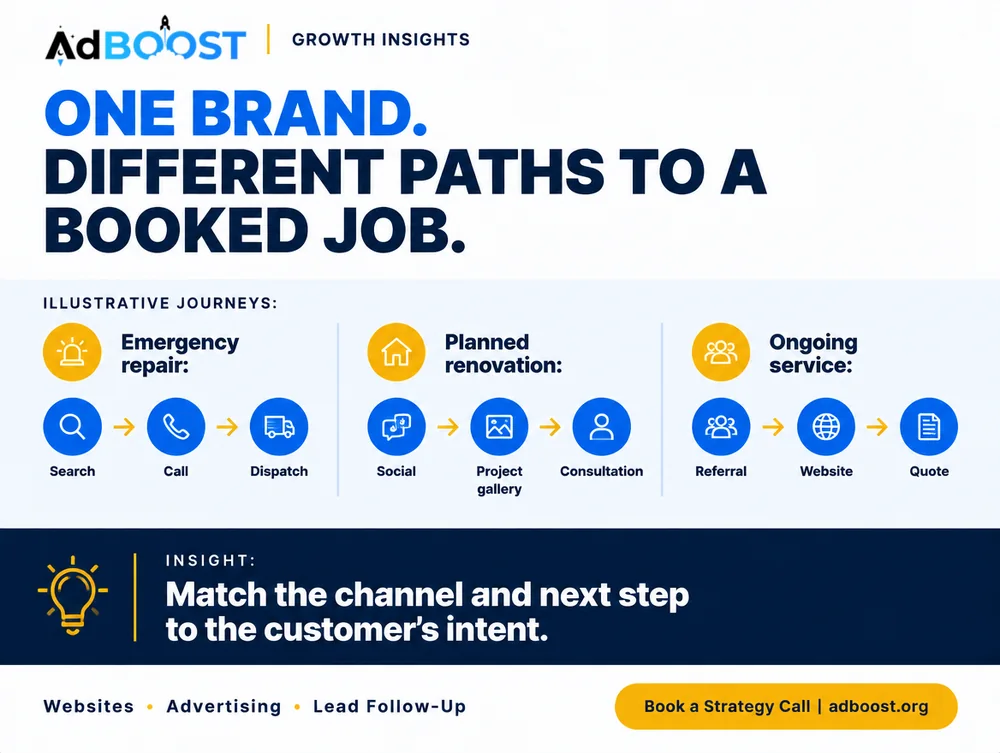
An emergency repair customer calls in minutes. A roof replacement customer compares three bids for weeks. One brand needs two different paths to contact.
A patient with urgent pain and one planning an elective procedure need different information and different booking paths.
Someone facing an urgent matter wants a fast call. Someone planning an estate or business matter researches for weeks. Build a path for each.
 AD BOOST INTELLIGENCE
The Buying Path Mapper
One brand. Different customer needs. Different routes to contact.
Urgent Need
Planned Purchase
Referral-Led
Match the journey to the buying situation, not just the service category.
An original Ad Boost customer-journey framework that compares urgent, planned, and referral-led buying situations. It identifies the information, trust signals, contact options, and next steps each situation requires while connecting all paths to one reliable lead-management process.
One business can serve customers who are making completely different decisions
A real estate agent receives two inquiries on the same afternoon. One person has inherited a property and needs to understand what selling might involve. Another has researched neighborhoods for months and wants to tour a particular home. Both are potential clients. They do not need the same advertisement, landing page, first conversation, or follow-up sequence.
The first person may be uncertain about timing, property condition, estate-related considerations, and whether selling is even the right choice. The second may already have specific location preferences, financing questions, and scheduling needs. Treating both as generic real estate leads creates unnecessary friction.
A customer journey is the sequence of experiences, questions, interactions, and decisions through which someone recognizes a need, evaluates options, contacts a provider, and potentially becomes a customer. The journey can include search, maps, referrals, advertising, direct visits, phone conversations, reviews, and offline experiences. It is not always linear, and not every interaction can be measured.
Buying paths differ for reasons that matter operationally. Urgency influences how much time a customer has. Purchase risk changes the level of evidence required. Prior knowledge changes which explanations are useful. Customer familiarity affects trust. Budget, location, availability, and professional requirements influence whether the person can proceed.
An emergency roofing repair inquiry may prioritize safety, service coverage, and prompt human contact. A homeowner planning a roof replacement may want materials, inspection details, financing information where offered, and estimates. Someone referred by a trusted neighbor may already recognize the company but still want to confirm that the contractor handles their particular project.
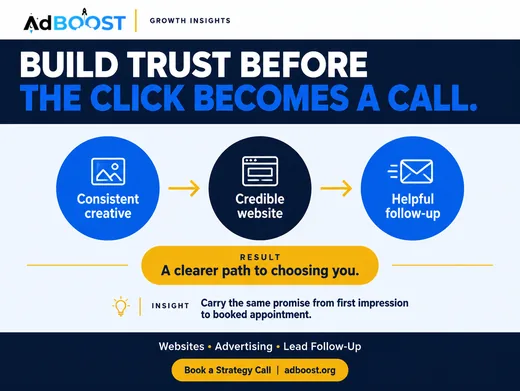
Those differences should influence marketing structure. A high-urgency service page needs clear availability and contact information. A planned-purchase guide needs decision criteria and transparent process explanations. A referral-oriented page should make verification easy rather than assuming that the recommendation eliminates every concern.
This does not mean building a separate advertising funnel for every imaginable persona. Excessive segmentation can complicate campaigns and reduce the amount of usable evidence. The objective is to identify materially different customer situations and provide an appropriate route for each.
Ad Boost's Buying Path Mapper focuses on three recurring patterns: urgent need, planned purchase, and referral-led evaluation. They are working models rather than universal categories. Real customers may move between them or follow an entirely different route. The model is useful when it exposes a mismatch between what the customer needs and what the business currently asks them to do.
Where is your marketing forcing different customers into the same path?
Review actual inquiries by customer situation before redesigning campaigns. Examine what customers ask, how quickly they need help, what information they already know, and where they hesitate. A campaign may generate acceptable lead volume yet attract people who cannot find the information appropriate to their buying stage. The diagnostic goal is to identify meaningful journey differences rather than manufacture elaborate personas without evidence.
- Which services attract urgent inquiries, extended research, or referral-led contact?
- Do customers with urgent needs see accurate availability and a direct contact option?
- Can planned purchasers compare service scope, process, suitability, and next steps before requesting a consultation?
- Do referred customers have an easy way to verify credentials, location, services, and actual business identity?
- Are landing pages aligned with the promise and urgency expressed in the advertisement or search query?
- Does your intake team distinguish immediate service needs from early-stage research and longer-term opportunities?
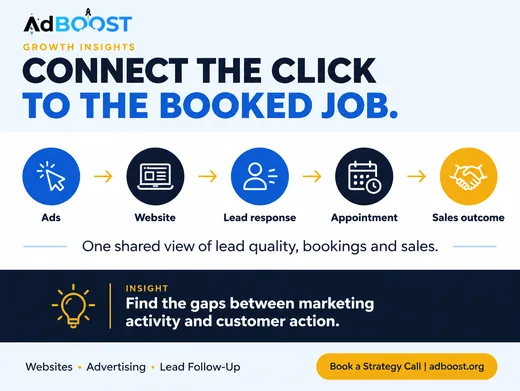
- Can your CRM track qualification, follow-up ownership, and outcomes without treating every journey as identical?
Which buying path should your marketing support?
| Situation | Recommended action | Why | Exception |
|---|---|---|---|
| A homeowner needs immediate help with an active plumbing leak. | Prioritize accurate emergency availability, service coverage, safety information, and a prominent contact method. | The customer has limited time and needs to understand whether help is available. | Do not advertise emergency coverage or response times the business cannot actually provide. |
| A homeowner is planning a major remodeling project. | Provide process details, project-fit criteria, realistic planning considerations, and consultation options. | A higher-consideration purchase requires more information before contact. | Some project specifics cannot be responsibly determined without an on-site assessment. |
| A customer arrives after receiving a personal recommendation. | Make business identity, relevant qualifications, service scope, and contact information easy to verify. | Existing familiarity may reduce some uncertainty but does not remove the need for evaluation. | A referral does not automatically mean the business is suitable for the customer's request. |
| A real estate buyer repeatedly views property information without contacting an agent. | Offer useful comparison resources and an appropriate opportunity to ask questions or schedule a showing. | The customer may still be gathering information or assessing readiness. | Avoid interpreting repeat visits as consent for intrusive outreach. |
| The same campaign attracts both urgent and research-stage inquiries. | Review whether separate messages or landing-page pathways would better serve materially different needs. | Urgency and information requirements can make one generic message less useful. | Keep the structure simple when volume or actual customer differences do not justify segmentation. |
| Leads enter the CRM but follow-up ignores their buying stage. | Add appropriate intent and timing fields, then use relevant human-owned follow-up workflows. | A customer considering a future project needs different communication from someone seeking immediate service. | Communication cadence and automation must respect consent, privacy, and customer preferences. |
Worked example
Imagine a fictional residential real estate team called Shoreline Property Advisors. The team serves buyers and sellers in a coastal market and uses one generic landing page for nearly every advertising campaign. The page says Find Your Next Move and immediately requests a name, telephone number, and preferred appointment time.
The team reviews a hypothetical month containing 36 valid new inquiries. Twelve concern homeowners considering a sale, fourteen concern buyers actively searching for properties, and ten come from referrals seeking information about a specific agent or service. These categories describe the initial reason for contact rather than the complete history of how each customer discovered the company.
Applying the Buying Path Mapper reveals distinct information needs. Sellers want to understand valuation, marketing preparation, timing, and the listing process. Active buyers want property relevance, local information, financing considerations, and showing availability. Referral-led prospects want to confirm the agent's actual service area, identity, and experience before making contact.
The team creates three clear entry paths without changing its underlying brand. A seller page explains the consultation and listing process without promising a particular sale price. A buyer page explains how to request property information or schedule a showing. A referral verification page provides accurate agent biographies, contact details, and relevant service information.
For a hypothetical comparison, suppose the original generic page receives 600 eligible visits and 30 valid inquiries, an observed inquiry rate of 5%. During another period, the three more specific pathways collectively receive 600 eligible visits and 39 valid inquiries, an observed rate of 6.5%. The difference does not prove that the new structure caused the improvement because audiences, market conditions, and available properties may have changed.
The team therefore examines actual consultations and qualified opportunities. It also tracks which prospects are immediately ready, which require planned follow-up, and which are simply gathering information. An inquiry from someone who expects to sell next year is not automatically low quality; its value depends on the firm's goals and ability to support longer-term relationships.
The central improvement is operational. Customers receive information that fits their situation, and the sales team can tailor the next conversation without guessing why the inquiry arrived. The company has one consistent brand but several legitimate buying paths.
Path-specific inquiry rate = valid inquiries associated with a defined entry path / eligible visits to that path x 100. Qualified consultation rate = qualified consultations booked / eligible valid inquiries x 100. Compare paths using consistent definitions and account for differences in customer intent.
The real estate team, customer categories, visits, inquiry counts, percentages, and outcomes are hypothetical teaching inputs rather than actual Ad Boost client data or established journey benchmarks.
How to map customer journeys without creating an unmanageable funnel
Identify the buying situations that materially differ
Review services, customer questions, intake records, and sales conversations. Group inquiries by practical differences such as urgency, decision complexity, prior familiarity, and readiness. Do not build personas from unsupported assumptions about demographics or lifestyle. A useful path should correspond to a real difference in what the customer needs.
Document the questions at each stage
For each path, list what customers need during discovery, evaluation, contact, and follow-up. Urgent buyers may prioritize availability. Planned purchasers may prioritize process and comparison. Referred customers may prioritize verification. Identify where existing pages answer these questions and where they create uncertainty.
Align advertisements with customer intent
Review campaign messages, search terms where available, audience relevance, and landing-page promises. Separate materially different intent when doing so improves clarity and measurement. Avoid claiming emergency service, guaranteed outcomes, or exclusive market expertise unless those claims are accurate. Keep targeting and advertising practices compliant with applicable rules.
Create useful pathways on the website
Use service-specific pages, clear navigation, practical comparison information, and relevant contact methods. Urgent pages should not bury contact details. Research-heavy pages should not hide essential information behind a form. Referral visitors should be able to verify business identity and service fit. Maintain consistent branding while allowing the information architecture to vary.
Capture intent during inquiry handling
Add a manageable set of CRM fields for service interest, urgency, qualification, and preferred timing. Ask customers what they need rather than inferring intent solely from a clicked advertisement. Assign appropriate follow-up ownership. Avoid creating so many status options that employees cannot use them consistently.
Build follow-up around the customer's stage
Create approved communication approaches for urgent requests, scheduled consultations, future plans, and referral questions. Confirm contact permissions and preferences before sending automated messages. Use helpful information relevant to the stated need rather than repeatedly pressing every customer to book immediately.
Evaluate paths using qualified outcomes
Compare inquiry quality, appointments, consultation attendance, sales outcomes, and customer feedback by path. Examine whether segmentation creates enough operational benefit to justify the extra complexity. Consolidate paths that do not serve meaningfully different needs and revise those that create confusion or unsuitable inquiries.
How to measure different buying journeys fairly
Different paths should not be judged by identical expectations. An urgent service inquiry and a planned property sale have different decision timelines. Define the purpose of each journey, compare similar customer situations, and follow records far enough to observe meaningful outcomes. Avoid treating immediate conversion as the only valuable behavior.
- Valid inquiries by buying path
- Count eligible inquiries classified by documented urgency, service interest, or buying situation. Use CRM intake fields and allow unknown or mixed intent when appropriate.
- Path-specific contact rate
- Valid inquiries associated with eligible visits to a defined page or journey divided by eligible visits, multiplied by 100. Document the attribution method and avoid treating it as a complete cross-channel history.
- Qualified appointment rate
- Qualified appointments booked from eligible inquiries in a path divided by eligible inquiries in that path, multiplied by 100. Account for legitimate differences in qualification.
- Time to meaningful next step
- Elapsed time between inquiry receipt and the appropriate documented action, such as an emergency response attempt, scheduled consultation, or agreed future follow-up. Report separately by buying situation.
- Journey-stage mismatch incidents
- Record cases where visitors received irrelevant information, misleading urgency, unsuitable follow-up, or an inappropriate contact request. Review actual examples and corrective actions.
- Customer progression by cohort
- Track eligible inquiries through qualification, appointment, opportunity, and customer stages using comparable cohorts. Allow longer maturation periods for planned or complex purchases.
Common mistakes and when this advice is wrong
- Treating all inquiries as ready to purchase. A person researching a future project may have a genuine need without being ready to book. Qualification and follow-up should reflect intent instead of labeling every slower journey as failure.
- Creating too many audience segments. Excessive segmentation can make campaigns difficult to manage and leave too little evidence for meaningful comparisons. Separate journeys only when customer needs justify different information or actions.
- Assuming the journey is always linear. Customers may compare providers, return through another channel, ask a referral, or restart research. The framework is a practical map, not a claim that every buyer follows the same sequence.
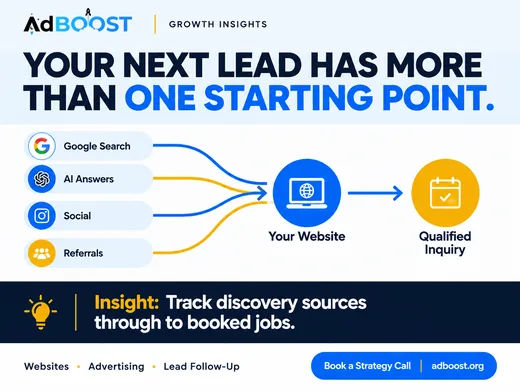
- Confusing discovery source with buying intent. A visitor from Google Search may be researching or ready to buy. A referral may still need substantial information. Determine intent using the actual inquiry and customer circumstances rather than channel alone.
- Automating follow-up without respecting customer preferences. Communication frequency, content, consent, privacy, and professional requirements matter. A technically sophisticated sequence can damage trust if it ignores what the customer requested.
Frequently asked questions
What is customer journey mapping for a local business?
Customer journey mapping documents how people recognize a need, discover providers, evaluate options, make contact, and move toward a purchase. For a local service business, it should focus on real customer questions, urgency, contact methods, and follow-up needs. The map helps identify where marketing creates unnecessary friction and where different customers require different information.
Should urgent and planned service inquiries use different landing pages?
Often they benefit from different emphasis because their needs differ. Urgent customers may require clear availability and direct contact. Planned purchasers may need process explanations, comparisons, and consultation details. Separate pages are useful when they provide genuinely distinct information and can be maintained accurately. One well-structured page may be sufficient when the differences are small.
How many customer journeys should a small business create?
Start with the meaningful differences evident in services and customer conversations rather than choosing an arbitrary number. Urgent, planned, and referral-led paths can be useful working categories, but some businesses need fewer or different groups. Each additional journey should justify its content, tracking, and operational complexity through a real customer need.
Does a referral customer still need marketing?
Yes, although their needs may differ from someone discovering the company for the first time. Referrals often arrive with some existing familiarity, but customers may still verify credentials, service area, reputation, process, and suitability. Accurate business information, useful pages, and dependable contact handling support that evaluation without treating the recommendation as a guaranteed sale.
How do I know which customer journey converts best?
Define comparable outcomes and review qualified inquiries, consultations, and customers by buying situation. Account for purchase timing, service mix, and differences in qualification. An urgent path may produce faster contact, while a planned path may create valuable opportunities over a longer period. The best journey is the one that appropriately serves its customers and supports sustainable business outcomes.
Review Your Customer Acquisition Journey
Find where your advertising, service pages, and follow-up fail to match how your customers actually make decisions.
Review Your Customer Acquisition Journey