When Every Competitor Uses AI, What Actually Sets You Apart?
What this means for your business
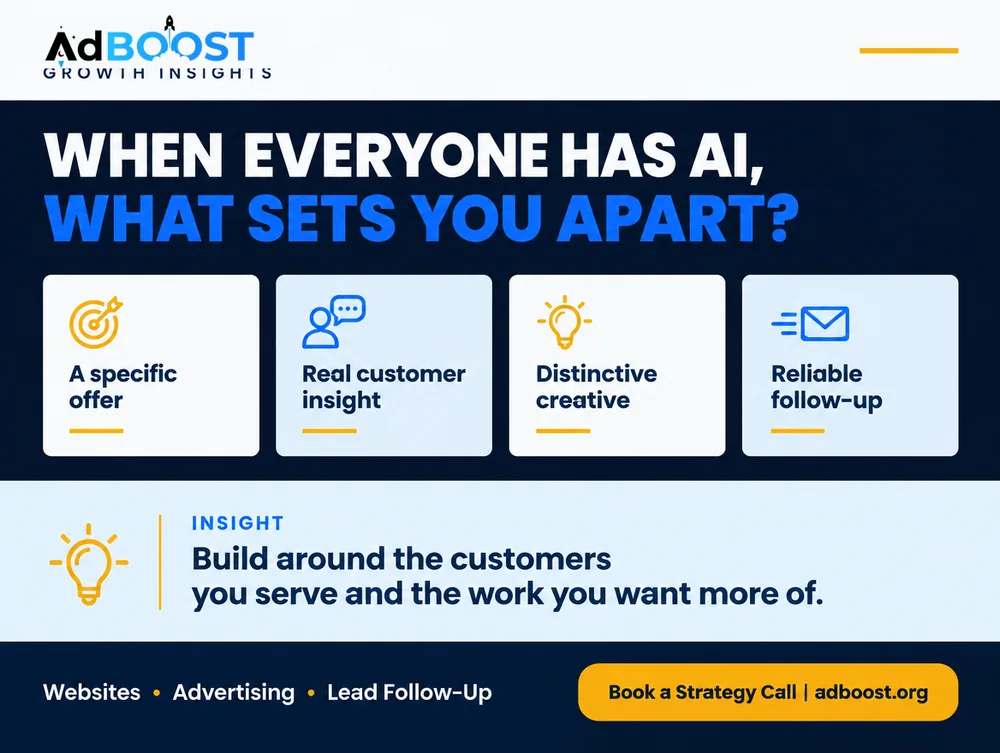
Every roofer can generate the same "trusted local experts" copy. Your edge is a specific offer, real job photos you own, and a follow-up process customers can feel.
Generic wellness copy is everywhere. Practices stand out with a specific specialty, real answers to patient questions and a booking experience that feels cared for.
Generic "aggressive representation" language blends together. Firms stand out with a clear practice focus, plain explanations of the process and prompt, human responses.
 AD BOOST INTELLIGENCE
The Distinctiveness Stack
Build an advantage on capabilities, not interchangeable claims.
- What can customers genuinely value?
- What can competitors easily copy?
- Which claims can you prove?
- Does the experience match the message?
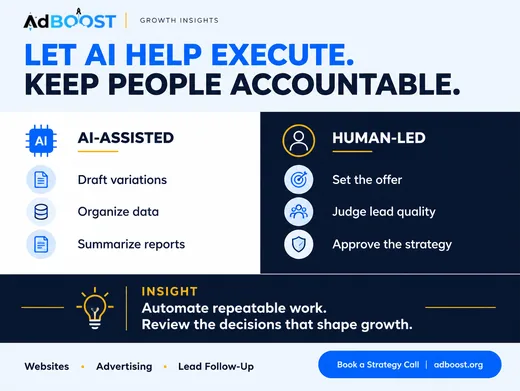
AI can accelerate communication. It cannot replace a real reason to choose you.
An original Ad Boost positioning framework built around five reinforcing layers: operational reliability, clear positioning, credible proof, customer experience, and consistent visibility. The model helps businesses distinguish easily copied marketing presentation from customer value grounded in actual capabilities.
Your competitors can copy your AI prompts. They cannot instantly copy your business.
A homeowner compares three remodeling contractors. Their websites use polished language about craftsmanship, transparent communication, and exceptional service. Their advertisements sound remarkably similar. Each company has professional-looking imagery and a chatbot ready to answer basic questions. Nothing about the messaging helps the homeowner decide which contractor is better suited to renovate an occupied home while minimizing disruption.
The problem is not that AI made the marketing worse. The problem is that every company presented interchangeable claims without explaining its actual operating differences.
Competitive differentiation is the process of establishing a meaningful reason for a specific customer to choose one business over available alternatives. That reason must be relevant, credible, and connected to what the company can consistently deliver. A business is not differentiated merely because it uses a new technology or describes itself with more impressive adjectives.
AI tools can reduce the effort required to draft advertisements, build content outlines, summarize information, and develop variations. Those capabilities can be valuable. But when similar capabilities are widely available, the tool itself becomes less distinctive. Competitors may produce comparable wording, content structures, or automation workflows without possessing comparable service expertise or customer relationships.
Local service businesses have potential sources of advantage that are more closely tied to operations. A roofing contractor may have a clearly documented inspection process and dependable communication during complex projects. A law firm may concentrate on a specific type of matter and explain its intake process with unusual clarity. A dental practice may differentiate through its actual clinical capabilities, patient communication, and appointment experience. A commercial contractor may offer relevant project expertise and a disciplined estimating workflow.
These are not automatically advantages simply because the company mentions them. They matter when the intended customer values them, the business can prove or demonstrate them, and the experience consistently matches the promise.
Distinctiveness also requires deciding what not to promise. A company that competes on thoughtful project planning should not automatically imitate an advertisement emphasizing the fastest possible completion. A practice that prioritizes careful consultation should not promise instant treatment decisions merely because a competitor uses that language. Positioning becomes stronger when it accurately reflects operational strengths.
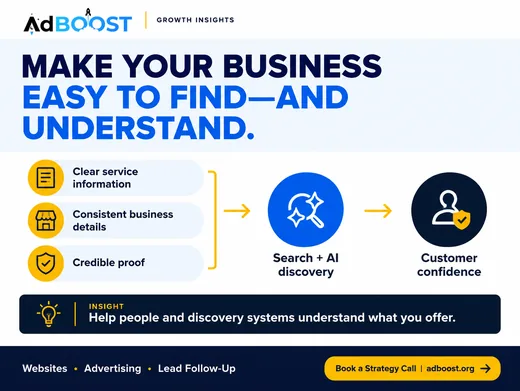
The practical challenge is to connect the reason a customer should choose you with the evidence available before purchase and the experience delivered afterward. Ad Boost's Distinctiveness Stack organizes those requirements from the operational foundation upward. AI belongs inside the system as an accelerator, not at the top as the central customer promise.
The replace-your-logo test: does your marketing say anything distinctive?
Open your home page and two relevant competitors' websites. Hide the logos and business names. If the primary headlines, service claims, and reasons to contact each company could be exchanged without changing their meaning, your positioning may be too generic. The purpose is not to invent a dramatic point of difference. It is to identify genuine customer-relevant capabilities that your messaging currently fails to explain.
- Can you describe the specific customer or service situation your business is especially well equipped to handle?
- Do you communicate a meaningful operating difference beyond quality, integrity, professionalism, and customer satisfaction?
- Can customers verify your differentiating claims through actual credentials, processes, relevant work, or authentic experience?
- Are your advertisements and website explaining why your service fits the customer rather than merely listing common features?
- Does the customer experience after inquiry reinforce the difference your marketing promises?
- Would a competitor using the same AI tools be able to copy your message without changing its own operations?
- Are you measuring qualified customer outcomes and expectation fit rather than relying only on impressions or content output?
Where a defensible competitive advantage comes from
| Situation | Recommended action | Why | Exception |
|---|---|---|---|
| Every competitor advertises excellent customer service. | Describe a real service process, communication standard, or operational commitment that you consistently deliver. | Specific evidence is more useful to a buyer than interchangeable praise. | Avoid promising a response or completion time the business cannot reliably support. |
| Your company serves many types of customers but struggles to explain its strengths. | Prioritize the customers and service situations where your capabilities are most relevant. | Clear positioning helps suitable buyers recognize fit. | A broad service offering can remain appropriate when customers genuinely benefit from it. |
| AI-generated content makes your website sound like competitors. | Replace generic claims with original service explanations, decision criteria, verified examples, and practical expertise. | Actual knowledge and operational detail create useful distinctions. | AI can assist with drafting and editing when facts and strategic direction remain human-controlled. |
| Your advertised advantage is low price. | Verify sustainable economics and explain what the customer receives at that price. | Price can be relevant, but an unsustainable promise is not a durable advantage. | Low-price positioning may be legitimate when the operating model genuinely supports it. |
| You have strong expertise but little public evidence. | Publish accurate capability descriptions, approved work examples, genuine professional information, and transparent processes. | Customers need a reasonable basis for believing a differentiating claim. | Some expertise cannot be publicly demonstrated because of confidentiality or professional restrictions. |
| Your business attracts interest but poor-fit customers. | Clarify service scope, suitability, exclusions, and the intended customer profile. | Differentiation should help unsuitable buyers self-select out as well as attract suitable ones. | Some customers require a consultation before fit can responsibly be determined. |
Worked example
Imagine a fictional residential remodeling business called Cedarline Renovations. It competes for kitchen and interior renovation projects. Its website promises beautiful transformations, quality craftsmanship, and exceptional service. Competitor websites make nearly identical claims. The owner believes the solution is to produce more advertisements using AI.
During an internal positioning review, the company identifies a genuine operating strength: it uses a documented preconstruction planning process designed to help homeowners understand scope, scheduling dependencies, material selections, and potential disruptions before work begins. The process is part of its actual service model, but its current marketing does not explain it.
The business applies the Distinctiveness Stack. Operational Reliability means documenting and consistently following the planning process. Clear Positioning means communicating the value to homeowners concerned about renovation uncertainty. Credible Proof means showing genuine planning documents or authorized project examples without exposing private customer information. Customer Experience means making the initial consultation explain the process clearly. Consistent Visibility means expressing the same truthful advantage across advertisements, service pages, and follow-up.
For a hypothetical teaching exercise, suppose the company's original landing page receives 300 eligible visits and 18 valid inquiries. The observed inquiry rate is 6%. A revised page explains the preconstruction process and includes a clear description of who benefits from it. During another illustrative period, the revised page receives 300 eligible visits and 21 valid inquiries, an observed rate of 7%.
The owner should not automatically declare the revised positioning a proven success. The periods may have different audiences, market conditions, or service availability. More importantly, the business must inspect whether the inquiries concern appropriate projects. Suppose the revised page produces a higher proportion of consultations with homeowners planning complex renovations, while some price-only inquiries decline. That could be commercially useful even if total inquiries changed very little.
The business documents what customers ask during consultations, whether the planning process helps set expectations, and whether its team consistently delivers the advertised experience. If the company discovers that the process is inconsistently followed, the correct response is to improve operations or revise the promise rather than increasing marketing claims.
The advantage is not that Cedarline uses AI to generate better adjectives. It is that the business can explain a real customer-relevant process, demonstrate its existence, and consistently deliver it.
Valid inquiry rate = valid inquiries / eligible landing-page visits x 100. Qualified inquiry rate = qualified inquiries / valid inquiries x 100. Positioning effectiveness should also consider customer fit, expectation accuracy, and actual business outcomes rather than a single numerical score.
The remodeling business, operating process, visits, inquiry counts, percentages, and outcomes are fictional teaching inputs, not actual Ad Boost client results or verified performance findings.
How to build an advantage competitors cannot copy with a prompt
Choose the customer situation you want to own
Identify which customer needs, service types, project conditions, or purchase situations align best with your real capabilities. Review completed work, customer questions, qualification outcomes, and operational constraints. A law firm, dental practice, or contractor should not claim broad expertise where its actual experience is narrower. Clear positioning begins with a defensible choice about whom the business serves.
Inventory capabilities competitors cannot instantly reproduce
Document real operating processes, specialized expertise, service coverage, customer support practices, scheduling capabilities, quality controls, and relevant relationships. Distinguish meaningful customer benefits from internal features. Owning advanced software is not automatically a customer benefit; consistently delivering a smoother service process may be.
Translate capability into customer value
For every capability, identify the problem it helps solve, the customer most likely to value it, and what the customer should expect. Use the structure: We help this type of customer address this problem through this specific process or capability. Remove broad claims that competitors could copy without changing their businesses.
Build authentic proof around the promise
Collect approved examples of real processes, professional qualifications, relevant completed work, genuine customer feedback, or other suitable evidence. Verify material statements and respect confidentiality. For regulated professions, ensure examples and claims comply with applicable professional requirements. When proof is unavailable, narrow the wording rather than inventing it.
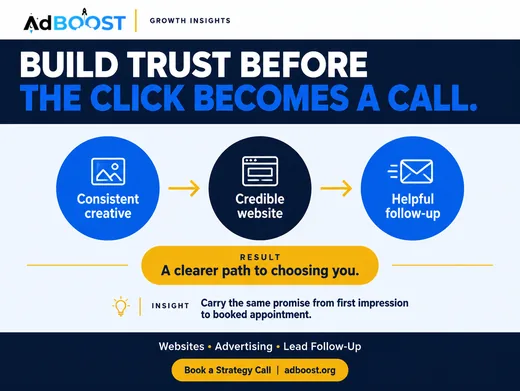
Make the customer journey deliver the positioning
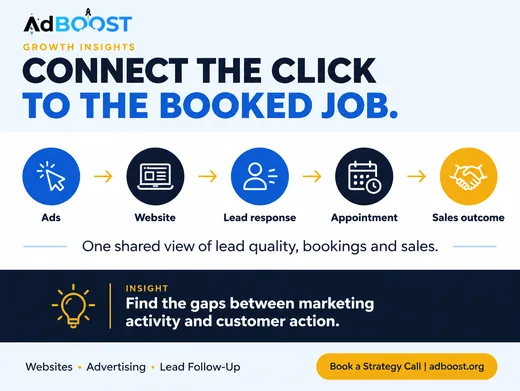
Review advertising, website content, inquiry handling, estimates, consultations, scheduling, and service delivery. Identify where the experience contradicts the promise. If the brand emphasizes responsive communication, establish real response ownership. If it emphasizes careful project planning, ensure the sales process demonstrates that approach.
Use AI to scale accurate communication
Provide AI tools with approved positioning, service details, claim restrictions, real customer questions, and examples of suitable language. Use assistance for drafting advertisements, organizing content, or developing variations while retaining human approval of consequential claims. Reject output that turns a distinctive process into exaggerated promises or generic marketing clichés.
Measure customer fit and revisit the position
Review qualified inquiries, suitable consultations, customer objections, expectation mismatches, and commercial outcomes. Determine whether the positioning attracts the intended buyers and accurately reflects delivery. Revisit it when services, capabilities, competitors, or customer priorities change. Distinctiveness should evolve with the business rather than remain a fixed slogan.
How to measure differentiation without inventing a competitive advantage score
Differentiation is partly strategic and partly observable through customer behavior. No single metric proves that a brand possesses a durable advantage. Use evidence about customer fit, understanding, trust, and commercial outcomes. Keep marketing performance separate from actual service delivery and avoid assuming every change resulted from new positioning.
- Qualified inquiry rate
- Qualified inquiries divided by valid inquiries, multiplied by 100. Define qualification using the intended customer, service requirements, geography, and business capacity.
- Target-customer fit
- Review whether inquiries match the clearly defined customer situations the business intends to serve. Record consistent qualification categories and the reasons unsuitable inquiries are declined.
- Customer-reported selection reasons
- Ask an open-ended question about why customers chose to contact or hire the business. Categorize responses without forcing them into the positioning statement or treating recollection as perfect causal evidence.
- Expectation mismatch incidents
- Record verified situations where customers misunderstood pricing, process, availability, qualifications, or advertised benefits. Investigate whether marketing wording or operations created the mismatch.
- Consultation-to-customer conversion
- Customers acquired from eligible completed consultations divided by eligible completed consultations, multiplied by 100. Compare appropriately matured cohorts and consider pricing, competition, and service suitability.
- Brand-promise delivery consistency
- Audit representative customer records or completed work against the specific process commitments used in marketing. Record verified exceptions and corrective actions instead of manufacturing a universal brand score.
Common mistakes and when this advice is wrong
- Treating AI adoption as the main differentiator. Customers generally need an outcome, not proof that a business uses fashionable software. Explain how the actual service experience benefits rather than presenting access to a common tool as a unique advantage.
- Claiming to be the best without evidence. Unsupported superiority claims, invented awards, fabricated client stories, and exaggerated credentials undermine trust. Prefer specific, demonstrable capabilities and accurate customer expectations.
- Choosing a niche the business cannot serve well. Narrow positioning is useful only when the business has relevant capabilities and sufficient demand. Do not advertise specialization that its staff, systems, or professional qualifications cannot support.
- Assuming differentiation requires higher prices. A business may legitimately compete through convenience, simplicity, reliability, accessibility, specialized service, or an efficient operating model. The objective is meaningful customer value, not automatically premium positioning.
- Marketing a stronger experience than operations deliver. A distinctive promise creates expectations. If scheduling, communication, pricing, or service delivery contradicts that promise, stronger advertising may increase dissatisfaction rather than sustainable growth.
Frequently asked questions
How can a small business stand out when competitors use the same AI tools?
Build differentiation around what the business actually does and delivers. Identify a customer group you serve well, a meaningful capability or process, credible evidence, and a dependable experience. AI can help communicate those strengths, but competitors can often produce similar generic content. The stronger question is whether customers can recognize and verify a reason to choose your business.
Does using AI make marketing less original?
Not necessarily. AI can assist with organizing research, drafting variations, and improving communication. Originality depends on the information, judgment, experience, and perspective behind the content. If a company provides only generic instructions, the results may resemble competitors' materials. If it contributes verified service expertise, real processes, and a distinctive point of view, AI-assisted production can still support useful original communication.
What if my business does not have anything unique?
Begin with the customer experience rather than searching for an extraordinary claim. Examine which customers you serve especially well, which problems your team handles reliably, how your service process works, and what customers appreciate. Some capabilities may be common individually but become meaningful through consistent execution. If no strong advantage exists yet, improve the operating model before making a larger marketing promise.
Should every local business choose a narrow niche?
No. Specialization can improve relevance, but a broad offering may be appropriate for businesses with genuine capabilities across multiple service types. The decision depends on customer needs, competition, capacity, economics, and how clearly the company can explain its value. Avoid narrowing solely because it sounds more sophisticated. Choose positioning that reflects actual strengths and commercially viable demand.
How do I know whether my brand positioning is working?
Review whether the intended customers understand the message, whether inquiries match your service capabilities, and whether the actual experience fulfills the promise. Track qualification, suitable consultations, customer objections, and commercial outcomes. Ask customers why they considered the business. Avoid treating improved clicks or one favorable reporting period as proof that a positioning change caused better results.
Review Your Competitive Positioning
Identify the real strengths your business can prove and turn them into clearer advertising, stronger service pages, and better-qualified opportunities.
Review Your Competitive Positioning