How Quickly Does Your Marketing Turn Results Into Better Decisions?
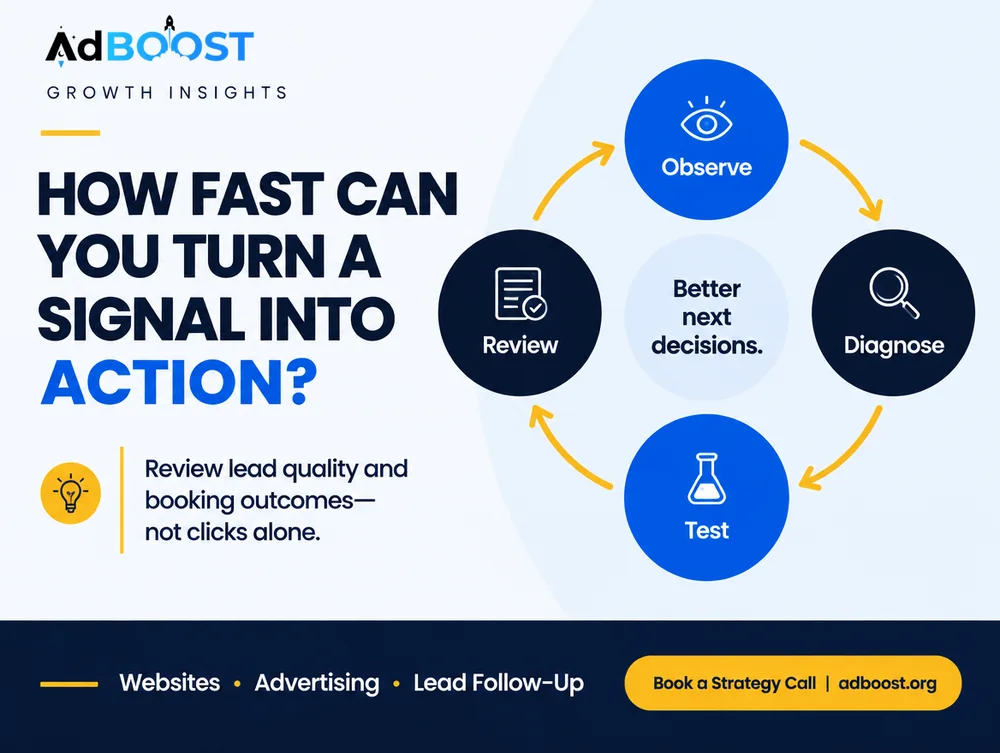
What this means for your business
Review booked jobs weekly: which service, which area, which ad. Shift budget and phone scripts toward what actually fills the schedule, not what gets clicks.
Look at booked appointments by service line each month. Adjust what you promote based on completed appointments, not just form fills.
Review which inquiries became signed clients by practice area. Put effort where qualified matters come from, and change one thing at a time so you can learn from it.
 AD BOOST INTELLIGENCE
The Test–Learn–Decide Loop
Replace random optimization with documented learning.
- Observe the Problem
- Form a Hypothesis
- Change One Variable
- Measure Real Outcomes
- Make a Decision
↻ One question. One learning cycle.
A completed test produces a defensible decision, not merely a new report.
An original Ad Boost marketing improvement framework that moves from a verified observation to a specific hypothesis, a controlled change, meaningful measurement, and an explicit decision. Every completed cycle ends with a documented choice to keep, revise, stop, or retest.
Your marketing isn't learning just because someone is making changes
A roofing contractor launches five advertisements on Monday. By Wednesday, someone pauses two, replaces three headlines, changes the audience, and raises the budget. On Friday, lead volume improves. Everyone celebrates the optimization. But nobody knows which change mattered, whether the improvement reflects normal variation, or whether those leads will turn into profitable roofing projects.
This is activity, not disciplined learning. A marketing team can make dozens of changes while gaining very little knowledge about why customers respond.
Marketing testing is the structured process of investigating how a specific change influences an observable outcome. A marketing experiment begins with a hypothesis, defines the intended change, identifies how success will be evaluated, and considers other explanations for the result. The objective is to improve future decisions, not simply produce a better-looking report.
Speed to learning is the elapsed time between recognizing a meaningful marketing question and reaching a sufficiently supported decision about what to do next. It differs from speed of execution. Launching new creative within an hour may demonstrate operational efficiency, but it does not demonstrate that the creative works.
Local service businesses face particular testing challenges. Lead volumes may be uneven. An HVAC company can experience sudden demand changes when temperatures rise. A roofing company may receive more inquiries after a storm. A dental practice may have appointment availability constraints unrelated to its advertising. A law firm may need substantial time to determine whether an inquiry represents a suitable case. These conditions can distort results when campaigns are evaluated without context.
The strongest marketing teams distinguish observations, hypotheses, tests, and decisions. An observation might be that a landing page receives visits but few appointment requests. A hypothesis might be that the page fails to explain what happens during the consultation. A test could introduce a clearer process explanation while preserving other important conditions. The decision depends on evidence about qualified appointments, not merely whether visitors clicked a different button.
Testing also requires judgment about uncertainty. A handful of inquiries rarely justifies confident conclusions about two advertisements. A large change in demand may reflect weather, competition, scheduling capacity, or tracking failures rather than creative quality. Sometimes the correct decision is to gather more evidence instead of declaring a winner.
Ad Boost's position is straightforward: a marketing team should be able to explain what it learned, what evidence supports the conclusion, and what it will do differently. If it cannot answer those questions, another campaign change is unlikely to solve the underlying problem.
Is your marketing team testing ideas or reacting to dashboards?
Review the last several meaningful campaign changes. For each change, ask what question the team wanted to answer and whether the result produced a useful decision. If the explanation is limited to a metric going up or down, the process needs greater discipline. A testing history should resemble a record of business decisions, not a collection of disconnected screenshots.
- Before changing a campaign, does your team document the specific problem and the hypothesis being tested?
- Can you identify which variable changed and which important conditions were intended to remain stable?
- Are success measures connected to qualified inquiries, appointments, or customers rather than clicks alone?
- Does your team distinguish ordinary fluctuations from results that justify an operational decision?
- Are tests documented with dates, ownership, audience conditions, and relevant external events?
- When results are inconclusive, does your team investigate uncertainty instead of announcing a winner?
- Can someone explain which lessons from previous tests have been retained and incorporated into current campaigns?
What your next marketing test should address
| Situation | Recommended action | Why | Exception |
|---|---|---|---|
| An advertisement receives clicks but few valid inquiries. | Check landing-page relevance, tracking accuracy, offer clarity, and contact functionality before testing creative. | The problem may occur after the click rather than inside the advertisement. | If traffic is visibly irrelevant, targeting and message alignment may deserve attention first. |
| Two advertisements have similar early results. | Continue collecting comparable observations or test a more meaningful difference. | Small early differences may reflect ordinary variation rather than a useful signal. | Stop an advertisement immediately when it violates policy or makes a materially inaccurate claim. |
| Lead volume improves but appointment quality declines. | Review qualification criteria and downstream outcomes before keeping the change. | More inquiries do not necessarily create more valuable opportunities. | A temporary quality difference may reflect scheduling or classification issues. |
| A campaign suddenly performs worse during a local event. | Document the event and examine demand, competition, weather, availability, and tracking before changing strategy. | External conditions can affect observed performance independently of advertising decisions. | A verified technical failure or serious budget problem may require immediate intervention. |
| A landing-page test produces promising but limited evidence. | Preserve the result as provisional and define what further observation would justify a decision. | Uncertainty should be recorded rather than disguised as confidence. | A low-risk usability correction may be worthwhile without formal experimental proof. |
| The team keeps repeating previously unsuccessful ideas. | Create a searchable experiment log with hypotheses, outcomes, context, and decisions. | Organizational memory prevents repeated investigation of the same unresolved assumptions. | A previously unsuccessful idea may deserve retesting when conditions materially change. |
Worked example
Imagine a fictional HVAC company called Northline Heating & Air. It advertises maintenance appointments before the busiest cooling season. Its landing page receives relevant traffic, but the owner notices that relatively few visitors request a maintenance visit. The initial reaction is to increase the advertising budget.
Instead, the marketing manager reviews the page and identifies a specific problem: the appointment button is prominent, but the page does not explain what the maintenance visit includes. The team develops a hypothesis that clearer service expectations may help suitable visitors decide whether to book.
For a hypothetical teaching exercise, the original page receives 400 eligible visits and 20 valid appointment requests during a defined period. The observed inquiry rate is 5%. The team creates a revised page that adds a concise explanation of the inspection process, service limitations, and scheduling expectations. The advertisement and core offer remain substantially unchanged.
Suppose the revised page receives 400 eligible visits and 28 valid requests during a later comparable period. Its observed inquiry rate is 7%. The difference is two percentage points. That does not establish that the explanation caused the increase, particularly because the periods were sequential rather than randomized and external conditions may have changed.
The manager also reviews actual appointments. Suppose 14 requests from the original period and 21 from the revised period became booked visits. The team investigates whether the added requests were suitable and whether scheduling capacity differed. It documents the observed improvement, the limitations of the comparison, and the decision to continue monitoring the clearer page.
The test is useful because it investigates a meaningful customer question and produces a documented next step. It is not useful because someone can announce a dramatic percentage improvement without considering the underlying evidence.
If the company later tests different appointment offers, that becomes a separate experiment with its own hypothesis. The team does not bundle new pricing, new copy, different audiences, and changed scheduling procedures into one unexplained optimization.
Observed inquiry rate = valid inquiries / eligible landing-page visits x 100. Observed appointment rate = booked appointments / valid appointment inquiries x 100. Time to learning = decision date and time - documented observation date and time.
The HVAC company, periods, visits, inquiries, appointments, percentages, and outcomes are hypothetical teaching inputs, not actual Ad Boost results or evidence of a typical conversion lift.
How to build a marketing testing process that gets smarter over time
Identify the business decision behind the test
Start with a concrete question such as whether a clearer estimate process improves qualified roofing consultations. Define why answering it matters to bookings, margins, customer experience, or operational capacity. Avoid vague objectives like improving performance. Separate problems caused by inaccurate tracking or broken forms from genuine marketing hypotheses.
Document the baseline and relevant context
Record available traffic, valid inquiries, qualification outcomes, appointment activity, current creative, offer details, and tracking configuration. Note unusual conditions such as weather events, staffing shortages, holidays, and changed service availability. Select a comparable baseline rather than choosing whichever dates make the result look strongest.
Write a falsifiable hypothesis
Use the structure: We believe changing this specific element may influence this defined customer behavior because of this observable problem. Record what evidence would support or weaken the explanation. Distinguish the proposed mechanism from the desired outcome. A hypothesis should be specific enough to test without rewriting the entire campaign.
Design a controlled and practical comparison
Change one principal variable when feasible. Randomized comparisons can reduce some sources of bias, but may not be practical for every small business. When using sequential periods, document the limitations. Avoid claiming statistical significance without a valid analysis. Establish operational stop conditions for budget problems, policy violations, inaccurate claims, or customer harm.
Measure customer outcomes, not only surface metrics
Track the immediate behavior being tested and relevant downstream outcomes. A form improvement might be evaluated using valid inquiries and booked appointments. A lead-quality experiment should follow qualification and customer outcomes. Preserve the source records and account for delayed sales cycles before interpreting results.
Make and record the decision
Choose Keep, Revise, Stop, or Retest. Explain what the observations support, which alternative explanations remain plausible, and what action the business will take. If evidence is insufficient, say so plainly. A test can still produce value by disproving an assumption or revealing a tracking problem.
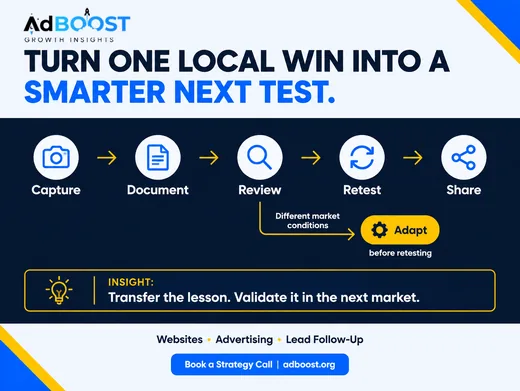
Turn the lesson into operating knowledge
Save the hypothesis, implementation details, results, limitations, and decision in a shared experiment log. Tag the service, audience, offer, and channel. Review previous lessons before planning another test. When applying an insight to another location or service, verify whether the conditions are comparable before treating the earlier result as transferable.
Metrics that reveal whether your marketing is actually learning
The goal is not to maximize the number of experiments. It is to improve the quality and timeliness of decisions. Establish consistent definitions, distinguish valid tests from routine maintenance, and record unresolved uncertainty. A slower, well-designed test may be more valuable than several rushed changes that reveal nothing.
- Time to supported decision
- Elapsed time from the documented business observation to a recorded Keep, Revise, Stop, or Retest decision. Use experiment-log timestamps and identify cases delayed by missing data or operational constraints.
- Decision completion coverage
- Completed tests with a documented decision and supporting rationale divided by completed tests eligible for review, multiplied by 100. Count inconclusive decisions when the uncertainty is explicitly documented.
- Qualified inquiry rate
- Qualified inquiries divided by valid inquiries from the relevant test population, multiplied by 100. Use the same qualification definition across variations and compare appropriate customer cohorts.
- Appointment or consultation rate
- Eligible inquiries producing booked appointments divided by eligible inquiries, multiplied by 100. Verify appointments through CRM or scheduling records and account for delayed booking.
- Experiment implementation accuracy
- Review whether the planned variable, tracking, audience conditions, and stop rules were implemented as documented. Record deviations individually rather than assigning unsupported precision to test quality.
- Repeat-issue recurrence
- Count previously documented problems that reappear after an agreed corrective action. Use experiment and issue logs to distinguish unresolved implementation from genuinely changed market conditions.
Common mistakes and when this advice is wrong
- Changing several major variables at once. Simultaneously modifying creative, targeting, offers, and landing pages makes it difficult to identify the source of a result. Use isolated changes where practical and document unavoidable interactions.
- Declaring winners from insufficient evidence. A few clicks or inquiries can create dramatic-looking percentages. Report sample sizes, uncertainty, and practical limitations rather than presenting every observed difference as a proven improvement.
- Ignoring delayed customer outcomes. A law firm or real estate business may need time to determine whether an inquiry becomes a suitable case or transaction. Premature evaluation can reward inexpensive inquiries instead of valuable opportunities.
- Testing when the system is technically broken. If forms fail, conversion events duplicate, or staff cannot respond, repair the operating system before interpreting marketing experiments. A broken measurement process cannot reliably evaluate the change.
- Insisting on formal experiments for obvious corrective action. You do not need a controlled test to correct an inaccurate phone number, remove a prohibited claim, or fix an inaccessible booking form. Testing discipline should improve judgment, not delay necessary repairs.
Frequently asked questions
How often should a small business test its advertising?
Test when there is a meaningful question, reliable measurement, and enough opportunity to learn. The appropriate cadence depends on traffic, lead volume, purchase cycle, and operational complexity. A high-volume service campaign may support more frequent testing than a specialized business with infrequent inquiries. Establish a regular review rhythm, but do not manufacture experiments simply to meet a weekly activity target.
How long should a marketing experiment run?
There is no universal duration that guarantees a reliable answer. Define the decision you need to make, the expected frequency of meaningful outcomes, the comparison method, and potential outside influences. Avoid ending tests simply because an early result looks favorable. For low-volume businesses, consider longer observation periods or tests that evaluate well-defined intermediate behaviors while acknowledging their limitations.
What should I test first if my ads are not generating leads?
Begin by verifying that traffic is relevant, conversion tracking works, forms and calls function, and the offer is accurately represented. If the contact process is broken, repair it first. If relevant visitors arrive but hesitate to inquire, test a specific explanation such as unclear pricing expectations or an unfamiliar consultation process. The first test should investigate the most consequential unresolved problem.
Is A/B testing useful for a business with very few leads?
It can be, but limited samples make small differences difficult to interpret. A low-volume business may benefit from qualitative customer feedback, usability checks, clear before-and-after documentation, and carefully scoped tests. Avoid declaring statistical certainty from a handful of outcomes. Some improvements, such as correcting misleading wording, are valuable because they improve accuracy regardless of a measured conversion lift.
What makes a marketing test successful if conversions do not improve?
A test is useful when it produces a defensible decision or identifies a meaningful limitation. It may reveal that a hypothesis was unsupported, that tracking is incomplete, or that a proposed message attracts unsuitable customers. Record those lessons and update future decisions. A failed hypothesis is not wasted work if it prevents repeated mistakes and produces reliable organizational knowledge.
Review Your Marketing Testing Process
Find out whether your campaigns are generating useful learning or simply accumulating changes without clear decisions.
Review Your Marketing Testing Process